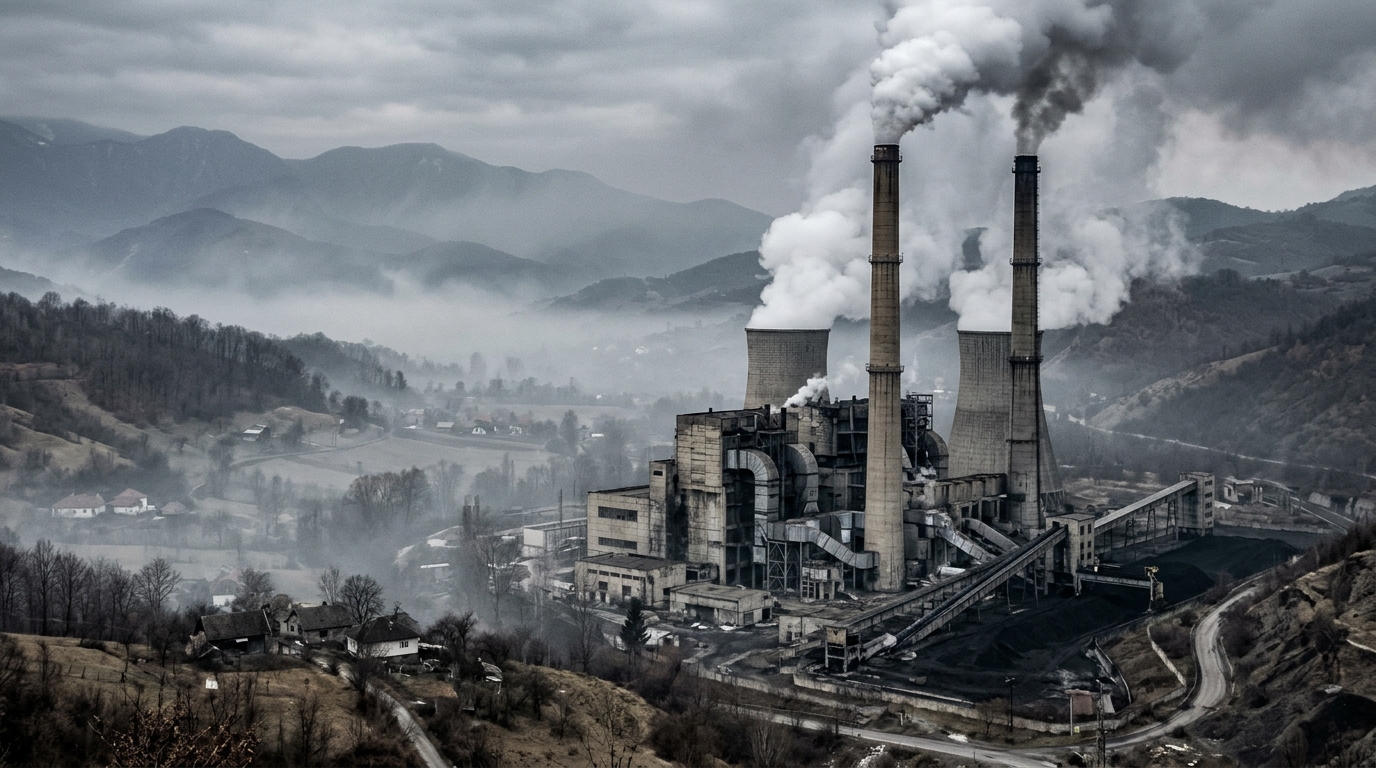
The Western Balkans could avoid more than 5,300 premature deaths in 2030 alone if its power sector follows the trajectory that European transmission system operators now forecast, rather than the slower path laid out in national energy plans, according to a new scenario analysis published in Energy Reports. The study, led by researchers at the European Commission’s Joint Research Centre, is the first to benchmark a regional electricity market model against the six economies’ own National Energy and Climate Plans and translate both into projected air pollution and death tolls.
The region, which comprises Albania, Bosnia and Herzegovina, Kosovo, Montenegro, North Macedonia and Serbia, is one of Europe’s most severe air pollution hotspots. In 2019, air pollution was linked to nearly 30,000 premature deaths there, 93 percent of them attributed to fine particulate matter known as PM2.5. The mortality rate attributable to air pollution, roughly 160 deaths per 100,000 inhabitants, is more than double the EU27 average. Coal is central to the problem: in 2023, 57 percent of the region’s electricity and heat generation was based on coal, contributing more than 90 percent of national sulphur dioxide emissions and 45 percent of nitrogen oxide emissions.
The researchers modelled two families of scenarios. The first, the Joint Research Centre Electricity Market Model, or EMM, comes in two configurations calibrated with the Ten-Year Network Development Plan editions released in 2022 and 2024 by ENTSO-E, the European network of transmission system operators. The second translates the National Energy and Climate Plans, or NECPs, into four configurations that differ in the timing of coal plant decommissioning and the deployment of Best Available Techniques, or BAT, for emission control: NECP-BAT assumes full BAT deployment, NECP-EXT assumes none, and two delayed variants add a five-year postponement of coal phase-out to each.
The modelling chain works in stages. Scenario emissions of sulphur dioxide, nitrogen oxides and PM2.5 from the power sector are fed into JRC-FASST, a source-receptor tool rooted in the EMEP chemical transport model that simulates PM2.5 concentrations and health impacts at a resolution of 0.1 by 0.1 degrees, validated against real-world observations in the region. Health impacts are then estimated with concentration-response functions, linking PM2.5 exposure to population-attributable risk, baseline mortality rates and exposed population, with premature deaths calculated at grid-cell level. The approach captures both primary particles and secondary PM2.5 formed in the atmosphere from emitted pollutants, which a direct assessment of power plant emissions alone would miss.
The fuel mix projections diverge sharply. Under the EMM-2024 configuration, coal and lignite consumption falls by 99.9 percent by 2030, a near-complete phase-out, while natural gas becomes the dominant fossil fuel and total fossil fuel consumption drops 92 percent from 2023 levels. The EMM-2022 configuration is far more gradual, with coal rising 17 percent by 2030 before falling 75 percent by 2040. The NECP path is slower still: coal and lignite decline 29 percent by 2030 and 49 percent by 2040, while natural gas expands 54 percent by 2030 and 179 percent by 2040, reflecting the plans’ vision of gas as the primary replacement fuel alongside renewables.
These fuel choices translate directly into emissions. Under EMM-2024, sulphur dioxide emissions from power generation fall 99 percent from 2015 levels already by 2030, and nitrogen oxides fall 98 percent. Under NECP-BAT, sulphur dioxide falls 86 percent by 2030 and 96 percent by 2040. The steepest contrast emerges when decommissioning is delayed. Under NECP-BAT-DELAY, sulphur dioxide emissions in 2030 reach 344,000 tonnes, more than three times the 112,000 tonnes projected under timely implementation. Even where final 2040 targets are eventually met, the delay produces substantially higher cumulative emissions across the 2025 to 2035 transition period.
The concentration and mortality projections follow the same pattern. Power-sector PM2.5 concentrations attributable to generation fall from 7.1 micrograms per cubic metre in 2015 to 1.1 micrograms by 2030 under timely NECP-BAT implementation, but only to 4.2 micrograms under the delayed variant, 3.8 times higher. Under NECP-EXT, the delay raises 2030 concentrations from 2.4 to 5.6 micrograms per cubic metre. In mortality terms, the EMM-2024 configuration achieves almost a 100 percent reduction in power-sector PM2.5-related deaths by 2030 relative to 2015, effectively eliminating the sector’s contribution, and avoids more than 5,340 premature deaths in 2030 compared with the previous 2022 plan. The NECP-BAT configuration cuts the mortality rate from 40 to 9 premature deaths per 100,000 inhabitants by 2030, a 79 percent reduction.
The delayed scenarios quantify the health cost of inaction with unusual precision. A five-year delay under NECP-EXT-DELAY would cause approximately 5,031 additional premature deaths by 2030, raising the mortality rate from 18 to 44 deaths per 100,000 inhabitants, and 3,250 additional deaths by 2040. Under NECP-BAT-DELAY, the delay produces roughly 5,332 additional premature deaths by 2030, lifting the mortality rate from 9 to 36 per 100,000, and 3,408 more by 2040. Overall, the study concludes that failing to deploy the emission control techniques envisaged in NECP-BAT would double the regional health burden by 2030 compared with NECP-EXT, while a five-year delay in the coal phase-out during the critical transition period would quadruple it.
The findings arrive against a backdrop of persistent regulatory non-compliance. The Large Combustion Plants Directive has been in force in the region since 2018, yet data reported under the National Emission Reduction Plans show ongoing exceedances for sulphur dioxide, nitrogen oxides and dust across the four economies subject to those plans. Sulphur dioxide emissions have remained roughly six times higher than the established ceilings, dust exceeds ceilings by 1.6 to 1.8 times, and nitrogen oxide emissions have trended upward since 2022, reaching nearly 1.4 times the combined ceilings in 2023. Desulphurisation investments are under way, but nitrogen oxide control still relies mainly on low-NOx burners rather than full catalytic reduction systems.
Carbon pricing adds a further layer of pressure. None of the six economies except Montenegro has implemented a carbon-pricing instrument for power generation, yet the region exported and transited substantial electricity volumes to the EU in 2023, volumes that may fall under the Carbon Border Adjustment Mechanism as it fully phases in from 2026. The authors argue that technical measures alone will not deliver compliance: structural changes to the electricity mix, including coal phase-out, renewable expansion, emission control uptake and carbon pricing schemes, are needed for the Western Balkans to converge with EU air-quality and health protection levels, a critical step for a region where air pollution remains a leading cause of mortality and where delayed decarbonisation risks interfering with EU accession negotiations.
Subject of Research: Scenario modelling of power-sector transition pathways in the Western Balkans and their projected air quality and health impacts
Article Title: Analysis of power transition scenarios in the Western Balkans: Evaluating air quality and health impacts
Article References: Kona, A., Cadenovic, R., Gavros, A., Monforti-Ferrario, F., Minnebo, P., & Belis, C. A. (2026). Analysis of power transition scenarios in the Western Balkans: Evaluating air quality and health impacts. Energy Reports, 16, Article 109802. https://doi.org/10.1016/j.egyr.2026.109802
Image Credits: AI Generated
DOI: 10.1016/j.egyr.2026.109802
Keywords: Western Balkans, coal phase-out, PM2.5, air pollution, premature deaths, power sector, NECP scenarios, electricity market model, carbon pricing, Energy Community, health impacts, emission controls
News Source: Denise Maddox. (November 5, 2026). Coal Delay in the Western Balkans Could Quadruple Power Sector’s Death Toll. Scienmag.