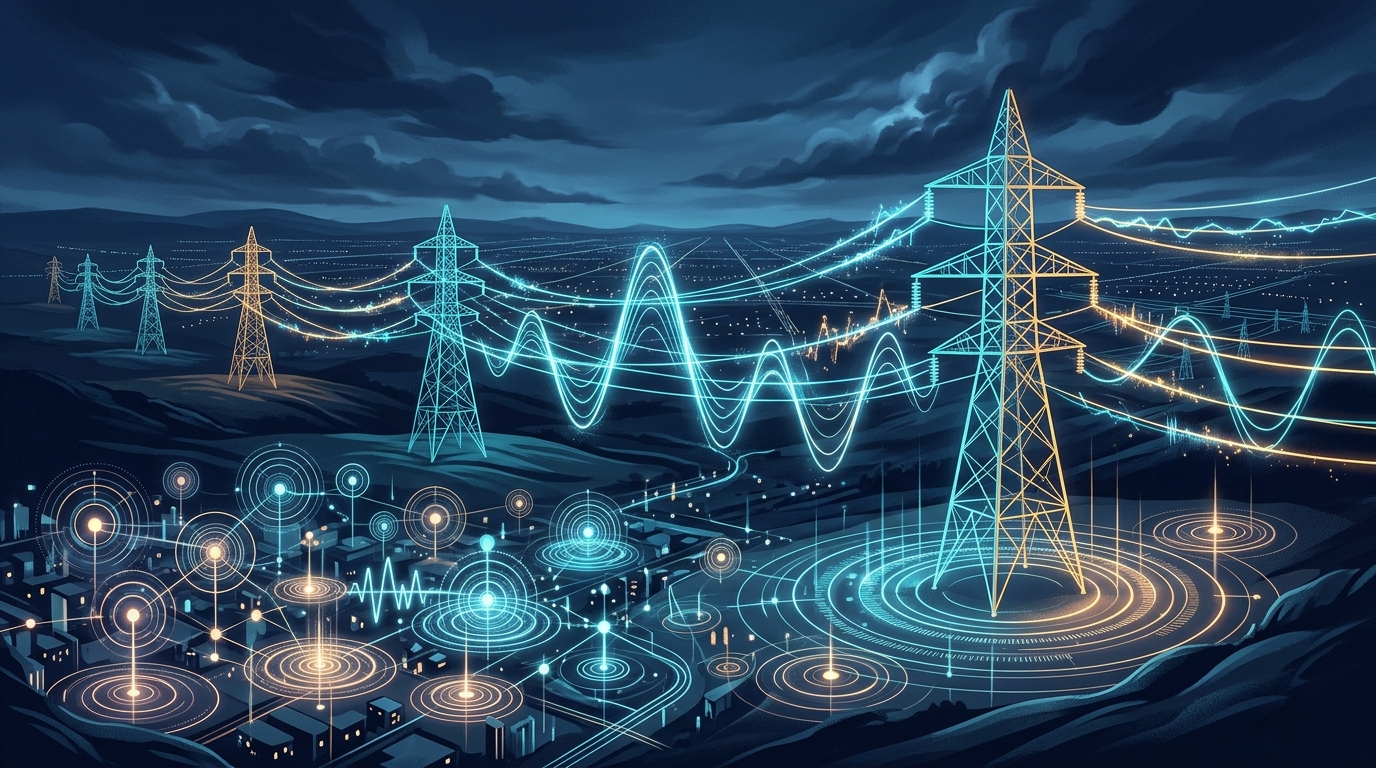
Grid frequency across the world pulses with a strange rhythm: a tiny dip and recovery that repeats every 60 seconds, with almost metronomic precision. For years, this one-minute oscillation has appeared in frequency recordings from power systems on five continents, yet its origin remained unexplained. A new study published in Nature Energy now points to an unexpected culprit — the clock-synchronized control software running inside digitally controlled energy devices, most notably uninterruptible power supplies and battery energy storage systems.
The research team, which includes Carsten Hartmann and Dirk Witthaut among its authors, shows that when many digitally controlled devices execute their control routines on a shared clock, their individual power draws can align in time. Each synchronized routine produces a brief, periodic peak in power demand, and when many such peaks coincide, they add up to coherent power variations at system scale that can give rise to the observed one-minute pattern. The result is a persistent oscillatory pattern with a period of exactly one minute, superimposed on the normal fluctuations of power supply and demand.
To uncover the pattern, the researchers analysed frequency time series from an unusually broad set of sources. Transmission-level data with one-second resolution for the Continental European, British and Scandinavian grids came from the transmission system operators and covered the period from 1 January 2015 to 31 December 2025. Australian frequency data were available at four-second resolution, and Irish data for 2016 were obtained directly from the network operator EirGrid at one-second resolution. Distribution-level measurements from the United States, Malaysia, South Korea, South Africa, Mallorca, Ireland and Iceland were recorded with standalone Electrical Data Recorders, covering intervals ranging from about five years in Mallorca to just one and a half weeks in Malaysia. On the Jülich research campus, more than 80 Class A power quality meters, compliant with the IEC 61000-4-30 standard, provided three-second-resolution measurements of frequency, voltage, current and power.
Because the pattern recurs with such stability, averaging over many hours or days reveals a clean, repeatable shape rather than random noise. What emerged was a highly stable recurrence with a period of exactly one minute in power systems across five continents — a signal the authors describe as an ultra-low-frequency oscillation whose long-term coherence had previously lacked an explanation.
The clearest evidence for the mechanism comes from the Irish power system. There, the initial frequency drop of the one-minute signal grew to 12 millihertz in 2021, with substantially larger values during individual periods. That increase coincides with the rapid expansion of data centres equipped with large uninterruptible power supply installations, whose electricity demand reached approximately 18 percent of national consumption in 2022. The study identifies uninterruptible power supplies and battery energy storage systems as particularly relevant devices, whose clock-synchronized control software generates periodic power-demand peaks. When these routines are synchronized across many installations, their combined power modulation becomes visible at system scale. The growing importance of data centres for power-system planning has drawn attention to their dynamic interaction with the grid, the authors note, but the role of synchronized UPS control has largely been overlooked.
The mechanism is not limited to data centres. Many modern energy devices, including large-scale batteries, photovoltaic inverters and smart appliances, rely on embedded software and external time synchronization. The study suggests that any such device population whose control actions are scheduled by clocked software processes can contribute to coherent cyber–physical power oscillations. Model-based studies cited by the authors indicate that even partial temporal coherence across large device populations may already produce measurable aggregate effects on the power balance. With battery storage systems and Internet-of-Things devices projected to expand rapidly, the relevance of these synchronization effects is likely to grow in future power systems.
Two trends make the problem more pressing. First, the pattern amplitude has increased substantially in several grids over recent years. Second, as inverter-based generation displaces conventional synchronous generators, system inertia declines, which increases the frequency response to any coherent power imbalance. The authors also point out that hydropower turbine-governor dynamics may amplify coherent oscillations through resonant feedback effects, adding a further amplification pathway in systems with significant hydropower. The study notes that decreasing system inertia increases the frequency response to coherent power imbalances, while the rapid projected expansion of battery storage and IoT devices is likely to increase the relevance of such synchronization effects.
The consequences are not merely cosmetic. The study reports that the pattern contributes to wear and tear in hydropower systems. This has motivated stricter frequency-control requirements. The authors observe that system-level measures, such as stricter primary frequency-control requirements, can reduce the frequency impact of deterministic disturbances, as observed in the Scandinavian and Australian grids. However, such measures mainly suppress the grid’s response to the coherent power modulation rather than removing its source.
Addressing the root cause requires changes in control design. The researchers propose randomized scheduling, adaptive offsets, or event-driven instead of strictly time-driven routines, so that the control actions of individual devices no longer align on a common clock. Their measurements demonstrate that such mitigation is technically feasible, although coordinating implementation across heterogeneous populations of large-scale devices remains a significant challenge.
Beyond the specific one-minute signal, the authors argue that the finding marks a shift in how power-system stability must be understood. Traditionally, stability has been analysed in terms of physical infrastructure and control dynamics. Increasing digitalization, they write, requires an integrated perspective in which control logic, software timing and synchronization are treated as integral components of power-system stability. Collective effects, they conclude, are central to future cyber–physical power systems and can emerge both through interactions in the physical grid and through digital interconnections. The study adds a more subtle systemic challenge arising from the cyber–physical coupling of modern power systems, beyond the widely recognized challenges of cybersecurity and the management of power imbalances.
Subject of Research: Origin of a persistent one-minute oscillation in global grid frequency caused by synchronized digital control software in energy devices
Article Title: One-minute frequency disturbances from unintended synchronization in cyber–physical power systems
Article References: Hartmann, C., Din, E. D., Carta, D., Middelkoop, F., Neubauer, A., Kruse, J., Oberhofer, U., Jumar, R., Schäfer, B., Pesch, T., Benigni, A., & Witthaut, D. (2026). One-minute frequency disturbances from unintended synchronization in cyber–physical power systems. Nature Energy. https://doi.org/10.1038/s41560-026-02144-0
Image Credits: AI Generated
DOI: 10.1038/s41560-026-02144-0
Keywords: grid frequency, power systems, unintended synchronization, uninterruptible power supplies, battery energy storage, data centres, cyber-physical systems, frequency control, system inertia, hydropower wear, digital control, Internet of Things
News Source: Faith Mcneil. (November 4, 2026). Clock-synced devices blamed for mysterious one-minute grid frequency wobble. Scienmag.