Aust-German research shows opportunity triggered armed violence
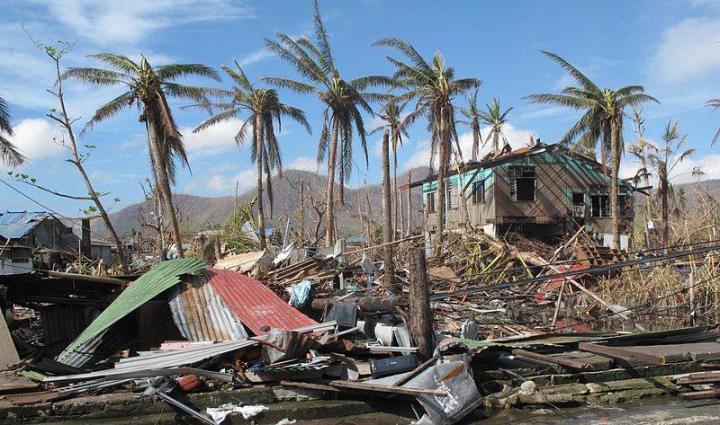
Credit: InsideClimate News
Researchers have found strong evidence that the risk for armed conflict is higher after a climate-related disaster, but only in vulnerable countries.
Lead author Tobias Ide from the University of Melbourne said the disasters include storms, floods and droughts – the frequency and intensity of which will increase in the future, due to climate change.
“Bushfires in Australia will not spark a civil war as the state is democratic and able to provide relief,” said DECRA Fellow Dr Ide. “But when it comes to droughts in Nigeria or storms in Pakistan, where you have large marginalised populations and little state presence, the picture may well change.”
The paper, published today in the Global Environmental Change journal, provides invaluable evidence for policy makers such as the United Nations Security Council, which has been called on to invest in climate adaptation and risk reduction for the millions of people already suffering from the effects of climate change.
“The question ‘Will a warming world also be a world with more violent and armed conflicts?’ has been a very real one for political leaders and civil societies across the world,” Dr Ide said. “Climate change makes tense social and political situations even worse, so climate-change disasters may act like a ‘threat multiplier’ for violent conflicts.
“Only countries with large populations, the political exclusion of ethnic groups and relatively low levels of economic development, are susceptible to disaster-conflict links. Measures to make societies more inclusive and wealthier are, therefore, no-regrets options to increase security in a warming world.”
Research on the effects of climate change have on armed violence have previously been open to interpretation but Dr Ide and his colleagues say their study shows that climate-related disasters enhance armed conflict risks.
“We find that almost one third of all conflict onsets in vulnerable countries over the recent decade have been preceded by a climate-related disaster within seven days,” said co-author Carl-Friedrich Schleussner from Climate Analytics. “This does, however, not mean that disasters cause conflicts, but rather that occurrence of disasters increase the risks of an outbreak.”
Dr Ide added: “If we look at what happened in Mali when a severe drought occurred in June 2009, we can see that the militant Al-Qaeda in the Islamic Maghreb (AQIM) group exploited the resulting state weakness and desperation of local people to recruit fighter and expand its area of operation. The Philippines were another country where recurrent disasters weakened government structures in contested regions, hence opening a space for rebel groups.”
In the large majority of cases, opportunity factors drove the onset of armed violence. Rather than aggrieved populations, rebels exploited the temporary weakness of the state after a disaster, to stage attacks.
Michael Brzoska, a co-author and Associate Senior Researcher from the University of Hamburg, said: “The most surprising result of our study for me was the prevalence of opportunities for armed violence over those related to grievances in post-disaster situations.”
The study employed an innovative approach combining different research methods. “For the first time, we brought together statistical analysis on the global level with case study assessments allowing us to assess the robustness of our findings as well as to compare the individual circumstances of each case,” said co-author Jonathan Donges from the Potsdam Institute for Climate Impacts Research.
###
Media Contact
Lito Vilisoni Wilson
[email protected]
Related Journal Article
http://dx.