


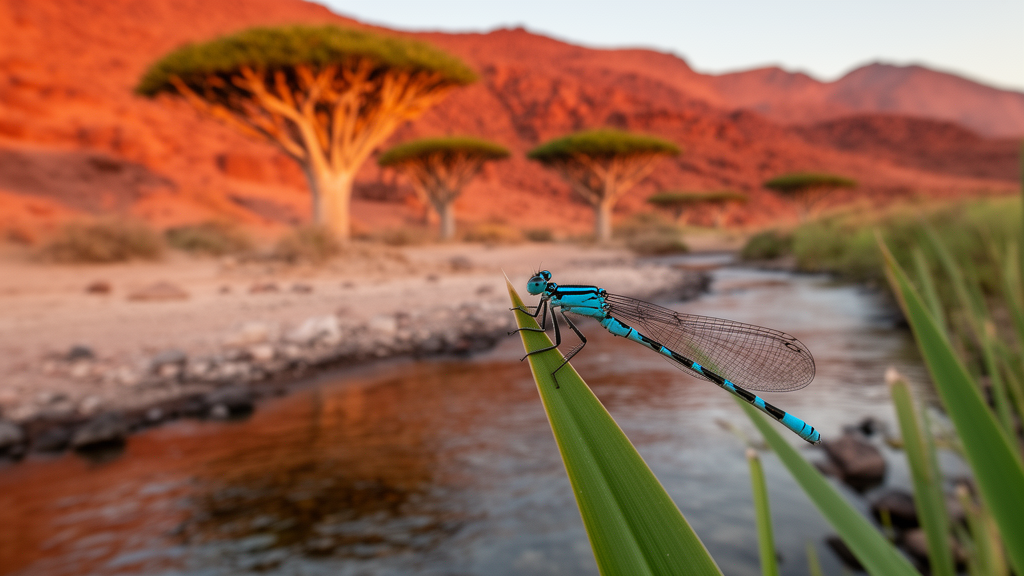
The Socotra bluet, a small damselfly found nowhere on Earth except the Socotra Archipelago, has long been assumed to face wholesale range contraction as its island home grows hotter and drier. A new modelling study published in BMC Ecology and Evolution suggests a more complicated future. Rather than simply shrinking, the suitable habitat for Azuragrion granti is projected to be dramatically redistributed, with the most suitable zones expanding several-fold while large clusters of unsuitable terrain also spread across the island. The finding reframes conservation priorities for a species listed as Near Threatened that depends on scarce freshwater refugia.
The research team, Kartik Omanakuttan, Taniya Pandey and Sandeep Kumar, combined maximum-entropy species distribution modelling, known as MaxEnt, with spatial hotspot statistics and landscape metrics. They drew on 289 occurrence records from the Global Biodiversity Information Facility spanning 1996 to 2024, filtering the data for coordinate accuracy, duplicates and georeferencing errors, and retaining only records from the Socotra Archipelago within the species’ known elevational range. After this screening, 192 records were used for modelling. Bioclimatic variables were obtained from WorldClim at 2.5 arc-minute resolution, and collinearity among the 19 standard bioclimatic variables was reduced using Pearson correlations and variance inflation factors, leaving five predictors: mean temperature of the wettest quarter, precipitation of the wettest quarter, precipitation seasonality, temperature seasonality and temperature annual range.
The predictor set leans toward seasonal precipitation and temperature variability rather than annual averages, which the authors argue better reflects the ecology of a freshwater-obligate insect whose habitat depends on the timing and persistence of wet-season conditions. Two of the retained variables, precipitation of the wettest quarter and mean temperature of the wettest quarter, remained moderately correlated at r = −0.83 despite acceptable variance inflation values. The authors kept both, noting that one captures water availability during the wettest quarter while the other captures the thermal conditions under which that water arrives, and they caution that their individual contributions should be read as complementary rather than independent effects.
Model performance was assessed in two ways. Ten-fold cross-validation on the full dataset produced a mean training AUC of 0.759 and a test AUC of 0.713. A separate chronological validation, training on records from 1996 to 2010 and testing against records from 2011 to 2024, yielded a training AUC of 0.757 and a test AUC of 0.766. Across the future scenarios, AUC values exceeded 0.75, peaking at 0.763 for SSP370 in 2041–2060, and TSS values ranged from 0.601 to 0.696, which the authors classify as useful performance. They note, however, that the temporal validation showed a wider spread across replicate folds, indicating a less stable result than the cross-validation figures alone would suggest.
The projections themselves are striking. In the present-day baseline, unsuitable habitat dominates the island, covering roughly 85.26 percent of its 4,394.25 square kilometres. Under all three shared socioeconomic pathways examined, SSP126, SSP245 and SSP370, for the periods 2021–2040 and 2041–2060, unsuitable area is projected to fall sharply; under SSP126 in 2021–2040 it drops to 26.27 percent of the island. Meanwhile, the higher suitability classes expand. Very high suitability, currently just 2.3 percent of the island, is projected to grow to between 708 and 830 square kilometres, as much as 18.89 percent of the total area, under several future scenarios. High suitability zones, now limited to 162 square kilometres, grow to around 830 square kilometres in several projections. Among all scenarios, SSP370 for 2041–2060 showed the highest overall expansion in both the least and most suitable categories, which the authors interpret as a signal of intensifying climatic extremes.
The spatial statistics add a crucial layer of nuance. Using Getis-Ord Gi* and Local Moran’s I analyses across three decades, the team found that unsuitable habitat showed the strongest and most statistically significant clustering of increase, meaning that large areas are projected to degrade in tandem rather than randomly. Moderate and high suitability changes, by contrast, did not form statistically significant clusters, indicating dispersed and inconsistent gains. Persistent coldspots covered 2,247.75 square kilometres, intensifying hotspots 1,296 square kilometres and consecutive hotspots 850.5 square kilometres. The statistically significant hotspots of very high suitability were small and localized, which the authors describe as emerging micro-refugia.
Geographically, the persistent and intensifying hotspots concentrate in eastern Socotra, notably the Hagher and Hajhir highlands. The authors suggest these areas may be sustained by orographic moisture, partly captured by the canopy of the endemic dragon’s blood tree, Dracaena cinnabari, which intercepts an estimated 790 millimetres of horizontal precipitation per year. Yet they are careful to flag a significant caveat: because occurrence records were visibly concentrated in eastern Socotra and no spatial thinning, bias file or rarefaction diagnostic was applied, the eastern hotspot signal should be treated as provisional. Repeated sampling at a few accessible eastern sites could inflate both model performance and the apparent intensity of eastern hotspots, and only independent field validation or a spatially rarefied sensitivity analysis can resolve whether the pattern is genuinely ecological.
Other limitations temper the headline numbers. The model is built on static bioclimatic variables and elevation alone, with no hydrological layers such as stream flow, spring discharge or topographic wetness, so a site can register as climatically suitable while its actual water source is degraded or absent. The projected expansion is therefore an estimate of climatic potential rather than a forecast of realized habitat. Dispersal poses a further constraint: comparable damselflies move on the order of 300 metres to 2 kilometres per generation, far smaller than the spatial scale of the projected shifts, so newly suitable areas contiguous with existing populations near the eastern highlands are far more plausible colonization targets than isolated pockets elsewhere. The authors also note that the model captures climate responses specifically and does not account for grazing, tourism access or infrastructure development, which could independently alter freshwater habitat availability.
From these convergent lines of evidence, the study identifies a broadly contiguous candidate corridor of priority sites in the eastern highlands, including the Hajhir Mountains, the Diksam Plateau with its permanent streams and pools via Wadi Dirhur, the Socotra Island nature conservation zone and adjacent Ashul wadi, and the Jabal Buzayri and Ahelef hills. The authors recommend managing this corridor as a single connected unit through community co-management of its hydrological features, building on Socotra’s existing Conservation Zoning Plan and its network of conservation nurseries, rather than creating isolated micro-reserves. In western Socotra, only Dighat wadi showed both very high suitability and consecutive hotspot persistence, but its isolation and the absence of confirmed occurrence records there lead the authors to call for field or environmental DNA verification before any active management. The study offers a spatially explicit blueprint for safeguarding A. granti and the freshwater biodiversity it represents, while underscoring that modelled suitability, however robust, is only the first step toward confirmed conservation on the ground.
Subject of Research: Modelling current and future habitat suitability and conservation hotspots for the endemic Near Threatened damselfly Azuragrion granti on the Socotra Archipelago
Article Title: Predicting the habitat suitability and hotspot regions of the near threatened Socotra bluet on the Socotra Archipelago using an integrated modelling approach
Article References: Omanakuttan, K., Pandey, T., & Kumar, S. (2026). Predicting the habitat suitability and hotspot regions of the near threatened Socotra bluet on the Socotra Archipelago using an integrated modelling approach. BMC Ecology and Evolution, 26(1), Article 89. https://doi.org/10.1186/s12862-026-02594-w
Image Credits: AI Generated
DOI: 10.1186/s12862-026-02594-w
Keywords: Socotra bluet, Azuragrion granti, damselfly, species distribution modelling, MaxEnt, climate change, habitat suitability, hotspot analysis, Socotra Archipelago, freshwater conservation, endemic species, Near Threatened
News Source: Margaret Porter. (October 29, 2026). Climate Models Redraw the Map for a Threatened Damselfly on Socotra. Scienmag.



