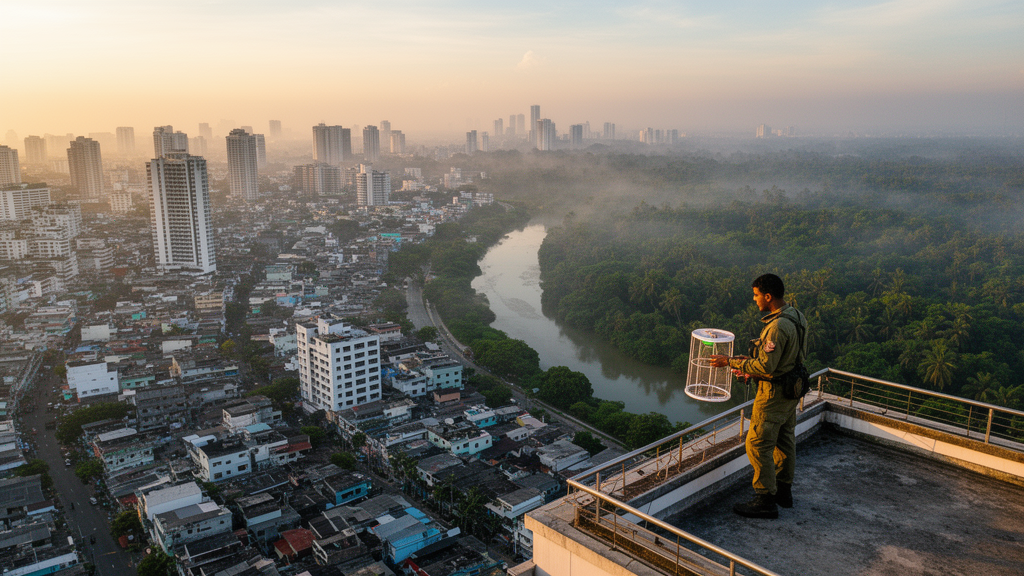
Vector-borne diseases now account for more than 17 percent of all infectious diseases worldwide, causing hundreds of millions of infections and over 700,000 deaths each year. A comprehensive review published in Frontiers in Tropical Diseases argues that the forces reshaping this burden cannot be understood one at a time. Bireshwar Bera of St. Joseph’s College in Darjeeling synthesizes evidence from 312 publications, selected from nearly 4,900 screened records, into a triaxial framework that treats climate, human land use, and ecological degradation as interacting axes rather than independent risk factors. The review, spanning literature through early 2026, arrives at a moment when the numbers themselves demand attention: malaria caused an estimated 249 million cases in 2023, and 2024 delivered the highest global dengue burden ever recorded, with 14.1 million cases reported worldwide.
The framework’s central claim is that additive models, which simply sum the effects of warming, deforestation, and biodiversity loss, systematically underestimate risk. Instead, each axis modifies the marginal effect of the others. The impact of rising temperature on vector breeding depends on how fragmented the surrounding forest already is; the effect of deforestation on transmission depends on the biodiversity of remaining host communities; and the consequences of biodiversity loss are themselves modulated by climatic suitability for vector survival. The review substantiates this interaction-based formulation with quantitative evidence. In southern Venezuela, a spatiotemporal modeling study found that the same ENSO-linked climatic anomaly produced markedly larger increases in malaria incidence in environmentally degraded municipalities than in intact ones. In the Peruvian Amazon, an analysis of Plasmodium vivax malaria found that a model including an interaction between ENSO phase and county-level forest cover achieved a goodness of fit of R-squared 0.85, compared with just 0.26 for a model without the interaction term.
Temperature remains the most extensively studied climatic driver, and for good reason. Because mosquitoes, ticks, and sandflies are ectothermic, nearly every trait that governs transmission—larval development time, adult survival, biting frequency, and the extrinsic incubation period during which a pathogen matures inside the vector—varies with temperature in a unimodal, non-linear fashion. Malaria transmission by Anopheles mosquitoes peaks between roughly 25 and 30 degrees Celsius, with transmission ceasing above about 34 degrees. Dengue transmission by Aedes aegypti is optimal between 21 and 34 degrees, and models project a 35 percent rise in global dengue incidence by 2050 under moderate warming. West Nile virus transmission peaks in a narrower band of 23 to 26 degrees, and Lyme disease transmission intensity peaks within an even tighter window of 17.0 to 20.5 degrees Celsius—a thermal sweet spot that is shifting geographically as surface temperatures rise, causing risk to decline in regions that warm past the optimum while emerging in newly suitable cooler areas.
The review also highlights a frequently neglected dimension: the diurnal temperature range. Even when mean temperatures sit comfortably within a vector’s optimal range, large daily fluctuations can reduce mosquito survival and lengthen the extrinsic incubation period, while small fluctuations within an already optimal range can accelerate pathogen development. Climate models projecting a reduced diurnal temperature range under greenhouse warming may therefore have implications for transmission intensity that extend beyond mean temperature effects. The review is candid about the limitations of current thermal suitability models, noting that laboratory-derived thermal performance curves often diverge from field estimates because microclimatic heterogeneity, behavioral thermoregulation, and biotic interactions modulate vector ecology in ways controlled experiments cannot replicate.
Precipitation and humidity exert their own complex influence. Moderate rainfall creates and replenishes the standing water that mosquito larvae require, but intense flooding can flush larval habitats, temporarily suppressing vector populations before floodwaters recede and create abundant new pools. Drought produces a paradox of its own: as water sources shrink, humans, livestock, and wildlife cluster around them, intensifying contact between hosts and vectors. The El Niño–Southern Oscillation acts as a powerful multi-year modulator of these dynamics. In Bangladesh, dengue cases surged by 317 percent in 2023 compared with 2019, with observed links to ENSO and Indian Ocean Dipole dynamics, and recent research indicates that rising ENSO amplitude is intensifying dengue risk globally.
Sea level rise emerges as an underappreciated but consequential driver. Global mean sea level has risen approximately 0.20 meters between 1901 and 2018 and is projected to rise by 0.43 to 0.84 meters by 2100 under the highest emissions scenario. Saltwater intrusion pushes brackish water into coastal aquifers and wetlands, expanding habitat for mosquitoes such as Anopheles sundaicus that breed preferentially in saline conditions. In Bangladesh’s Ganges-Brahmaputra delta, salinity intrusion has already shifted the distribution of this malaria vector landward by 15 to 30 kilometers, correlating with a doubling of malaria incidence in affected coastal districts. In the Nile Delta, a modeling study predicted a 35 percent increase in the seasonal abundance of Culex pipiens under a 0.5-meter sea level rise scenario, with a corresponding 20 percent rise in filariasis transmission potential. Displacement adds another layer: sea level rise is projected to displace 13 to 40 million people in South and Southeast Asia by 2100, many of whom will relocate to informal settlements with poor sanitation and high vector exposure.
On the anthropogenic axis, deforestation stands out as one of the most powerful drivers of emerging and re-emerging vector-borne disease. A synthesis of 305 studies identified deforestation, forest fragmentation, and agricultural development as the most commonly reported drivers of transmission change in the scientific literature. A landmark study in Amazonian Brazil demonstrated that each 1 percent increase in deforestation was associated with a nearly 1 percent increase in malaria incidence, driven by the expansion of sun-exposed forest edges where vector density is highest. Urbanization compounds the problem: by 2050, 68 percent of the world’s population is projected to live in urban areas, and unplanned expansion creates ideal conditions for Aedes aegypti through water storage containers, discarded plastic waste, and blocked drains, while the urban heat island effect raises temperatures 2 to 5 degrees Celsius above surrounding rural areas, enabling year-round mosquito activity at latitudes where winters would otherwise interrupt transmission.
Globalization completes the anthropogenic triad. A comprehensive global analysis documented 697 first records of non-native mosquito vectors across 288 regions, with Aedes aegypti now present in 192 regions and Aedes albopictus in 189. The Asian tiger mosquito’s spread from Southeast Asia to Europe, the Americas, and Africa has been driven largely by the international trade in used tires and lucky bamboo plants, in which desiccation-resistant eggs survive long-distance transport. The explosive emergence of Zika virus in the Americas between 2015 and 2017 exemplifies the role of travel, with phylogenetic analyses tracing the introduction of the Asian lineage to Brazil through viremic travelers, after which the virus spread through existing Aedes aegypti populations across 35 countries within two years. Meanwhile, insecticide resistance—driven by metabolic detoxification, target-site mutations, and behavioral adaptations such as shifts to nighttime biting—continues to undermine chemical control programs, with warming temperatures accelerating the selection of resistance alleles by boosting detoxification enzyme activity in mosquitoes.
The ecological axis ties these threads together through the dilution effect hypothesis, which posits that diverse host communities reduce transmission by including incompetent hosts that dilute the proportion of bites taken on competent reservoirs. When biodiversity declines, communities become dominated by amplification hosts such as the white-footed mouse, a highly competent reservoir for the bacterium that causes Lyme disease, elevating tick infection rates in fragmented forest patches. A recent meta-analysis confirmed that global change drivers, including biodiversity loss, are significantly associated with elevated infectious disease risk across a broad range of pathogens. The review also documents three self-reinforcing feedback loops: deforestation releases stored carbon while creating warmer edge habitats favorable for vector breeding; urban growth generates heat islands that extend mosquito seasons while producing artificial breeding sites; and biodiversity loss attenuates the dilution effect, driving higher transmission that further degrades ecosystems through the socioeconomic consequences of endemic disease.
Against this sobering picture, the review documents interventions that work. In Niterói, Brazil, the release of Wolbachia-infected mosquitoes helped reduce dengue cases from 12,000 in 2013 to fewer than 330 in total between 2020 and 2023, with Wolbachia persisting in over 90 percent of the mosquito population even after releases stopped. A community-based program in Chiapas, Mexico, reduced dengue transmission by more than 80 percent through participatory elimination of Aedes breeding sites. The WHO’s recommendation of the R21/Matrix-M malaria vaccine alongside RTS,S represents a historic breakthrough, and Kenya’s Rift Valley fever early warning system correctly predicted the 2018–2019 outbreak three months in advance by linking satellite-derived vegetation indices with livestock serosurveillance. The review concludes that limiting warming to 1.5 degrees Celsius rather than 2.5 to 3 degrees would leave hundreds of millions fewer people exposed to novel vector-borne disease risk by 2100, but that adaptation must also address the health equity dimension: low-income tropical countries bear the greatest burden of these climate-sensitive diseases while contributing least to the emissions driving them. The next decade, the author argues, will be critical.
Subject of Research: How climatic, anthropogenic, and ecological changes interact to drive vector-borne disease transmission
Article Title: Influence of environmental, anthropogenic, and climatic changes on vector-borne disease transmission: a comprehensive framework and critical review
Article References: Influence of environmental, anthropogenic, and climatic changes on vector-borne disease transmission: a comprehensive framework and critical review. (n.d.). https://doi.org/10.3389/fitd.2026.1908060
Image Credits: AI Generated
DOI: 10.3389/fitd.2026.1908060
Keywords: vector-borne diseases, climate change, deforestation, dengue, malaria, urbanization, biodiversity loss, El Niño-Southern Oscillation, sea level rise, insecticide resistance, One Health, Aedes aegypti
News Source: Kristina Jarvis. (October 16, 2026). Climate, Cities and Vanishing Forests Are Rewriting the Map of Vector-Borne Disease. Scienmag.