• HOME
  • NEWS
  • EXPLORE
    • CAREER
      • Companies
      • Jobs
    • EVENTS
    • iGEM
      • News
      • Team
    • PHOTOS
    • VIDEO
    • WIKI
  • BLOG
  • COMMUNITY
    • FACEBOOK
    • INSTAGRAM
    • TWITTER
Sunday, May 10, 2026
BIOENGINEER.ORG
No Result
View All Result
  • Login
  • HOME
  • NEWS
  • EXPLORE
    • CAREER
      • Companies
      • Jobs
        • Lecturer
        • PhD Studentship
        • Postdoc
        • Research Assistant
    • EVENTS
    • iGEM
      • News
      • Team
    • PHOTOS
    • VIDEO
    • WIKI
  • BLOG
  • COMMUNITY
    • FACEBOOK
    • INSTAGRAM
    • TWITTER
  • HOME
  • NEWS
  • EXPLORE
    • CAREER
      • Companies
      • Jobs
        • Lecturer
        • PhD Studentship
        • Postdoc
        • Research Assistant
    • EVENTS
    • iGEM
      • News
      • Team
    • PHOTOS
    • VIDEO
    • WIKI
  • BLOG
  • COMMUNITY
    • FACEBOOK
    • INSTAGRAM
    • TWITTER
No Result
View All Result
Bioengineer.org
No Result
View All Result
Home NEWS Science News Chemistry

Clean and effective electronic waste recycling

Bioengineer by Bioengineer
May 15, 2019
in Chemistry
Reading Time: 3 mins read
0
IMAGE
Share on FacebookShare on TwitterShare on LinkedinShare on RedditShare on Telegram

IMAGE

Credit: Prof. Hamid Hosano

As the number of electronics devices increases around the world, finding effective methods of recycling electronic waste (e-waste) is a growing concern. About 50 million tons of e-waste is generated each year and only 20% of that is recycled. Most of the remaining 80% ends up in a landfill where it can become an environmental problem. Currently, e-waste recycling involves mechanical crushers and chemical baths, which are expensive, and manual labor, which can cause significant health and environmental problems when not performed properly. Thus, researchers from Kumamoto University, Japan have been using pulsed power (pulsed electric discharges) to develop a cleaner and more efficient recycling method.

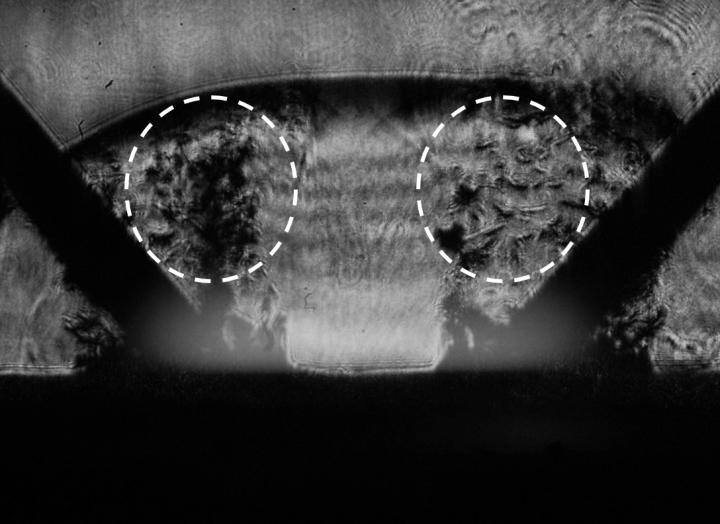
Pulsed power has been shown to be successful in processing various waste materials, from concrete to waste water. To test its ability to be used in e-waste recycling, researchers examined its effectiveness in separating components found in one of the most prolific types of e-waste, CD ROMs. In previous work, they showed that complete separation of metal from plastic occurred using 30 pulses at about 35 J/pulse (At the current price of electricity in Tokyo, this amount of energy costs about 0.4 Yen for recycling 100 CD ROMs). To examine the mechanism of material separation using this method, researchers performed further analyses by observing the plasma discharge with a high-speed camera, by taking schlieren visualizations to assess the shock wave, and using shadowgraph images to measure fragment motion.

Images at the early stage of electrical discharge showed two distinct light emissions: blue-white and orange. These indicated excitation of aluminum and upper protective plastic materials respectively. After the plasma dissipated, fragments of metal and plastic could be seen flying away from the CD ROM sample.

Schlieren images were taken throughout the process and revealed that the main destructive shock waves developed around the two electrodes. The shock produced a pressure of over 3.5 MPa (about the same amount of pressure a galloping horse will exert on the ground) near the tips of the electrodes and quickly fell to below 0.8 MPa at 7.1 mm. In both the schlieren and shadowgraph images, material dispersal was very clearly observed.

“E-waste is perhaps one of the most important waste recycling problems we face today due to its ubiquitous nature,” said study leader Professor Hamid Hosano. “Our project showed the importance of shock waves when using pulse power for material removal and separation in e-waste recycling. We believe our data will be important in the development of future recycling projects.”

This work was published online in Waste Management on 3 April 2019.

###

[Source]

Yamashita, T., Akiyama, H., Sakugawa, T., Hosano, H., 2019. Metal-coated plastics recycling by pulsed electric discharge. Waste Management, 89, pp.57-63. Available at: http://dx.doi.org/10.1016/j.wasman.2019.03.069.

Media Contact
J. Sanderson
[email protected]

Original Source

https://www.sciencedirect.com/science/article/pii/S0956053X19302120?via%3Dihub

Related Journal Article

http://dx.doi.org/10.1016/j.wasman.2019.03.069

Tags: Biomedical/Environmental/Chemical EngineeringComputer ScienceElectrical Engineering/ElectronicsElectromagneticsMaterialsMechanical EngineeringParticle PhysicsPollution/RemediationTechnology/Engineering/Computer Science
Share12Tweet8Share2ShareShareShare2

Related Posts

Miniature Sensor Uses Light to Detect Touch — Chemistry

Miniature Sensor Uses Light to Detect Touch

May 8, 2026
Iron Minerals Determine Whether Dissolved Organic Matter Fuels Microbes or Becomes Long-Term Carbon Storage — Chemistry

Iron Minerals Determine Whether Dissolved Organic Matter Fuels Microbes or Becomes Long-Term Carbon Storage

May 8, 2026

Kate Evans Appointed Associate Lab Director for Biological and Environmental Systems Science at ORNL

May 8, 2026

Advancing Multiscale Modeling and Overcoming Operational Challenges in Autothermal COâ‚‚-to-Methanol Reactors

May 8, 2026
Please login to join discussion

POPULAR NEWS

  • Research Indicates Potential Connection Between Prenatal Medication Exposure and Elevated Autism Risk

    840 shares
    Share 336 Tweet 210
  • New Study Reveals Plants Can Detect the Sound of Rain

    727 shares
    Share 290 Tweet 181
  • Scientists Investigate Possible Connection Between COVID-19 and Increased Lung Cancer Risk

    68 shares
    Share 27 Tweet 17
  • Salmonella Haem Blocks Macrophages, Boosts Infection

    61 shares
    Share 24 Tweet 15

About

We bring you the latest biotechnology news from best research centers and universities around the world. Check our website.

Follow us

Recent News

Evaluating Digoxin Use in Patients with Symptomatic Rheumatic Heart Disease

Evaluating the Effectiveness and Safety of Digitalis Glycosides in Treating Heart Failure

Urdu Fall Risk Questionnaire Adapted for Elderly

Subscribe to Blog via Email

Success! An email was just sent to confirm your subscription. Please find the email now and click 'Confirm' to start subscribing.

Join 82 other subscribers
  • Contact Us

Bioengineer.org © Copyright 2023 All Rights Reserved.

Welcome Back!

Login to your account below

Forgotten Password?

Retrieve your password

Please enter your username or email address to reset your password.

Log In
No Result
View All Result
  • Homepages
    • Home Page 1
    • Home Page 2
  • News
  • National
  • Business
  • Health
  • Lifestyle
  • Science

Bioengineer.org © Copyright 2023 All Rights Reserved.