• HOME
  • NEWS
  • EXPLORE
    • CAREER
      • Companies
      • Jobs
    • EVENTS
    • iGEM
      • News
      • Team
    • PHOTOS
    • VIDEO
    • WIKI
  • BLOG
  • COMMUNITY
    • FACEBOOK
    • INSTAGRAM
    • TWITTER
Friday, June 26, 2026
BIOENGINEER.ORG
No Result
View All Result
  • Login
  • HOME
  • NEWS
  • EXPLORE
    • CAREER
      • Companies
      • Jobs
        • Lecturer
        • PhD Studentship
        • Postdoc
        • Research Assistant
    • EVENTS
    • iGEM
      • News
      • Team
    • PHOTOS
    • VIDEO
    • WIKI
  • BLOG
  • COMMUNITY
    • FACEBOOK
    • INSTAGRAM
    • TWITTER
  • HOME
  • NEWS
  • EXPLORE
    • CAREER
      • Companies
      • Jobs
        • Lecturer
        • PhD Studentship
        • Postdoc
        • Research Assistant
    • EVENTS
    • iGEM
      • News
      • Team
    • PHOTOS
    • VIDEO
    • WIKI
  • BLOG
  • COMMUNITY
    • FACEBOOK
    • INSTAGRAM
    • TWITTER
No Result
View All Result
Bioengineer.org
No Result
View All Result
Home NEWS Science News Health

City, University of London academics develop algorithm to analyse HeLa cancer cells

Bioengineer by Bioengineer
October 26, 2020
in Health
Reading Time: 2 mins read
0
IMAGE
Share on FacebookShare on TwitterShare on LinkedinShare on RedditShare on Telegram

Dr Constantino Carlos Reyes-Aldasoro and Dr Cefa Karabag collaborate with the Francis Crick Institute on a novel approach published in the PLoS ONE journal, which significantly reduces the amount of time taken to analyse the cell line
IMAGE

Credit: p.d

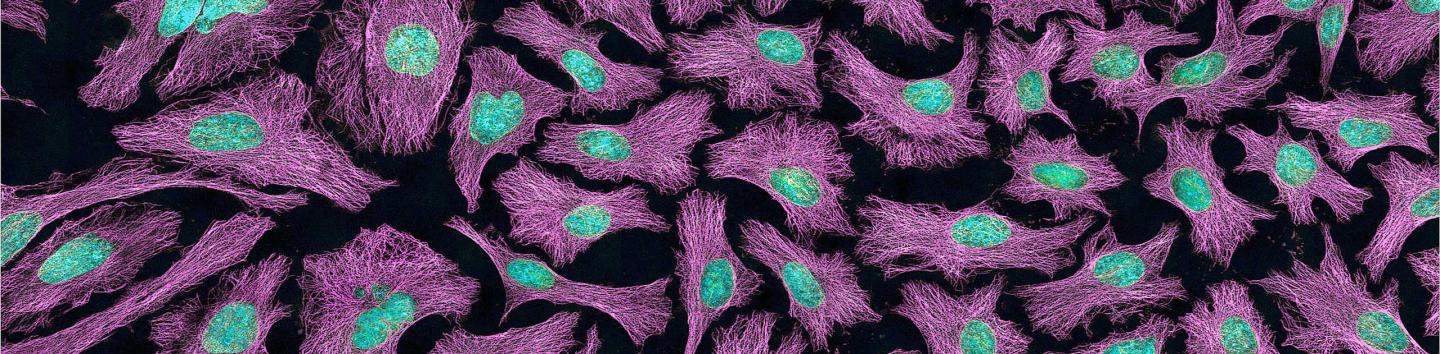
Dr Cefa Karabag and Dr Constantino Carlos Reyes-Aldasoro have collaborated with the Francis Crick Institute in preparing and analysing HeLa cells as part of a research project, documented in the October edition of the PLoS ONE journal: Semantic segmentation of HeLa cells: An objective comparison between one traditional algorithm and four deep-learning architectures.

The HeLa cell line was developed in the 1950s from a particularly aggressive strain of cervical cancer cells taken during a routine biopsy from a 30-year-old African-American mother of five named Henrietta Lacks.

She was treated for the disease by Dr George Gey in the segregated, coloured ward, of The Johns Hopkins Hospital in Baltimore, USA.

The City/Francis Crick Institute team prepared and observed the HeLa cell line using Electron Microscopy (EM), which can acquire tens of thousands of data sets that can easily exceed several gigabytes of data per month.

Part of the team’s research requires the identification of the nuclei of these cells, which is a complicated task that can take an expert around a week to accomplish.

Dr Cefa Karabag and Dr Constantino Carlos Reyes-Aldasoro developed a computational approach that solves this task in minutes, and with minimal effort, using an algorithm. It consists of several steps of processing in which features are highlighted and used to ultimately identify the nucleus of the cell and the membrane surrounding it.

The main contributions of the team’s work can be summarised as follows:

  • The objective comparison of five semantic segmentation strategies – one traditional image processing and four deep learning.
  • These strategies were compared through the semantic segmentation of the nucleus, nuclear envelope, cell and background of three hundred slices of a HeLa cell observed with electron microscopy.
  • The open source code for all the segmentation strategies, has been made available through GitHub. All the programming was performed in MatlabĀ® (The Mathworks™, Natick, USA).
  • The four-class ground truth for 300 slices has been created and made available through Zenodo. The EM data is available through EMPIAR.

###

Media Contact
John Stevenson
[email protected]

Related Journal Article

http://dx.doi.org/10.1371/journal.pone.0230605

Tags: Biomedical/Environmental/Chemical EngineeringBiotechnologycancerCell BiologyDisease in the Developing WorldElectromagneticsGynecologyHardwareTechnology/Engineering/Computer Science
Share13Tweet8Share2ShareShareShare2

Related Posts

Tracking Lanthanide-Labeled Microplastics in Plants

June 25, 2026

Neural Design Enables Zero-Shot Drug-Binding Proteins

June 25, 2026

Genomic Insights into Human Skin Fungi Diversity

June 25, 2026

Chiral Laser Gyroscopes Surpass Lock-In Limit

June 25, 2026
Please login to join discussion

POPULAR NEWS

  • Saying Goodbye to PGY-6: Pediatric Fellowship Realities

    103 shares
    Share 41 Tweet 26
  • Multi-Hospital Study Reveals Long Covid Burden Is Twice as High as Current Estimates

    92 shares
    Share 36 Tweet 23
  • Detection of EDCs in Breast Milk and Infant Urine Up to Six Months Highlights Early Exposure Risks

    77 shares
    Share 31 Tweet 19
  • New Drug Candidate Developed at McMaster Shows Potential for Treating Brain Cancer

    58 shares
    Share 23 Tweet 15

About

We bring you the latest biotechnology news from best research centers and universities around the world. Check our website.

Follow us

Recent News

Tracking Lanthanide-Labeled Microplastics in Plants

POSTECH Researchers Slash Cost of Reconstituted Cell-Free Systems by 95%

AI and Physics Collaborate to Design Advanced Hydrogen Storage Materials

Subscribe to Blog via Email

Success! An email was just sent to confirm your subscription. Please find the email now and click 'Confirm' to start subscribing.

Join 82 other subscribers
  • Contact Us

Bioengineer.org Ā© Copyright 2023 All Rights Reserved.

Welcome Back!

Login to your account below

Forgotten Password?

Retrieve your password

Please enter your username or email address to reset your password.

Log In
No Result
View All Result
  • Homepages
    • Home Page 1
    • Home Page 2
  • News
  • National
  • Business
  • Health
  • Lifestyle
  • Science

Bioengineer.org Ā© Copyright 2023 All Rights Reserved.