Every growing season, farmers around the world spread millions of tonnes of urea onto their fields, and a startling share of it never reaches a crop. Urea is the most widely consumed nitrogen fertilizer on Earth, prized for its 46 percent nitrogen content, low cost, and ease of handling, yet its extreme solubility means that up to 60 percent of the nitrogen applied can be lost to the environment through ammonia volatilization, nitrate leaching, denitrification, and nitrous oxide emissions. With fertilizer nitrogen recovery rates in cropping systems frequently languishing between 30 and 50 percent, the consequences extend beyond wasted money to soil acidification, atmospheric pollution, and the eutrophication of rivers and lakes. A new study published in Polymer Bulletin by researchers at the Federal University of São Paulo, the University of São Paulo, and Embrapa Instrumentation in Brazil now shows that a single biodegradable polymer matrix, engineered with two modest additives, can dramatically change that picture.
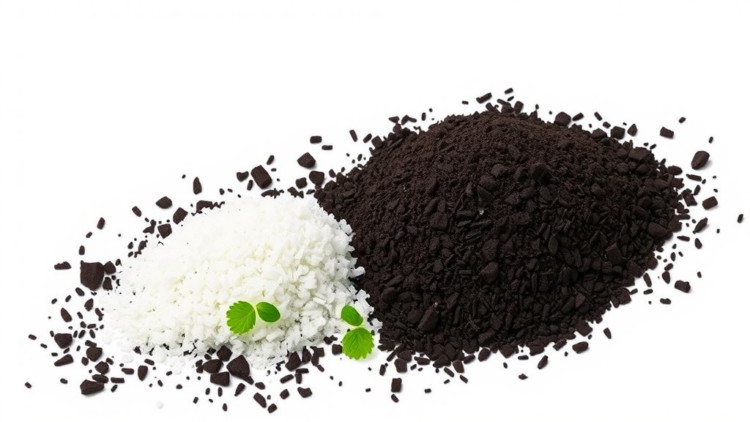
The research team, led by Amanda S. Giroto, set out to build a controlled-release urea fertilizer from carboxymethyl cellulose, or CMC, a renewable, low-toxicity derivative of cellulose that is abundant, highly hydrophilic, and capable of forming films and hydrogels. CMC has long been viewed as a promising scaffold for agricultural delivery systems, but it carries a fundamental weakness: its affinity for water is so strong that, unless the polymer network is stabilized, it swells excessively or dissolves outright, releasing its payload by disintegration rather than by regulated diffusion. The Brazilian group tackled this problem with a dual strategy, crosslinking the polymer chains with citric acid, a cheap and food-safe polycarboxylic acid that forms ester bonds with cellulose hydroxyl groups, and dispersing bamboo-derived biochar throughout the matrix as a physical barrier and adsorptive phase.
The experimental design was deliberately systematic. A 2 percent aqueous CMC solution was prepared, urea was added at 50 percent of the polymer mass, and biochar was incorporated at a fixed 1 percent of total composite mass. Citric acid was then introduced at four levels, 0, 10, 20, and 30 percent by weight relative to CMC, and the mixtures were heated to 80 degrees Celsius for two hours to drive the crosslinking reaction before being cast into self-supporting films and dried. The resulting formulations, labeled CMC/U, CMC/U/BC/CA0, CA10, CA20, and CA30, were probed with X-ray diffraction, infrared spectroscopy, electron microscopy, and thermal analysis, then subjected to swelling tests, water-retention trials in sandy soil, aqueous urea-release experiments, and a 42-day soil incubation tracking ammonia volatilization and ammonium formation.
The structural characterization revealed formulation-dependent changes in the crystalline organization and thermal environment of urea within the matrices. Electron microscopy showed that the non-crosslinked material possessed a smooth surface with well-defined urea crystals, while biochar incorporation produced a rougher, more heterogeneous morphology dotted with porous features. The 10 percent citric acid formulation displayed a relatively cohesive structure, the 20 percent version was the most compact and homogeneous, and the 30 percent sample turned granular and fragmented. Thermal analysis showed that the decomposition temperature of the polymer backbone shifted progressively upward with increasing citric acid content, reaching roughly 284 degrees Celsius at the highest loading, evidence of a more thermally stabilized network. Differential scanning calorimetry, meanwhile, showed that the sharp melting endotherm of pure urea at about 136 degrees Celsius was broadened, reduced, or suppressed in the composites, indicating that urea molecules were dispersed and interacting within the polymeric network rather than sitting as free crystalline granules.
The swelling experiments delivered the study’s most striking numbers. Without citric acid, the composites rapidly lost their structural integrity in water, forming a viscous gelatinous mass that could not even be weighed reliably. In contrast, all crosslinked formulations remained intact throughout immersion, and the 10 percent citric acid composite swelled to approximately 7500 percent of its dry mass within an hour, compared with about 4800 percent at 20 percent crosslinker and 2800 percent at 30 percent. Counterintuitively, the highest swelling did not translate into the fastest nutrient release. In water, pristine urea dissolved almost instantaneously, releasing its entire payload within the first four hours, whereas the CA10 composite had surrendered only about 18 percent of its urea at that point and roughly 80 percent by the end of the eight-day test. The 20 and 30 percent formulations released faster, with the CA20 sample reaching up to 90 percent.
This non-linear relationship between crosslinker content and release behavior is one of the paper’s central insights. The authors argue that beyond an optimal point, additional citric acid restricts polymer-chain mobility, increasing matrix rigidity and morphological heterogeneity in ways that can open preferential diffusion pathways and accelerate transport rather than slow it. Kinetic modeling reinforced the complexity of the mechanism. All composites fitted the Higuchi diffusion model well, but the Peppas–Sahlin analysis showed that urea release involved simultaneous diffusional transport and polymer-chain relaxation, with the relaxational contribution growing from roughly a quarter to nearly 40 percent of the modeled release over the first eight hours. The researchers are careful to note that the data do not support describing the process as purely Fickian diffusion; instead, release emerges from the coupled interplay of hydration, structural reorganization, and solute transport.
Water retention, a critical co-benefit for drought-prone agriculture, also improved. In sandy soil amended with the composites and held at 40 degrees Celsius, the non-crosslinked biochar formulation retained about 59 percent of its initial water after 120 hours, compared with 47 percent for unamended sand, although this difference fell short of statistical significance. At 24 hours, significant differences among treatments were detected, and the biochar-containing matrices showed a consistent tendency toward better long-term moisture preservation, a property the authors attribute to the hydrogel’s water-holding capacity combined with biochar’s porosity.
Perhaps the most consequential results came from the soil incubation. Over 42 days under conditions deliberately chosen to accelerate urea hydrolysis and nitrogen loss, every composite reduced measured ammonia volatilization relative to pure urea. Pure urea lost the most nitrogen as ammonia, 3.74 milligrams, while the uncrosslinked CMC/urea composite lost the least, 2.29 milligrams, a statistically significant reduction. Ammonium dynamics shifted as well: in the first week, the composites sustained higher exchangeable ammonium pools than pristine urea, suggesting that the matrices kept nitrogen in a plant-available mineral form for longer rather than letting it escape as gas. A partial nitrogen recovery accounting, based on the two measured pools, ranged from 56.4 to 72.4 percent of the applied nitrogen, with the remainder classified conservatively as unaccounted because nitrate and matrix-associated nitrogen were not directly quantified.
The practical implications are considerable. Because CMC, citric acid, and biochar are all inexpensive, renewable, and biodegradable, the proposed system sidesteps the central criticism of commercial controlled-release fertilizers, many of which rely on non-biodegradable synthetic coatings that persist in soil. The fabrication route is equally appealing: a simple aqueous process, a single heating step at 80 degrees Celsius, and air drying, with no exotic reagents or energy-intensive procedures. The authors frame the work as demonstrating that one biodegradable polymer matrix, properly architected, can efficiently regulate nutrient release through a simple, scalable, and sustainable strategy for advanced nitrogen fertilizers.
The deeper lesson, however, is about optimization philosophy. Increasing crosslinker content did not monotonically improve performance, and the best formulation was the one that balanced swelling, structural integrity, and diffusion-pathway continuity rather than the most heavily crosslinked one. As agriculture confronts the twin pressures of feeding a growing population and cutting the nitrogen pollution that warms the climate and degrades waterways, studies like this one suggest that the smartest fertilizers of the coming decade may be built not from petrochemical shells but from engineered plant polysaccharides, kitchen-safe acids, and charcoal, tuned with precision at the molecular scale.
Subject of Research: Development of citric acid-crosslinked carboxymethyl cellulose and biochar composites for controlled-release urea fertilizer
Article Title: Controlled urea release from CMC-based composites: effects of citric acid crosslinking and biochar incorporation
Article References: Giroto, A. S., Prado, T. R., Yashima, A., Valle, S. F., Alves, B. L., & Gonçalves, M. (2026). Controlled urea release from CMC-based composites: effects of citric acid crosslinking and biochar incorporation. Polymer Bulletin, 83(11), Article 636. https://doi.org/10.1007/s00289-026-06685-y
Image Credits: AI Generated
DOI: 10.1007/s00289-026-06685-y
Keywords: controlled-release fertilizer, carboxymethyl cellulose, urea, biochar, citric acid crosslinking, nitrogen use efficiency, ammonia volatilization, biodegradable polymer, hydrogel, soil water retention, release kinetics, sustainable agriculture
Cite Scienmag News
APA MLA Chicago
Bethany Barker. (September 20, 2026). Citric Acid and Biochar Turn Biodegradable Cellulose into a Smarter Slow-Release Urea Fertilizer. Scienmag. https://scienmag.com/citric-acid-and-biochar-turn-biodegradable-cellulose-into-a-smarter-slow-release-urea-fertilizer/
Bethany Barker. “Citric Acid and Biochar Turn Biodegradable Cellulose into a Smarter Slow-Release Urea Fertilizer.” Scienmag, 20 September 2026, https://scienmag.com/citric-acid-and-biochar-turn-biodegradable-cellulose-into-a-smarter-slow-release-urea-fertilizer/. Accessed 20 September 2026.
Bethany Barker. “Citric Acid and Biochar Turn Biodegradable Cellulose into a Smarter Slow-Release Urea Fertilizer.” Scienmag. September 20, 2026. https://scienmag.com/citric-acid-and-biochar-turn-biodegradable-cellulose-into-a-smarter-slow-release-urea-fertilizer/
Copy citation Download RIS
Tags: ammonia volatilizationapplication of biochar and citric acid in agriculturebio-based polymer matrices for fertilizersBiocharBiochar-enhanced biodegradable fertilizersbiodegradable polymercarboxymethyl cellulosecitric acid crosslinkingcitric acid in fertilizer technologycontrolled-release fertilizercontrolled-release urea fertilizereco-friendly fertilizer innovationsenvironmental impact of fertilizer runoffenvironmentally sustainable fertilization methodshydrogelnitrogen fertilizer efficiency improvementnitrogen use efficiencyplant nutrient delivery systemsreduction of nitrogen loss in cropping systemsrelease kineticssoil water retentionsustainable agriculturesustainable agriculture soil amendmentsurea