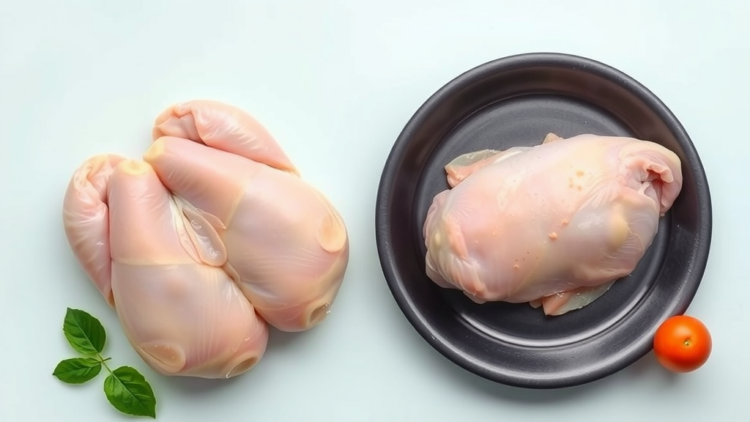
A gel built from two of the most ordinary ingredients in a food laboratory—bovine serum albumin and the polysaccharide curdlan—has shown it can capture the antibacterial and antioxidant firepower of orange peel and then spend it slowly, protecting refrigerated chicken breast for twelve days. The study, published in Food Chemistry: X, describes how a dual-component protein–polysaccharide gel was loaded with a flavonoid extract from orange peel and tested both as a chemical system and as a practical marinade for fresh poultry. The results point to a preservation strategy that leans on natural plant compounds instead of synthetic additives, at a time when consumer resistance to chemical preservatives in meat is rising and producers face mounting losses to microbial spoilage.
The research team began with a byproduct that most juice factories discard by the ton: orange peel. Using an 80 percent ethanol extraction followed by purification on an AB-8 resin column, the researchers obtained a flavonoid-rich extract that was then profiled by targeted UPLC-ESI-QQQ-MS/MS against a panel of 46 flavonoids. Quantifiable signals emerged for 35 compounds, with kaempferide dominating at roughly 78,252 nanograms per gram and neohesperidin close behind at about 43,642 nanograms per gram. These two flavonoids became the structural representatives for the molecular modeling that followed, and their abundance helped explain why the extract showed the strong antimicrobial and antifungal reputation that citrus peel has accumulated in the literature.
The gel itself was assembled through heat. Bovine serum albumin, a 66-kilodalton protein, was dissolved in dilute salt solution, combined with curdlan—a bioactive polysaccharide of 300 to 500 glucose units—and held overnight at 4 degrees Celsius before being heated to 81 degrees for ten minutes to trigger irreversible gelation. The flavonoid extract was added at three concentrations, 5, 7, and 9 milligrams per milliliter, producing gels labeled BSA-Cn-Fs-5, BSA-Cn-Fs-7, and BSA-Cn-Fs-9. Food-grade ethanol in the final mixture never exceeded 5 percent, keeping the formulation within the bounds of what a food application could tolerate. The resulting heat-set gels looked and behaved like pliable orange-tinted matrices, semi-spherical in microstructure and noticeably more compact once the flavonoids were woven in.
The central analytical question was how, exactly, the flavonoids were held inside the gel. A battery of multispectral techniques converged on a single answer: non-covalent bonding, dominated by hydrogen bonds. Fourier transform infrared spectroscopy showed the hydroxyl stretching band of the protein–polysaccharide network shifting from 3323.78 to 3278.38 reciprocal centimeters after flavonoid loading, a classic fingerprint of hydrogen-bond formation. Ultraviolet–visible spectra retained the flavonoid signature near 330 nanometers inside the gel, and intrinsic fluorescence of the albumin was quenched in a concentration-dependent manner, reaching 97.44 percent quenching at the highest extract loading, with the emission peak shifting dramatically from 341 to 420 nanometers—evidence that the aromatic chromophores of the protein had entered a genuinely altered chemical environment.
Structural and thermal analyses reinforced the picture. X-ray diffraction revealed that the composite gels were largely amorphous, with reduced molecular ordering after flavonoid incorporation, a transition the authors note may enhance bioaccessibility and sustain flavonoid activity over time. Differential scanning calorimetry showed the loaded gel undergoing major transitions at 230.12 and 315.01 degrees Celsius, higher than the corresponding peaks of curdlan alone, consistent with non-covalent stabilization of the network. X-ray photoelectron spectroscopy documented an increase in the oxygen signal and a decrease in the carbon signal after loading, matching the oxygen-rich chemistry of flavonoid hydroxyl groups joining the matrix. Molecular docking of kaempferide and neohesperidin into albumin identified plausible contacts with residues including Trp213, Arg217, and Ser343, with calculated interaction energies of −1.91 and −1.98 kilocalories per mole respectively—modest values that the authors interpret qualitatively as support for the spectroscopic evidence rather than as measured binding strengths.
Functionally, the gels behaved like reservoirs rather than single-dose dispensers. Over 24 hours in buffered solution at body temperature, cumulative flavonoid release reached 65.60 percent for the lowest loading, 67.91 percent for the middle formulation, and 72.91 percent for BSA-Cn-Fs-9, with a marked acceleration around the ten-to-twelve-hour mark followed by continued slow release. Antioxidant capacity tracked the loading level: DPPH radical scavenging climbed from 25.3 percent for the unloaded gel to 40.3 percent for BSA-Cn-Fs-9, while ABTS scavenging rose from 81.43 to 93.73 percent. The authors are careful to state that BSA-Cn-Fs-9 was the best performer within the tested range rather than a statistically optimized global maximum, an honest caveat that distinguishes this work from looser claims in the food-preservation literature.
The antimicrobial results were equally concrete. In agar diffusion assays, the loaded gels produced inhibition zones that widened with flavonoid concentration against four significant foodborne and spoilage bacteria—Escherichia coli, Staphylococcus aureus, Bacillus cereus, and Listeria monocytogenes. Listeria proved the most sensitive, yielding a 16-millimeter zone around the highest-loading gel compared with 8.7 millimeters for the unloaded control. Against two spoilage fungi, Penicillium expansum and Aspergillus westerdijkiae, the top formulation inhibited growth by up to 33.33 percent and 57.44 percent respectively after seven days, meaning the flavonoid integration boosted the antimicrobial activity of the base gel by as much as 36 percent. Flavonoids are thought to work by disrupting cytoplasmic membrane permeability and causing intracellular leakage, mechanisms well documented in prior citrus extract studies.
The decisive test came in a refrigerated chicken model. Fresh chicken breast portions were marinated with distilled water, the unloaded gel, or BSA-Cn-Fs-9, then stored at 4 degrees Celsius and sampled at days 0, 3, 6, 9, and 12. Control samples climbed from 3.21 to 7.82 log10 colony-forming units over the storage period, crossing freshness limits, while the flavonoid-loaded gel held total counts to 5.94 log10—within the hygiene standard for fresh poultry. Pathogen-specific counts told the same story: Bacillus cereus fell from 6.23 to 4.11 log10 and E. coli from 6.11 to 3.98 log10 under the loaded gel, with parallel suppression of Listeria and Staphylococcus. Thiobarbituric acid reactive substances, the standard marker of lipid oxidation, stayed significantly lower in treated samples, and pH rose only from 5.73 to 6.58 compared with 6.02 to 7.24 in untreated controls, reflecting the extract’s acidity and its inhibition of the alkaline nitrogen compounds that accompany meat deterioration.
What makes the study notable is the division of labor inside the gel. Curdlan contributes its own documented antifungal, immunomodulatory, and antibacterial activities, and its helix-reorganizing gelation behavior; albumin supplies heat-set gelation, antioxidant amino acid residues, and binding sites for polyphenols. Together they solve a problem that has long limited citrus flavonoids in food applications: their sensitivity to light, oxygen, metal ions, pH shifts, and heat. By physically embedding the extract in a protein–polysaccharide network held together by hydrogen bonds and hydrophobic contacts, the matrix shields the compounds while metering them out gradually—precisely the release behavior a preservative needs during a multi-day shelf life.
The authors stop well short of declaring a commercial product. Release testing was conducted only at neutral pH, no antibiotic positive control was included in the antimicrobial assays, and the docking energies were too small to interpret thermodynamically. Direct marination with a bovine-serum-albumin-containing gel also raises sensory, allergen-labeling, regulatory, and clean-label questions that the proof-of-concept model does not address. The research group’s roadmap is explicit: quantify individual flavonoids against authentic standards, optimize loading and gel composition, test release under food-relevant pH conditions, include reference antimicrobials, and reformulate the system as an edible coating or active-packaging component rather than a marinade. Even so, the core demonstration stands—waste orange peel, two edible biopolymers, and gentle heat produced a dual-action preservative that measurably slowed microbial growth, restrained oxidation, and kept refrigerated chicken within freshness limits for twelve days, a result that suggests the next generation of natural food preservatives may come less from novel chemistry than from clever engineering of familiar molecules.
Subject of Research: A dual-component curdlan and bovine serum albumin gel loaded with orange peel flavonoid extract for antimicrobial and antioxidant preservation of refrigerated chicken breast
Article Title: Enhancing the preservation of chicken breast using a curdlan/BSA gel interacted with citrus flavonoids: Interaction mode and dual-component protection
Article References: Enhancing the preservation of chicken breast using a curdlan/BSA gel interacted with citrus flavonoids: Interaction mode and dual-component protection. (n.d.). https://doi.org/10.1016/j.fochx.2026.104426
Image Credits: AI Generated
DOI: 10.1016/j.fochx.2026.104426
Keywords: orange peel flavonoids, curdlan gel, bovine serum albumin, chicken breast preservation, natural food preservatives, hydrogen bonding, antimicrobial activity, antioxidant activity, controlled release, lipid oxidation, food spoilage, heat-set gel
Cite Scienmag News
APA MLA Chicago
Bethany Barker. (September 20, 2026). Orange Peel Flavonoids Locked in a Curdlan–BSA Gel Extend Refrigerated Chicken Shelf Life. Scienmag. https://scienmag.com/orange-peel-flavonoids-locked-in-a-curdlan-bsa-gel-extend-refrigerated-chicken-shelf-life/
Bethany Barker. “Orange Peel Flavonoids Locked in a Curdlan–BSA Gel Extend Refrigerated Chicken Shelf Life.” Scienmag, 20 September 2026, https://scienmag.com/orange-peel-flavonoids-locked-in-a-curdlan-bsa-gel-extend-refrigerated-chicken-shelf-life/. Accessed 20 September 2026.
Bethany Barker. “Orange Peel Flavonoids Locked in a Curdlan–BSA Gel Extend Refrigerated Chicken Shelf Life.” Scienmag. September 20, 2026. https://scienmag.com/orange-peel-flavonoids-locked-in-a-curdlan-bsa-gel-extend-refrigerated-chicken-shelf-life/
Copy citation Download RIS
Tags: antibacterial and antioxidant properties of flavonoidsantimicrobial activityantioxidant activitybovine serum albuminchicken breast preservationchicken shelf life extensioncontrolled releasecurdlan gelcurdlan–BSA gel for meat preservationflavonoid extraction from orange peelfood chemistry innovationsfood spoilagefunctional food packagingheat-set gelhydrogen bondinglipid oxidationmicrobial spoilage prevention in poultrynatural food preservativesnatural marinade for poultryorange peel flavonoid extractorange peel flavonoidsplant-based food additivesplant-derived antimicrobial agents