Federated learning has become one of the most influential paradigms in modern machine learning precisely because it promises something that seemed impossible a decade ago: training powerful shared models without ever collecting users’ raw data. Instead of shipping private information to a central server, each participant trains locally and transmits only model updates, allowing smartphones, hospitals, and industrial systems to contribute to a collective intelligence while their underlying data remains at home. Yet this architectural elegance creates a dangerous blind spot. Because the server never inspects the training data, it must judge clients purely by the numerical updates they submit, and a malicious participant can exploit that opacity to degrade the global model or quietly implant hidden backdoors that trigger misbehavior under attacker-chosen conditions.
Researchers at Ajman University, the University of Jordan, the University of Sharjah, and Jordan University of Science and Technology have now introduced a framework designed to close this gap. In a study published in Neural Computing and Applications, Salam Fraihat and colleagues present GRAB-FL, a graph-aware, Byzantine-resilient aggregation scheme that treats the population of client updates not as a bag of independent vectors but as a living network of relationships. By modeling how each update relates to every other update through dynamic, multi-view similarity graphs, the system learns continuous trust scores that separate honest participants from adversaries, even when those adversaries adapt their behavior in response to what the global model is doing.
The technical problem the team tackles is known as Byzantine behavior, a term borrowed from distributed computing that describes participants who may act arbitrarily, including maliciously. Existing defenses typically rely on coordinate-wise statistics such as trimmed means, distance-based selection rules like Multi-Krum, trusted reference gradients as in FLTrust, or fixed pairwise similarity comparisons. These approaches have proven useful, but they share a structural weakness: they extract signals from the updates themselves without modeling the higher-order structure of the update population. Under non-IID data distributions, where honest clients naturally produce very different updates, and under coordinated attacks in which adversaries deliberately mimic benign statistics, these signals can become fragile and unreliable.
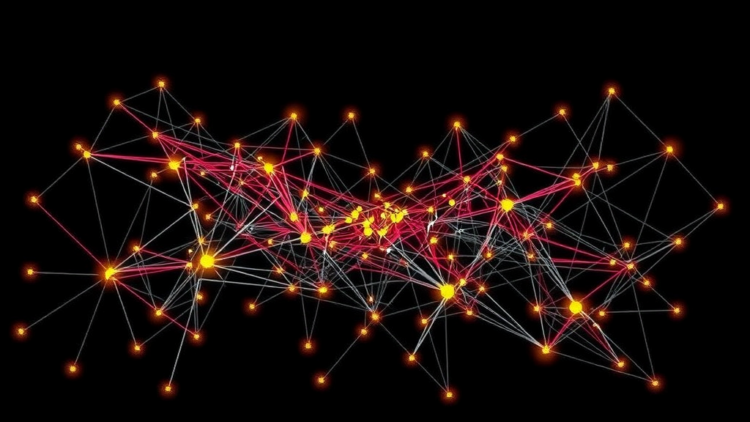
GRAB-FL reframes the detection problem through the lens of graph learning. On every aggregation round, the server constructs similarity graphs whose nodes are individual client updates and whose edges encode how alike those updates are across multiple views or feature representations. An attention-based graph neural network then processes these graphs, learning not only from each node’s own update-level features but also from relational patterns that emerge across the network. The intuition is subtle but powerful: a lone poisoned update might masquerade as benign when compared to any single neighbor, but coordinated attackers inevitably leave traces in the topology of the graph, forming clusters or exhibiting relationship patterns that honest, independently trained updates do not display.
A central design constraint is the threat model itself. The authors situate GRAB-FL in a bounded gray-box setting, meaning adversaries may observe the trajectory of the global model and adapt their submissions over time, but they cannot inspect the server-side trust states that the framework maintains. This assumption reflects a realistic class of attacks: sophisticated adversaries who track the evolving global model can craft updates that look plausible in any given round. GRAB-FL counters this adaptivity with an online trust model trained through self-supervised pseudo-labels derived from robust consensus statistics. Crucially, these pseudo-labels are reliability-gated: when the update population is unstable or highly dispersed, the system treats its own weak supervision as too noisy and skips the learning step rather than trusting potentially corrupted signals.
Once the graph neural network produces continuous trust scores, the framework does not discard conventional robust aggregation. Instead, the trust scores act as soft weights inside a base aggregation pipeline that can incorporate established filters such as Multi-Krum, trimmed mean, or Bulyan. This hybrid design means GRAB-FL inherits the theoretical guarantees of those base rules, including their standard bounded-adversary configuration requirements, while adding an adaptive layer that no fixed rule provides. Notably, the framework requires no trusted validation dataset, no ground-truth attack labels, and no attack-specific hyperparameter tuning, which distinguishes it from defenses that must be reconfigured for each anticipated threat.
The empirical evaluation spans five benchmarks: MNIST, Fashion-MNIST, CIFAR-10, a human activity recognition dataset, and APBench2, a standardized benchmark for availability poisoning attacks. The results are striking. Under an attack scenario with twenty percent Byzantine clients, GRAB-FL raises CIFAR-10 accuracy to 71.4 percent, compared with 65.8 percent for FLTrust and 63.2 percent for Bulyan. Against backdoor attacks, which attempt to implant hidden triggers that cause targeted misclassification while leaving overall accuracy intact, GRAB-FL reduces the attack success rate to just 11.3 percent, a substantial improvement that matters enormously for safety-critical deployments.
Detection performance is equally impressive. At a diagnostic threshold used solely for post-hoc reporting, the framework correctly identifies malicious clients with 91.7 percent accuracy while maintaining a false-positive rate of only 6.4 percent, meaning few honest participants are unfairly penalized. Sweeping the detection threshold across its range yields an area under the ROC curve of 0.957 and a precision-recall AUC of 0.881, indicating that the trust scores rank malicious updates reliably rather than merely separating them at one convenient operating point. The computational cost is modest: GRAB-FL adds roughly eighteen percent server-side runtime in the reported setup and, importantly, no additional communication rounds, preserving the communication efficiency that makes federated learning practical in the first place.
The authors are candid about the framework’s boundaries. Because graph construction requires access to individually submitted updates, GRAB-FL preserves raw-data locality but is not directly compatible with conventional secure aggregation protocols, which deliberately reveal only the aggregate of all updates and keep every individual contribution hidden. Reconciling per-client graph analysis with cryptographic privacy guarantees remains an open challenge, and the researchers position their work as a step within a broader design space rather than a final answer. Nevertheless, the combination of adaptivity, self-supervision, and compatibility with existing robust aggregation rules suggests a practical path forward for defenders facing increasingly strategic adversaries.
The significance of this work extends well beyond a single benchmark. Federated learning is rapidly expanding into 6G network security, drone-enabled learning systems, and healthcare informatics, domains where a successful poisoning attack could have severe real-world consequences. As attackers grow more adaptive and coordinated, static defenses built on fixed statistical assumptions will continue to erode. By teaching the aggregation server to see the hidden geometry of its clients’ relationships, GRAB-FL demonstrates that the structure of the update population itself carries a defense signal, one that adversaries cannot easily fake without revealing themselves. In the ongoing arms race between collaborative machine learning and those who would corrupt it, that shift from inspecting individual updates to reasoning over relational patterns may prove decisive.
Subject of Research: Byzantine-resilient federated learning using graph neural networks for adaptive detection of poisoning attacks
Article Title: Graph-aware Byzantine-resilient aggregation for adaptive poisoning detection in federated learning
Article References: Fraihat, S., Sanjalawe, Y., Yaseen, Q. M., Al-Betar, M. A., & Naser Makhadmeh, S. (2026). Graph-aware Byzantine-resilient aggregation for adaptive poisoning detection in federated learning. Neural Computing and Applications, 38(18), Article 743. https://doi.org/10.1007/s00521-026-12446-9
Image Credits: AI Generated
DOI: 10.1007/s00521-026-12446-9
Keywords: federated learning, Byzantine resilience, graph neural networks, poisoning attacks, robust aggregation, trust modeling, backdoor attacks, machine learning security, GRAB-FL, self-supervised learning, Graph-aware, Byzantine-resilient
Cite Scienmag News
APA MLA Chicago
Veronica Carney. (September 21, 2026). Graph Neural Networks Spot Poisoned Clients in Federated Learning Before They Sabotage the Model. Scienmag. https://scienmag.com/graph-neural-networks-spot-poisoned-clients-in-federated-learning-before-they-sabotage-the-model/
Veronica Carney. “Graph Neural Networks Spot Poisoned Clients in Federated Learning Before They Sabotage the Model.” Scienmag, 21 September 2026, https://scienmag.com/graph-neural-networks-spot-poisoned-clients-in-federated-learning-before-they-sabotage-the-model/. Accessed 21 September 2026.
Veronica Carney. “Graph Neural Networks Spot Poisoned Clients in Federated Learning Before They Sabotage the Model.” Scienmag. September 21, 2026. https://scienmag.com/graph-neural-networks-spot-poisoned-clients-in-federated-learning-before-they-sabotage-the-model/
Copy citation Download RIS
Tags: backdoor attack preventionbackdoor attacksByzantine resilienceByzantine-resilientByzantine-resilient aggregationcollaborative AI model robustnessfederated learningGRAB-FLGraph Neural NetworksGraph-awaregraph-aware anomaly detectionmachine learning securitymalicious client identificationmodel integrity in federated systemsneural network securitypoisoned client detectionpoisoning attacksprivacy-preserving machine learningrobust aggregationsecure federated model trainingself-supervised learningtrust modeling