Researchers have identified a specific signaling mechanism by which inflammatory cues initiate the formation of new fat cells, a process known as adipogenesis. Published in Nature Communications, the study demonstrates that transient activation of the C-C motif chemokine receptor 2 (CCR2) on primary cilia in preadipocytes is essential for the start of adipogenic differentiation. This finding clarifies a long-standing mechanistic gap in understanding how the inflammatory microenvironment of adipose tissue regulates its own development, particularly in the context of diet-induced obesity.
The study utilized both in vitro and in vivo models to investigate the role of primary cilia, which are microtubule-based sensory organelles extending from the surface of most mammalian cells. The team observed that adipose stem cells transiently activate a ciliary gene program to form ciliated preadipocytes. These cells subsequently commit to adipogenesis and lose their cilia upon further differentiation into mature adipocytes. This dynamic assembly and disassembly of cilia creates a temporally confined window of heightened sensitivity to environmental inflammatory cues, directing cell fate decisions in adipose tissue development.
Using fluorescence-activated cell sorting, the researchers isolated mouse adipocyte precursors and cultured them to three defined stages: a proliferative pre-differentiation stage, a growth-arrested differentiation initiation stage, and a post-differentiation stage marked by lipid droplet accumulation. Quantitative analysis revealed that cells at the initiation stage exhibited a significant increase in both the number and length of cilia compared to the proliferative stage. By the post-differentiation stage, following lipid accumulation, both cilia number and length had markedly decreased, indicating a strict temporal regulation of ciliogenesis during adipogenesis.
Transcriptomic analysis of these stages identified a transient upregulation of genes associated with ciliary structure and function, such as Ift88, Cep290, and Kif3, specifically at the onset of differentiation. The researchers further found that the mitogen-activated protein kinase (MAPK) signaling pathway was the only pathway transiently activated at this stage. Within the MAPK family, extracellular signal-regulated kinase (ERK) phosphorylation exhibited a transient peak at the onset of adipogenic differentiation, while phosphorylation of other kinases like JNK, p38, and AKT remained elevated throughout the process.
To determine the functional necessity of this transient ERK activation, the team perturbed ciliary dynamics in differentiating 3T3-L1 cells using genetic approaches. Depletion of IFT88, a core component of the intraflagellar transport-B complex, significantly reduced cilia number and length and abolished ERK phosphorylation. Conversely, knockdown of HDAC6, a tubulin deacetylase involved in cilium disassembly, resulted in cilia elongation and sustained ERK phosphorylation. Both perturbations markedly impaired adipogenic differentiation, as evidenced by reduced lipid droplet accumulation, suggesting that the dynamic cycle of cilia is required for the precise temporal pattern of ERK signaling.
The study further explored the role of the adipose tissue microenvironment in promoting adipogenesis under high-fat diet (HFD) conditions. Conditioned medium from the stromal vascular fraction (SVF) of HFD-fed mice markedly promoted adipogenesis in cultured cells compared to medium from standard diet-fed mice. This pro-adipogenic effect was dependent on primary cilia, as treatment with ciliobrevin D or genetic ablation of IFT88 abolished the ability of the HFD-conditioned medium to enhance differentiation. These results indicate that microenvironmental signals promote adipogenesis through a mechanism that requires the presence of primary cilia on preadipocytes.
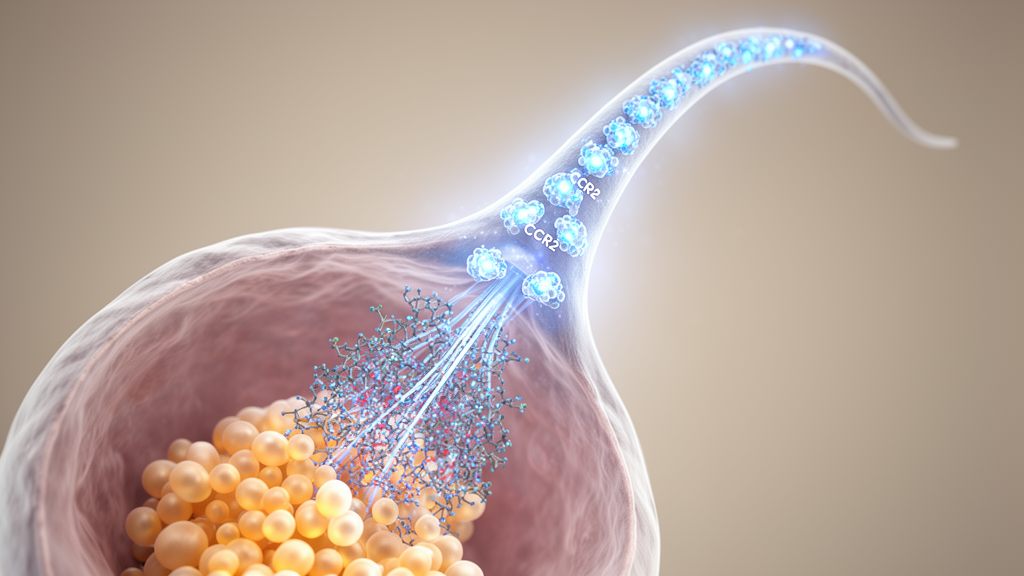
Among various inflammatory cytokines, the researchers identified C-C motif chemokine ligand 2 (CCL2) as a key mediator. HFD feeding remodels the adipose tissue microenvironment, elevating levels of CCL2, which engages the cilium-localized CCR2 to initiate adipogenesis. The study showed that CCR2 localizes to the primary cilia of preadipocytes, a process mediated by the trafficking protein TULP3. This ciliary localization creates a signaling hotspot, enhancing cellular responsiveness to extracellular CCL2. CCL2 treatment promoted the expression of key adipogenic transcription factors, PPARγ and C/EBPα, an effect that was suppressed by the CCR2 antagonist INCB3344.
Mechanistically, CCL2 treatment significantly increased the phosphorylation of ERK in a cilium-dependent manner. The researchers found that CCL2 enhances the tyrosine phosphorylation of CCR2, specifically at the Y152 residue within the DRY motif, which is crucial for GPCR activation. Ablation of primary cilia by IFT88 knockdown markedly reduced this CCL2-induced tyrosine phosphorylation of CCR2, confirming that an intact ciliary structure is required for efficient activation of the CCL2/CCR2 signaling axis. This pathway subsequently activates the downstream ERK signaling pathway, which is essential for adipogenic commitment.
To validate these findings in vivo, the team used Ift88fl/fl;Ubc-Cre/ERT2 mice, in which tamoxifen administration induces global deletion of Ift88, thereby disrupting primary cilia formation. These mice were treated with the CCR2 antagonist INCB3344 and fed a high-fat diet. Histological examination revealed marked adipocyte hypertrophy in the subcutaneous white adipose tissue of IFT88 knockout mice compared with wild-type controls. Notably, INCB3344 treatment induced significant adipocyte hypertrophy in wild-type mice, whereas this effect was abolished in IFT88 knockout mice, indicating that primary cilia are important for maintaining adipose tissue homeostasis.
Flow cytometric analysis of BrdU incorporation into mature adipocyte nuclei further supported the role of ciliary CCR2 signaling in adipogenesis. The proportion of BrdU-positive adipocyte nuclei was significantly reduced in IFT88 knockout mice compared with wild-type mice. Treatment with INCB3344 significantly decreased BrdU incorporation in wild-type mice but had no effect in IFT88 knockout mice. These results demonstrate that CCR2 signaling promotes adipogenesis in vivo in a manner that strictly depends on the presence of primary cilia. The absence of a corresponding increase in adipose tissue mass despite adipocyte hypertrophy suggests a specific defect in the formation of new adipocytes rather than overall tissue expansion.
The study highlights the complex interplay between inflammation and adipose tissue development. While chronic low-grade inflammation is often associated with metabolic dysfunction, the findings suggest that appropriate inflammatory signaling, such as that mediated by CCL2, can facilitate adipogenic differentiation. This transient activation of ciliary CCR2 signaling provides a mechanistic link between the inflammatory microenvironment and the initiation of adipogenesis. The dynamic assembly of primary cilia serves as a critical mechanism for the initiation of adipogenesis, reframing the role of inflammatory signaling in obesogenesis.
These findings have significant implications for understanding the molecular basis of obesity and related metabolic disorders. The identification of the CCL2/CCR2-ERK axis as a key regulator of adipogenesis provides potential therapeutic targets for combating adipogenesis-related diseases. By targeting primary cilia or the ciliary CCL2/CCR2-ERK signaling pathway, it may be possible to modulate adipose tissue expansion and improve metabolic health. The study underscores the importance of the primary cilium as a signaling platform that integrates environmental cues to regulate cell fate decisions in adipose tissue.
To understand the molecular drivers of ciliary remodeling, the research team analyzed the expression of numerous transcription factors known to regulate ciliogenesis, such as those in the Klf, Rfx, and Sp families. Their transcriptomic analysis revealed that specific members, including Klf2, Klf3, Klf6, Klf7, Klf12, Sp1, Sp3, and Rfx5, exhibited expression patterns that mirrored the dynamic assembly and disassembly of primary cilia during differentiation. These factors peaked at the onset of adipogenesis on day 0 and subsequently declined as the cells matured. While this temporal correlation suggests these transcription factors orchestrate the ciliary cycle, the authors noted that further functional studies are required to isolate the primary regulators responsible for driving these changes during preadipocyte commitment.
The study also delineated the unique signaling environment within the primary cilium. While other pathways, including the PI3K-AKT and cAMP cascades, showed sustained activation throughout the progression of adipogenesis, the MAPK pathway exhibited a distinct, transient activation pattern specifically coinciding with the assembly of primary cilia. This temporal specificity is critical, as sustained ERK activation often promotes cell-cycle progression rather than terminal differentiation. The researchers confirmed that the interaction between CCL2 and its receptor CCR2 at the ciliary membrane was the central mechanism facilitating this transient ERK burst. The receptor’s localization depends on the transport protein TULP3, which moves CCR2 into the ciliary compartment.
The biochemical activation of this pathway was further characterized by examining the conserved aspartic acid–arginine–tyrosine (DRY) motif in CCR2. Investigations into the phosphorylation status of the receptor demonstrated that CCL2-induced activation involves tyrosine phosphorylation rather than serine or threonine modifications. Specifically, the tyrosine 152 residue within the DRY motif was identified as the primary site for this modification. These findings offer a mechanistic explanation for how diverse extracellular inflammatory cues are integrated by preadipocytes to govern cell fate.
While this research highlights a pro-adipogenic role for CCL2/CCR2 signaling, the study acknowledges limitations inherent in using the tamoxifen-inducible Ift88fl/fl;Ubc-Cre/ERT2 mouse model. Because this approach induces global deletion of Ift88, the team noted it remains difficult to entirely exclude secondary effects originating from other ciliated cell types in the adipose tissue microenvironment. Nonetheless, the integration of these in vivo observations with cell-autonomous experiments in 3T3-L1 cells provides evidence that ciliary CCR2 signaling serves as an essential, direct regulator of healthy adipogenic differentiation.
Subject of Research: Mechanistic role of ciliary CCR2 signaling in the initiation of adipogenesis
Article Title: Transient activation of ciliary CCR2 signaling promotes the initiation of adipogenesis
Article References: Wu, Y., Kong, Y., Li, W., Ma, Y., Yan, S., Zhou, J., & Yang, Y. (2026). Transient activation of ciliary CCR2 signaling promotes the initiation of adipogenesis. Nature Communications, 17(1), Article 10903. https://doi.org/10.1038/s41467-026-77826-0
Image Credits: AI Generated
DOI: 10.1038/s41467-026-77826-0
Keywords: adipogenesis, primary cilia, CCR2 signaling, CCL2 chemokine, ERK pathway, adipose tissue, high-fat diet, inflammation, preadipocytes, IFT88, TULP3, obesity, cell differentiation, Nature Communications, Transient
News Source: Daisy Hatcher. (November 16, 2026). Ciliary CCR2 Signaling Triggers Fat Cell Formation. Scienmag.