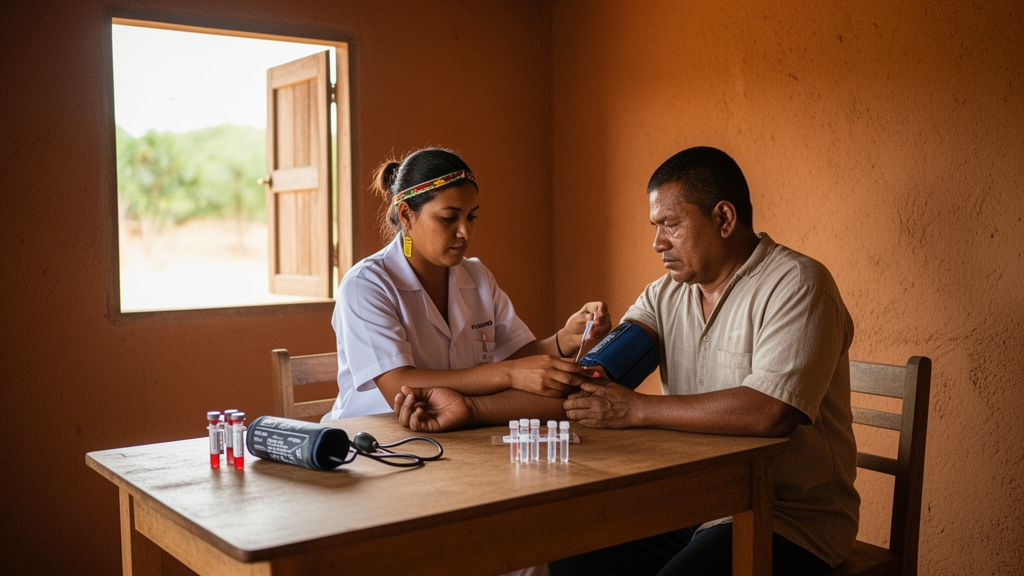
A cross-sectional study of Fulni-ô Indigenous adults in Northeastern Brazil has estimated the prevalence of chronic kidney disease (CKD) at 14.9% (95% CI 12.1–18.1), a figure reported in BMC Nephrology on 21 October 2026. The condition affects roughly 14% of adults worldwide, and Indigenous peoples are considered disproportionately vulnerable due to historical, structural, and social factors, yet epidemiological data on CKD among Brazilian Indigenous populations have remained scarce.
Researchers recruited Fulni-ô adults aged 18 years or older residing in Águas Belas, Pernambuco, Brazil. Of 911 adults initially evaluated, 569 met the inclusion criteria. Participants provided sociodemographic, anthropometric, and clinical information along with venous blood and urine samples. Estimated glomerular filtration rate (eGFR) was calculated using the race-free CKD-EPI 2021 equation, and CKD was defined according to KDIGO criteria as an eGFR below 60 mL/min/1.73 m² and/or a urinary albumin-to-creatinine ratio (UACR) of at least 30 mg/g.
In univariate analysis, older age, diabetes, hypertension, and dyslipidemia were each significantly associated with CKD, while sex and obesity were not. After multivariable adjustment, only two factors remained independently associated with the composite outcome: age of 60 years or older, with an adjusted odds ratio of 3.58 (95% CI 2.03–6.27), and diabetes, with an adjusted odds ratio of 3.03 (95% CI 1.53–5.90).
Isolated albuminuria with preserved eGFR was the most frequent CKD phenotype observed.
The adjusted linear regression analysis of eGFR as a continuous outcome showed that older age, hypertension, and dyslipidemia were associated with lower eGFR, while female sex was associated with higher eGFR. These continuous associations complement the categorical findings and help characterize how cardiometabolic risk factors track with kidney function measures in this cohort.
The authors conclude that the burden of CKD among Fulni-ô Indigenous adults is substantial and that older age and diabetes are the independent drivers of the composite outcome. They emphasize that the predominance of isolated albuminuria underscores the importance of routine urinary albumin screening, even among individuals with preserved eGFR, to enable earlier detection of kidney abnormalities and culturally appropriate management strategies in this population.
The study’s limitations are explicitly stated and matter for interpretation. The findings rest on single eGFR and UACR measurements rather than the repeated assessments over time that chronicity criteria typically require, meaning some degree of misclassification is possible. The authors also note limited coverage of the target population and the potential for selection bias, so the estimated prevalence should be read as applying to the 569 included participants rather than assumed to generalize automatically to all Fulni-ô adults.
As a cross-sectional study, the design captures associations at a single point in time and cannot establish that diabetes or aging causes kidney damage in this population, only that they are independently associated with the outcome after adjustment. Longitudinal follow-up and broader sampling would be needed to confirm temporal relationships and refine prevalence estimates for the community as a whole.
Within these constraints, the study adds concrete, measured data to a sparse evidence base. It identifies a specific, actionable screening target—albuminuria among people with preserved eGFR—and quantifies the independent contribution of age and diabetes, offering a baseline against which future studies of kidney health in Brazilian Indigenous populations can be compared.
Subject of Research: Prevalence and associated factors of chronic kidney disease among Fulni-ô Indigenous adults in Northeastern Brazil
Article Title: Prevalence and factors associated with chronic kidney disease among Fulni-ô Indigenous adults in Brazil
Article References: Gomes, O. V., Nicacio, J. M., Amorim, V. D., Matos Júnior, H. R. D., Junior, A. A. D. M., Pereira, V. C., Oliveira Armstrong, D. M. F. D., Carmo, R. F. D., Barral-Netto, M., Souza, C. D. F. D., & Armstrong, A. D. C. (2026). Prevalence and factors associated with chronic kidney disease among Fulni-ô Indigenous adults in Brazil. BMC Nephrology. https://doi.org/10.1186/s12882-026-05429-4
Image Credits: AI Generated
DOI: 10.1186/s12882-026-05429-4
Keywords: chronic kidney disease, Fulni-ô Indigenous people, Brazil, cross-sectional study, albuminuria, diabetes, hypertension, eGFR, CKD-EPI 2021, KDIGO criteria, Pernambuco, epidemiology
News Source: Jerry Hayes. (October 29, 2026). Chronic Kidney Disease Affects Nearly 15% of Fulni-ô Indigenous Adults in Brazil. Scienmag.