• HOME
  • NEWS
  • EXPLORE
    • CAREER
      • Companies
      • Jobs
    • EVENTS
    • iGEM
      • News
      • Team
    • PHOTOS
    • VIDEO
    • WIKI
  • BLOG
  • COMMUNITY
    • FACEBOOK
    • INSTAGRAM
    • TWITTER
Sunday, May 17, 2026
BIOENGINEER.ORG
No Result
View All Result
  • Login
  • HOME
  • NEWS
  • EXPLORE
    • CAREER
      • Companies
      • Jobs
        • Lecturer
        • PhD Studentship
        • Postdoc
        • Research Assistant
    • EVENTS
    • iGEM
      • News
      • Team
    • PHOTOS
    • VIDEO
    • WIKI
  • BLOG
  • COMMUNITY
    • FACEBOOK
    • INSTAGRAM
    • TWITTER
  • HOME
  • NEWS
  • EXPLORE
    • CAREER
      • Companies
      • Jobs
        • Lecturer
        • PhD Studentship
        • Postdoc
        • Research Assistant
    • EVENTS
    • iGEM
      • News
      • Team
    • PHOTOS
    • VIDEO
    • WIKI
  • BLOG
  • COMMUNITY
    • FACEBOOK
    • INSTAGRAM
    • TWITTER
No Result
View All Result
Bioengineer.org
No Result
View All Result
Home NEWS Science News Biology

Chromatin organizes itself into 3D ‘forests’ in single cells

Bioengineer by Bioengineer
January 10, 2020
in Biology
Reading Time: 2 mins read
0
IMAGE
Share on FacebookShare on TwitterShare on LinkedinShare on RedditShare on Telegram

Knowledge could help scientists understand chromatin’s role in cancer, other diseases
IMAGE

Credit: Northwestern University


A single cell contains the genetic instructions for an entire organism. This genomic information is managed and processed by the complex machinery of chromatin — a mix of DNA and protein within chromosomes whose function and role in disease are of increasing interest to scientists.

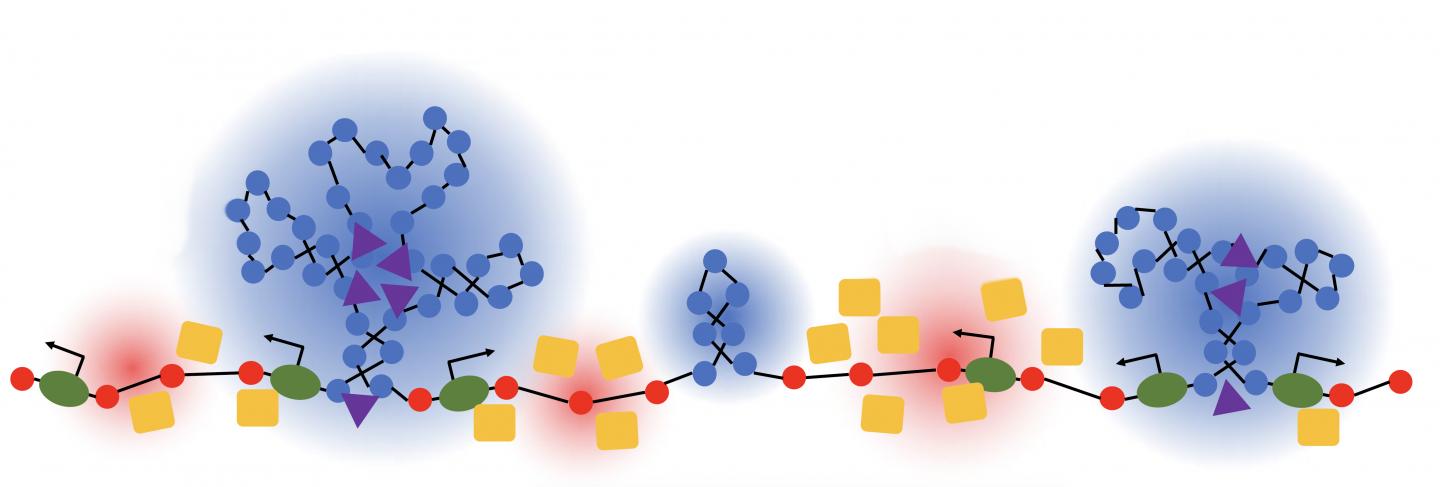
A Northwestern University research team — using mathematical modeling and optical imaging they developed themselves — has discovered how chromatin folds at the single-cell level. The researchers found chromatin is folded into a variety of tree-like domains spaced along a chromatin backbone. These small and large areas are like a mixed forest of trees growing from the forest floor. The overall structure is a 3D forest at microscale.

Chromatin is responsible for packing DNA into the cell nucleus. In humans, that’s about six feet of DNA in each cell. The new work suggests that chromatin is more structured and hierarchical in single cells than previously thought. Learning how chromatin correctly operates will help scientists understand what goes wrong with it in cancer and other diseases.

“By integrating theoretical and experimental work, we have produced a new chromatin folding picture that helps us see how the 3D genome is organized at the single-cell level,” said Igal Szleifer, the Christina Enroth-Cugell Professor of Biomedical Engineering at Northwestern’s McCormick School of Engineering. He co-led the research team with Vadim Backman.

Details of the interdisciplinary study will be published Jan. 10 in the journal Science Advances.

“If genes are the hardware, chromatin is the software,” said Backman, the Walter Dill Scott Professor of Biomedical Engineering and director of the Center for Physical Genomics and Engineering. “If the structure of chromatin changes, it can alter the processing of the information stored in the genome, but it does not alter the genes themselves. Understanding chromatin folding holds the key to understanding how cells differentiate and how cancer happens.”

Advances in genomic, imaging and information technologies are just beginning to enable scientists to better understand how chromatin works. The Northwestern researchers used a Partial Wave Spectroscopic (PWS) microscope, optical imaging developed by Backman and colleagues, to peer deep into live cells and “sense” alterations in chromatin packing. They also used electron imaging.

“Our paradigm-shifting picture of chromatin folding is an important missing piece in the holistic view of genomic structure,” said Kai Huang, the study’s first author. Huang is a postdoctoral fellow in Backman’s research group. “The results should inspire new strategies to fight cancer.”

###

The paper is titled “Physical and data structure of 3D genome.” The corresponding authors are Szleifer, Backman and Huang.

Backman also is professor of medicine and of biochemistry and molecular genetics at the Feinberg School of Medicine, program leader in cancer and physical sciences at the Robert H. Lurie Comprehensive Cancer Center of Northwestern University and a member of the Chemistry of Life Processes Institute.

Media Contact
Megan Fellman
[email protected]
847-491-3115

Tags: BiologycancerCell BiologyGenesMedicine/Health
Share13Tweet8Share2ShareShareShare2

Related Posts

Uncovering C. elegans Immunity via Genetic Screens — Biology

Uncovering C. elegans Immunity via Genetic Screens

May 16, 2026
Single mother must adapt swiftly — the survival of her colony depends on it — Biology

Single mother must adapt swiftly — the survival of her colony depends on it

May 15, 2026

Why Are Nearly Everyone Right-Handed? It Might Be Linked to How We Learned to Walk

May 15, 2026

Excessive Neuronal Activity Initiates Severe Autoimmune Brain Disorder

May 15, 2026
Please login to join discussion

POPULAR NEWS

  • Research Indicates Potential Connection Between Prenatal Medication Exposure and Elevated Autism Risk

    844 shares
    Share 338 Tweet 211
  • New Study Reveals Plants Can Detect the Sound of Rain

    730 shares
    Share 291 Tweet 182
  • Salmonella Haem Blocks Macrophages, Boosts Infection

    62 shares
    Share 25 Tweet 16
  • Breastmilk Balances E. coli and Beneficial Bacteria in Infant Gut Microbiomes

    58 shares
    Share 23 Tweet 15

About

We bring you the latest biotechnology news from best research centers and universities around the world. Check our website.

Follow us

Recent News

Flexible Framework Optimizes Data Center Site Planning

Short-Term Home Cognitive & Physical Training Tested in Seniors

Stress Evolution and Time Control in Retreat Roadways

Subscribe to Blog via Email

Success! An email was just sent to confirm your subscription. Please find the email now and click 'Confirm' to start subscribing.

Join 82 other subscribers
  • Contact Us

Bioengineer.org © Copyright 2023 All Rights Reserved.

Welcome Back!

Login to your account below

Forgotten Password?

Retrieve your password

Please enter your username or email address to reset your password.

Log In
No Result
View All Result
  • Homepages
    • Home Page 1
    • Home Page 2
  • News
  • National
  • Business
  • Health
  • Lifestyle
  • Science

Bioengineer.org © Copyright 2023 All Rights Reserved.