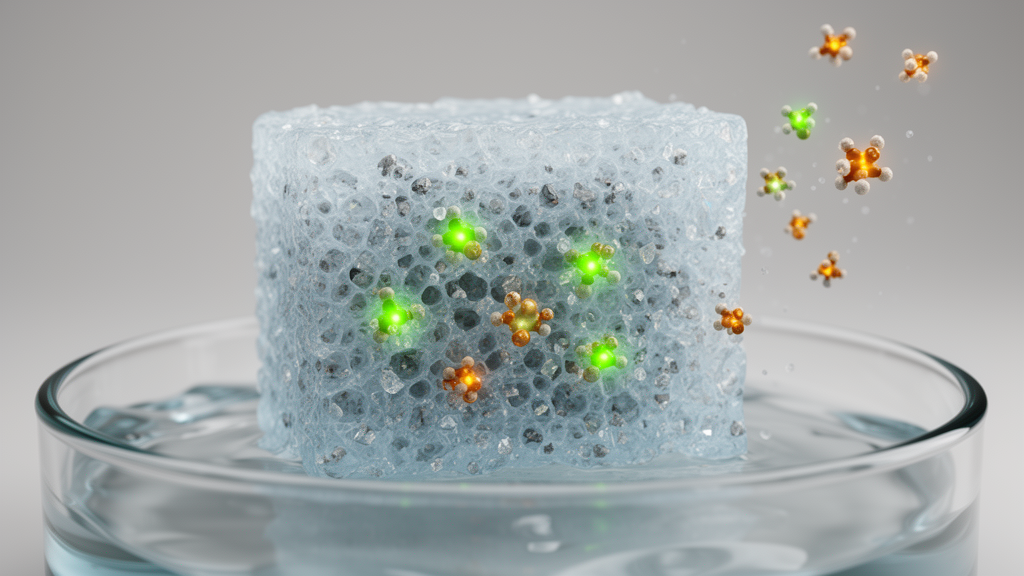
A new study of biodegradable hydrogel nanocomposites has mapped in detail how two widely used herbicides, paraquat and difenzoquat, are captured and released from polymer matrices whose behavior can be tuned by pH and by the salts dissolved in the surrounding water. The work, published in Bioscience Nanotechnology on 26 August 2026, was carried out by Fabrício C. Tanaka, Uilian G. Yonezawa, Marcia R. de Moura and Fauze A. Aouada and builds on the group’s earlier hydrogel systems by introducing chitosan as a cationic polysaccharide alongside the zeolite clinoptilolite.
The materials at the center of the study are nanocomposite hydrogels based on a poly(methacrylic acid)-co-polyacrylamide (PMAA-co-PAAm) copolymer network. The researchers synthesized hydrogels containing 1.5% w/v chitosan alone and versions with 0.5, 1.0 or 1.5% w/v zeolite added, using radical polymerization of methacrylic acid and acrylamide monomers with N,N-methylenebisacrylamide as crosslinker and potassium persulfate as initiator. After polymerization at over 70 °C for 24 hours, the gels were dialyzed in deionized water for seven days to remove unreacted species before testing.
A central practical challenge the team addressed is keeping zeolite particles evenly dispersed during synthesis. In an unstirred polymerization solution, finely dispersed zeolite particles collide, aggregate and sediment to the bottom of the mold, producing an inhomogeneous material. Chitosan solves this problem by acting as a thickening agent: the viscosity of the polymerization solution rose from 241.5 to 428.1 cP when zeolite was present with chitosan, and the researchers attribute the stabilization to interactions between protonated amine groups (NH3+) on chitosan and O–Si–O or O–Al–O groups in the zeolite framework. Notably, chitosan required a higher concentration to stabilize the zeolite (1.5% w/v) than carboxymethylcellulose needed in the group’s earlier work (0.75% w/v), yet the zeolite-containing chitosan solution reached a higher final viscosity than solutions with carboxymethylcellulose or methylcellulose, suggesting stronger chitosan–zeolite interactions despite chitosan’s lower molecular mass of 71,000 g/mol.
Thermogravimetric analysis confirmed that adding zeolite also changed the thermal behavior of the gels. Residual mass above 572 °C increased progressively with zeolite content, from 13.0% for the chitosan hydrogel without zeolite to 17.6%, 19.7% and 23.4% for composites with 0.5, 1.0 and 1.5% zeolite respectively. Mass losses during the second and third thermal events decreased as zeolite content rose, and the peak temperatures shifted, indicating that the mineral slows the degradation rate of part of the polymer matrix. Together with FTIR, XRD and SEM results from the group’s previous studies, these curves support successful incorporation of zeolite into the nanocomposite matrix.
Swelling experiments revealed how sensitive these hydrogels are to their ionic environment. When samples were immersed in NaCl solutions ranging from 0.05 to 0.20 mol/L, as well as 0.15 mol/L CaCl2 and AlCl3 solutions, water absorption fell well below the values measured in pure water, with a slight downward trend as NaCl concentration increased. The reduction was less pronounced for the chitosan and chitosan–zeolite gels: water absorption dropped by 88.5% for plain PMAA-co-PAAm but only 71.6% and 71.0% for the chitosan hydrogel and the 1.5% zeolite nanocomposite respectively. The researchers interpret chitosan and zeolite as acting as physical crosslinkers, and they observed that swelling decreased further when monovalent Na+ was replaced by divalent Ca2+ or trivalent Al3+, whose higher valence strengthens intra- and intermolecular interactions with the polymer chains.
The herbicide sorption results carried a counterintuitive twist. In every swelling medium and at every pH tested, the chitosan hydrogel and the zeolite nanocomposite actually adsorbed less herbicide than the plain PMAA-co-PAAm matrix, an effect the authors link to increased chain density and, for the herbicides’ permanently positively charged quaternary ammonium groups, possible electrostatic repulsion from the protonated polysaccharide. Nevertheless, paraquat sorption efficiency reached practically 100% within 24 hours for these matrices, while difenzoquat required longer: the plain matrix approached 100% after 8 hours, whereas the chitosan-containing hydrogel and nanocomposite needed 48 hours to reach maximum sorption. The abundant hydrophilic and silanol groups are thought to multiply interactions between herbicide and matrix, slowing molecular diffusion through the polymer.
Kinetic modeling sharpened this picture. All samples except the chitosan hydrogel with difenzoquat fit the pseudo-second-order model best, suggesting adsorption involving strong interactions resembling chemical bonds. For the nanocomposite, the pseudo-second-order rate constant was 0.054 g/mg·h for paraquat against 0.026 g/mg·h for difenzoquat, consistent with paraquat’s lower molecular weight and its two positively charged pyridinium nitrogens. The nanocomposite also adsorbed paraquat faster than the zeolite-free hydrogel (k2 = 0.030 g/mg·h), even though its equilibrium capacity was lower. Adsorption isotherm analysis showed a mechanistic shift: the chitosan hydrogel followed the Langmuir model, indicating monolayer adsorption on energetically similar sites, while the zeolite nanocomposite followed the Harkins–Jura model, pointing to multilayer adsorption on sites with irregular energy distribution, likely a consequence of the micropores and microcavities that zeolite introduces into the matrix morphology.
Release behavior proved just as tunable as uptake. Across pH 4.0, 7.0 and 10.0 in 0.1 mol/L NaCl, desorption profiles for all gels showed a burst of herbicide in the first 8 hours followed by slower release, but the plain matrix released the most paraquat per gram of hydrogel at every pH. For the chitosan-containing samples, release declined as pH rose, because at higher pH the carboxylic groups are ionized and amide groups remain non-protonated, strengthening the attraction between polymer chains and paraquat and hindering desorption. Interestingly, difenzoquat desorption from the chitosan nanocomposite exceeded that of the methylcellulose-based nanocomposite reported in the group’s earlier work at all tested pH values, and the chitosan samples released the herbicide more gradually over the whole evaluation period rather than exhausting their payload within 24 hours.
Ionic strength offered an even more powerful release trigger. Increasing Na+ concentration, or introducing divalent and trivalent salts, enhanced both the speed and the quantity of paraquat released. At the highest NaCl concentration tested (0.20 mol/L), the zeolite nanocomposite released the least paraquat, about 74.3%, compared with 82.4% for the plain matrix and 88.0% for the chitosan hydrogel, an effect attributed to strong retention by silanol and Si–O groups. The most striking result emerged with Ca2+ and Al3+: while the plain matrix and the chitosan hydrogel released practically all of their sorbed paraquat, the nanocomposite retained about 14.9% and 12.7% respectively, releasing 87.3% of the paraquat it had sorbed. The smaller atomic radius of Al3+ (0.53 Å) compared with Ca2+ (1.00 Å) and Na+ (1.02 Å) favored the ion-exchange mechanism that displaces paraquat from the polymer chains.
The authors point toward applications beyond simple herbicide delivery. Because these hydrogels can adsorb ions from the release medium and exchange them for agrochemicals held in their structure, they may help reduce concentrations of Al3+, which becomes mobile and toxic to crops such as cocoa and cotton in acidic soils, potentially lowering liming costs. The strong retention and ion-exchange capacity in aqueous media also position the materials as adsorbents for environmental remediation and wastewater treatment aimed at mitigating pesticide pollution. The team cautions, however, that complementary investigations, particularly of how soil conditions affect the release profile, are still needed before these nanocomposites can be confirmed as carrier vehicles for controlled-release systems or as adsorbents for contaminated soil and water.
Subject of Research: Nanocomposite hydrogels of chitosan, zeolite and PMAA-co-PAAm that sorb and release paraquat and difenzoquat herbicides under varying pH and ionic strength
Article Title: Transport mechanisms of herbicides in nanocomposite hydrogels under pH and ionic strength gradients
Article References: Tanaka, F. C., Yonezawa, U. G., de Moura, M. R., & Aouada, F. A. (2026). Transport mechanisms of herbicides in nanocomposite hydrogels under pH and ionic strength gradients. Bioscience Nanotechnology, 2(1), Article 27. https://doi.org/10.1186/s44331-026-00034-6
Image Credits: AI Generated
DOI: 10.1186/s44331-026-00034-6
Keywords: nanocomposite hydrogels, chitosan, zeolite, paraquat, difenzoquat, herbicide sorption, controlled release, PMAA-co-PAAm, ionic strength, pH, water remediation, thermal stability
News Source: Gregory Coleman. (October 28, 2026). Chitosan and zeolite hydrogels trap and slowly release paraquat and difenzoquat herbicides. Scienmag.