• HOME
  • NEWS
  • EXPLORE
    • CAREER
      • Companies
      • Jobs
    • EVENTS
    • iGEM
      • News
      • Team
    • PHOTOS
    • VIDEO
    • WIKI
  • BLOG
  • COMMUNITY
    • FACEBOOK
    • INSTAGRAM
    • TWITTER
Wednesday, May 13, 2026
BIOENGINEER.ORG
No Result
View All Result
  • Login
  • HOME
  • NEWS
  • EXPLORE
    • CAREER
      • Companies
      • Jobs
        • Lecturer
        • PhD Studentship
        • Postdoc
        • Research Assistant
    • EVENTS
    • iGEM
      • News
      • Team
    • PHOTOS
    • VIDEO
    • WIKI
  • BLOG
  • COMMUNITY
    • FACEBOOK
    • INSTAGRAM
    • TWITTER
  • HOME
  • NEWS
  • EXPLORE
    • CAREER
      • Companies
      • Jobs
        • Lecturer
        • PhD Studentship
        • Postdoc
        • Research Assistant
    • EVENTS
    • iGEM
      • News
      • Team
    • PHOTOS
    • VIDEO
    • WIKI
  • BLOG
  • COMMUNITY
    • FACEBOOK
    • INSTAGRAM
    • TWITTER
No Result
View All Result
Bioengineer.org
No Result
View All Result
Home NEWS Science News Health

Chirality in 'real-time'

Bioengineer by Bioengineer
January 10, 2019
in Health
Reading Time: 2 mins read
0
IMAGE
Share on FacebookShare on TwitterShare on LinkedinShare on RedditShare on Telegram

IMAGE

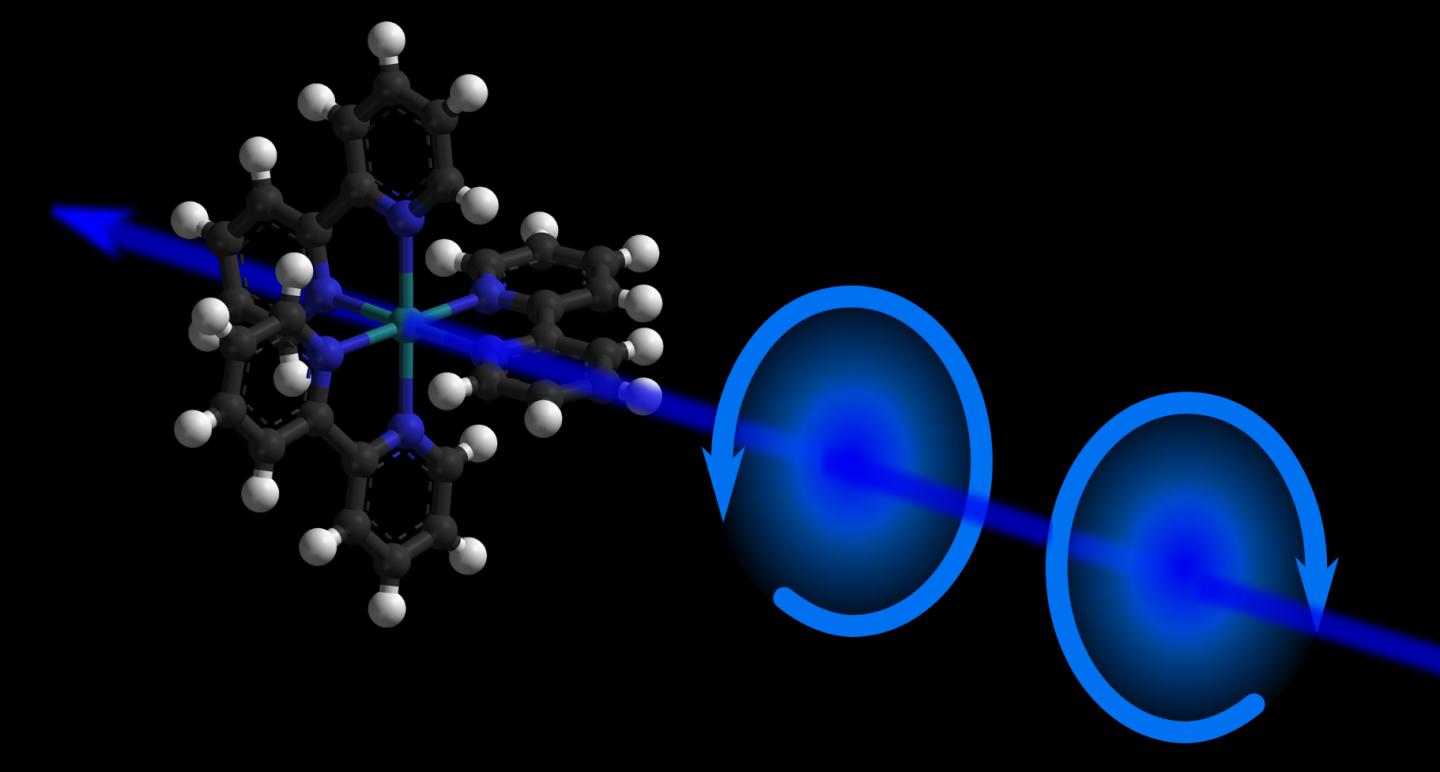
Credit: M. Oppermann, EPFL


In nature, certain molecules with the same chemical composition, can exist in two different shapes that are mirrors images of each other, much like our hands. This property is known as “chirality” and molecules with different chirality are called enantiomers. Enantiomers can exhibit entirely different chemical or biological properties, and separating them is a major issue in drug development and in medicine.

The method commonly used to detect enantiomers is circular dichroism (CD) spectroscopy. It exploits the fact that light polarized into a circular wave (like a whirlpool) is absorbed differently by left-handed and right-handed enantiomers. Steady-state CD spectroscopy is a major structural tool in (bio)chemical analysis.

During their function, biomolecules undergo structural changes that affect their chiral properties. Probing these in real-time (i.e. between 1 picosecond and 1 nanosecond) provides a view of their biological function, but this has been challenging in the deep-UV spectrum (wavelengths below 300 nm) where most biologically relevant molecules such as amino acids, DNA and peptide helices absorb light.

The limitations are due to the lack of adequate sources of pulsed light and of sensitive detection schemes. But now, the group of Majed Chergui at the Lausanne Centre for Ultrafast Science (EPFL) has developed a setup that allows the visualization of the chiral response of (bio)molecules by CD spectroscopy with a resolution of 0.5 picoseconds.

The setup uses a photoelastic modulator, which is an optical device that can control the polarization of light. In this system, the modulator permits shot-to-shot polarization switching of a 20 kHz femtosecond pulse train in the deep-UV range (250-370 nm). It is then possible to record changes in the chirality of molecules at variable time-delays after they are excited with a short laser pulse.

“Amino acid residues and DNA bases absorb light below 300 nm,” says Malte Oppermann, the paper’s first author. “This set-up is the first to cover this region, and we successfully tested it on a model molecular system. Our next aim is to move on to larger biosystems, like DNA oligomers.”

###

Other contributors

University of Geneva

University of Zurich

Reference

Malte Oppermann, Benjamin Bauer, Thomas Rossi, Francesco Zinna, Jan Helbing, Jérôme Lacour, Majed Chergui. Ultrafast broadband circular dichroism in the deep ultraviolet. Optica 6(1): 56-60, 10 January 2019. DOI: 10.1364/OPTICA.6.000056

Media Contact
Nik Papageorgiou
[email protected]
41-216-932-105

Original Source

https://actu.epfl.ch/news/chirality-in-real-time

Related Journal Article

http://dx.doi.org/10.1364/OPTICA.6.000056

Tags: Biomedical/Environmental/Chemical EngineeringChemistry/Physics/Materials SciencesIndustrial Engineering/ChemistryPharmaceutical SciencesPharmaceutical/Combinatorial ChemistryResearch/Development
Share12Tweet8Share2ShareShareShare2

Related Posts

Glycocalyx Exchange Powers Liquid Biopsies of Endothelium

May 13, 2026

Intensive Caregiving Duties Linked to Accelerated Cognitive Decline, Study Finds

May 13, 2026

Nanoplatform Combats Skin Inflammation via RNA, ROS

May 13, 2026

PSU-Led Team Advances Promising New Drug Candidate for Malaria Control and Eradication

May 13, 2026
Please login to join discussion

POPULAR NEWS

  • Research Indicates Potential Connection Between Prenatal Medication Exposure and Elevated Autism Risk

    842 shares
    Share 337 Tweet 211
  • New Study Reveals Plants Can Detect the Sound of Rain

    728 shares
    Share 290 Tweet 182
  • Salmonella Haem Blocks Macrophages, Boosts Infection

    62 shares
    Share 25 Tweet 16
  • Breastmilk Balances E. coli and Beneficial Bacteria in Infant Gut Microbiomes

    57 shares
    Share 23 Tweet 14

About

We bring you the latest biotechnology news from best research centers and universities around the world. Check our website.

Follow us

Recent News

Glycocalyx Exchange Powers Liquid Biopsies of Endothelium

Intensive Caregiving Duties Linked to Accelerated Cognitive Decline, Study Finds

Nanoplatform Combats Skin Inflammation via RNA, ROS

Subscribe to Blog via Email

Enter your email address to subscribe to this blog and receive notifications of new posts by email.

Join 82 other subscribers
  • Contact Us

Bioengineer.org © Copyright 2023 All Rights Reserved.

Welcome Back!

Login to your account below

Forgotten Password?

Retrieve your password

Please enter your username or email address to reset your password.

Log In
No Result
View All Result
  • Homepages
    • Home Page 1
    • Home Page 2
  • News
  • National
  • Business
  • Health
  • Lifestyle
  • Science

Bioengineer.org © Copyright 2023 All Rights Reserved.