• HOME
  • NEWS
  • EXPLORE
    • CAREER
      • Companies
      • Jobs
    • EVENTS
    • iGEM
      • News
      • Team
    • PHOTOS
    • VIDEO
    • WIKI
  • BLOG
  • COMMUNITY
    • FACEBOOK
    • INSTAGRAM
    • TWITTER
Monday, May 11, 2026
BIOENGINEER.ORG
No Result
View All Result
  • Login
  • HOME
  • NEWS
  • EXPLORE
    • CAREER
      • Companies
      • Jobs
        • Lecturer
        • PhD Studentship
        • Postdoc
        • Research Assistant
    • EVENTS
    • iGEM
      • News
      • Team
    • PHOTOS
    • VIDEO
    • WIKI
  • BLOG
  • COMMUNITY
    • FACEBOOK
    • INSTAGRAM
    • TWITTER
  • HOME
  • NEWS
  • EXPLORE
    • CAREER
      • Companies
      • Jobs
        • Lecturer
        • PhD Studentship
        • Postdoc
        • Research Assistant
    • EVENTS
    • iGEM
      • News
      • Team
    • PHOTOS
    • VIDEO
    • WIKI
  • BLOG
  • COMMUNITY
    • FACEBOOK
    • INSTAGRAM
    • TWITTER
No Result
View All Result
Bioengineer.org
No Result
View All Result
Home NEWS Science News Chemistry

Children with cancer wait an average of 6.5 years longer than adults to access new drugs

Bioengineer by Bioengineer
May 21, 2019
in Chemistry
Reading Time: 3 mins read
0
IMAGE
Share on FacebookShare on TwitterShare on LinkedinShare on RedditShare on Telegram

Researchers at Dana-Farber/Boston Children’s call for expanding children’s access to experimental cancer therapies
IMAGE

Credit: Patrick Bibbins / Boston Children’s Hospital

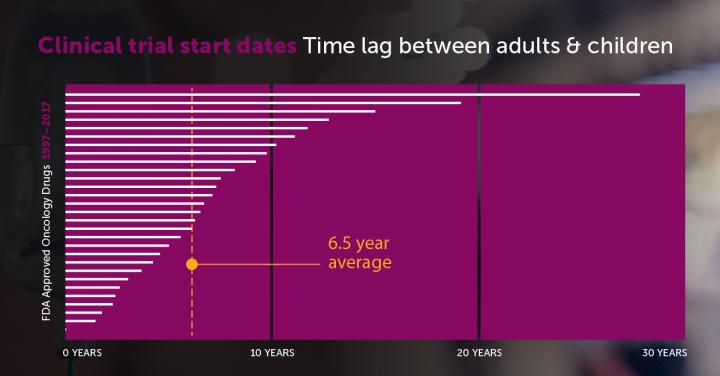
Cancer drugs approved by the U.S. Food and Drug Administration (FDA) took a median of 6.5 years to go from the first clinical trial in adults to the first trial in children, according to a study at the Dana-Farber/Boston Children’s Cancer and Blood Disorders Center. The study was published in the May issue of the European Journal of Cancer.

“Despite knowing that these agents are effective anticancer drugs, it’s taking too long to even start studying these therapies in children,” says Steven G. DuBois, MD, Dana-Farber/Boston Children’s Cancer and Blood Disorders Center, corresponding author on the study. “As a doctor taking care of young cancer patients, this is tremendously frustrating. If I were a parent of a child with cancer, I wouldn’t stand for this.”

The team at Dana-Farber/Boston Children’s conducted a systematic analysis of the time from first-in-human trials to first-in-child trials of agents first approved by the FDA for any oncology indication from 1997 to 2017. The investigators utilized clinical trials registry data, published literature and oncology abstracts to identify relevant trials and start dates.

Delayed pediatric trials

In that timeframe, 126 drugs received initial FDA approval for an oncology indication. After excluding hormonal modulators (not relevant to children’s cancers), 117 agents remained for analysis. Fifteen of 117 drugs (12.8%) had not yet had a pediatric trial, while 6 of 117 drugs (5.1%) included children in the initial FDA approval.

The data showed a median 6.5-year lag between first-in-human and first-in-child clinical trials, with a range of 0 to 27.7 years.

“Some may argue that this lag is appropriate to ensure safety of a vulnerable pediatric population and to only study agents in children that are on a path to FDA approval, based upon activity in adults with cancer,” says DuBois. “Others may argue that this lag is too long for children with life-threatening diseases and that some agents that fail in adult indications may nevertheless prove to be important drugs for pediatric indications.”

In the U.S., the recent RACE for Children Act strengthens the requirement that new cancer therapies with potential biological relevance to pediatric cancers be evaluated in children. This study can serve as a benchmark as this new policy is enacted, says DuBois.

###

Coauthors on the paper were Dylan V. Neel, Harvard Medical School student, and David S. Shulman, MD, from Dana-Farber/Boston Children’s. The study was supported by Alex’s Lemonade Stand Foundation and the National Institutes of Health.

About Dana-Farber/Boston Children’s Cancer and Blood Disorders Center

Dana-Farber/Boston Children’s Cancer and Blood Disorders Center – one of the nation’s top pediatric cancer centers, according to U.S. News & World Report – brings together two internationally known research and teaching institutions that have provided comprehensive care for pediatric oncology and hematology patients since 1947. The Harvard Medical School affiliates share a clinical staff that delivers inpatient care at Boston Children’s Hospital and most outpatient care at Dana-Farber Cancer Institute. Follow the Center on Twitter at @childcancercare.

Media Contact
Peter Cohenno
[email protected]

Related Journal Article

http://dx.doi.org/10.1016/j.ejca.2019.02.011

Tags: cancerClinical TrialsMedicine/HealthPediatricsPharmaceutical SciencePolicy/Ethics
Share12Tweet8Share2ShareShareShare2

Related Posts

Unveiling Dark Matter Through Molecular Insights — Chemistry

Unveiling Dark Matter Through Molecular Insights

May 11, 2026
From Touch to Sight: A Bioinspired Multisensory Framework Endows Robots with Human-Like Perception — Chemistry

From Touch to Sight: A Bioinspired Multisensory Framework Endows Robots with Human-Like Perception

May 11, 2026

Announcing the 2026 Carbon Future Young Investigator Award Winners

May 11, 2026

Innovative Photocatalytic Approach Distinguishes Reactant Activation from Product Release

May 11, 2026
Please login to join discussion

POPULAR NEWS

  • Research Indicates Potential Connection Between Prenatal Medication Exposure and Elevated Autism Risk

    841 shares
    Share 336 Tweet 210
  • New Study Reveals Plants Can Detect the Sound of Rain

    728 shares
    Share 290 Tweet 182
  • Salmonella Haem Blocks Macrophages, Boosts Infection

    62 shares
    Share 25 Tweet 16
  • Breastmilk Balances E. coli and Beneficial Bacteria in Infant Gut Microbiomes

    57 shares
    Share 23 Tweet 14

About

We bring you the latest biotechnology news from best research centers and universities around the world. Check our website.

Follow us

Recent News

Innovative Dense Eutectic Zr-Ta-O/YSZ Core-Shell Double-Layer Coating Boosts CMAS Resistance Through Dynamic Sealing and Self-Removal

BESSY II Reveals How Intrinsic Oxygen Reduces the Lifespan of Solid-State Batteries

Unveiling Dark Matter Through Molecular Insights

Subscribe to Blog via Email

Enter your email address to subscribe to this blog and receive notifications of new posts by email.

Join 82 other subscribers
  • Contact Us

Bioengineer.org © Copyright 2023 All Rights Reserved.

Welcome Back!

Login to your account below

Forgotten Password?

Retrieve your password

Please enter your username or email address to reset your password.

Log In
No Result
View All Result
  • Homepages
    • Home Page 1
    • Home Page 2
  • News
  • National
  • Business
  • Health
  • Lifestyle
  • Science

Bioengineer.org © Copyright 2023 All Rights Reserved.