Of nearly 500 patients seen at CHOP’s Pediatric Thyroid Center, very few needed to return to the OR
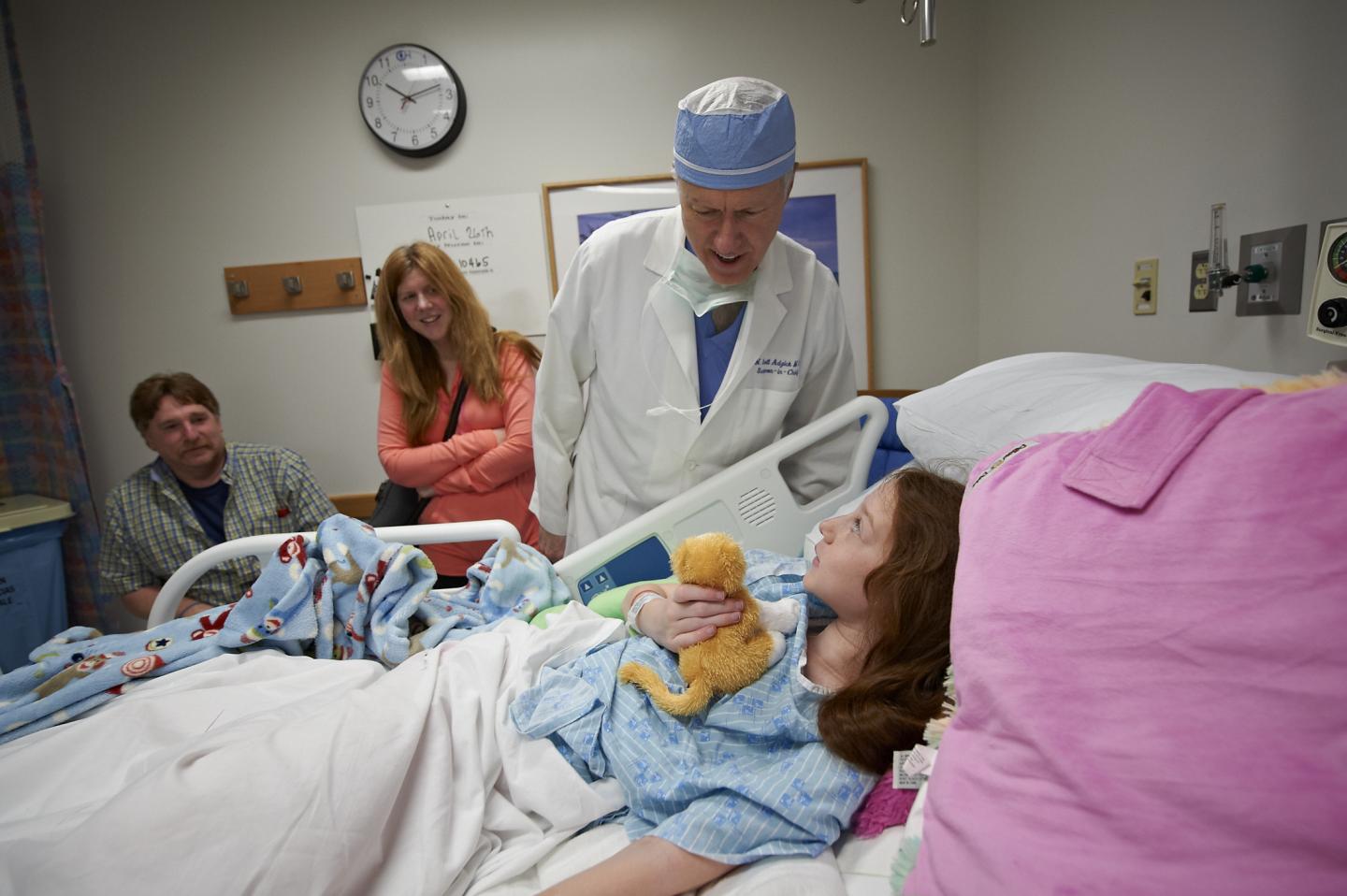
Credit: Children’s Hospital of Philadelphia
Philadelphia, April 4, 2019 — New research recently published in the Journal of Pediatric Surgery found that post-operative success rates of pediatric thyroid patients, particularly children who require a thyroidectomy, correlate with the institution’s patient volume. The study, conducted by a team at Children’s Hospital of Philadelphia (CHOP), reviewed nearly 500 cases. The findings underscore how a highly experienced clinical team can make a big difference when it comes to patient outcomes.
Since thyroid disease is less common in children than adults, pediatric surgery specialists often have less experience in managing thyroid disease. Other studies have reported an increased risk of complications for children undergoing thyroid surgery, with patients about 3.5 times more likely than adults to be readmitted and receive care that does not conform to national guidelines. For many patients, surgery is often a necessity, as is the case for patients with thyroid cancer where surgical removal of the thyroid and regional lymph nodes is the most important initial step in care after the diagnosis is confirmed by fine needle aspiration biopsy. Surgery is also commonly performed for patients with Graves’ disease, an autoimmune disorder that causes hyperthyroidism (overactive thyroid), since less than 30 percent of pediatric patients with Graves’ disease achieve remission.
“The Pediatric Thyroid Center at CHOP is the busiest center of its kind in the United States,” said N. Scott Adzick, MD, Surgeon-in-Chief of CHOP and senior author of the study. “Our highly skilled team performs at least 80 thyroid surgeries each year, along with the evaluation and management of care for hundreds of patients. We wanted to measure the advantages of being in a high-volume center and examine what that means for patient outcomes both before and after surgery.”
The study team reviewed medical records of 464 pediatric patients undergoing thyroid surgery at CHOP between 2009 and 2017. Data collection focused on pathologic diagnosis, surgical technique, and surgical complications. The patients were diagnosed with papillary or follicular thyroid cancer (n=168), benign modules (n=151), Graves’ disease (n=124), medullary thyroid cancer (n=14), and seven patients underwent a prophylactic thyroidectomy for multiple endocrine neoplasia, type 2A (MEN2a), which is characterized by medullary carcinoma of the thyroid. Surgery for papillary thyroid cancer included lymph node dissections based on the extent of disease.
Complication rates after thyroidectomy in 464 pediatric patients are the lowest ever reported. Only two patients demonstrated a persistent recurrent laryngeal nerve deficit at 6 months postoperatively (0.4%), and two patients had persistent hypoparathyroidism 6 months after total thyroidectomy (0.6%). There was no significant difference in either hypocalcemia or hypoparathyroidism after total thyroidectomy based on the patient’s age or diagnosis.
“We reported extremely low complication rates after surgery, underscoring that a high-volume center with specialized pediatric surgeons well-versed in these procedures should be considered for children and adolescents who require surgery for thyroid disease,” said Andrew J. Bauer, MD, an endocrinologist and Medical Director of the Pediatric Thyroid Center at CHOP and one of the co-authors of the study. “By seeing a higher volume of patients, our team is extremely skilled at ensuring an accurate and complete pre-operative evaluation, and selecting the best surgical plan for each patient based on their diagnosis. This approach is associated with optimizing outcomes while at the same time reducing complications for our patients and families.”
###
Baumgarten et al, “Surgical management of pediatric thyroid disease: Complication rates after thyroidectomy at the Children’s Hospital of Philadelphia high-volume Pediatric Thyroid Center.” J Pediatr Surg, online Feb. 28, 2019. doi.org/10.1016/j.jpedsurg.2019.02.009.
About Children’s Hospital of Philadelphia: Children’s Hospital of Philadelphia was founded in 1855 as the nation’s first pediatric hospital. Through its long-standing commitment to providing exceptional patient care, training new generations of pediatric healthcare professionals, and pioneering major research initiatives, Children’s Hospital has fostered many discoveries that have benefited children worldwide. Its pediatric research program is among the largest in the country. In addition, its unique family-centered care and public service programs have brought the 564-bed hospital recognition as a leading advocate for children and adolescents. For more information, visit http://www.
Media Contact
Ashley Moore
[email protected]
Related Journal Article
http://dx.