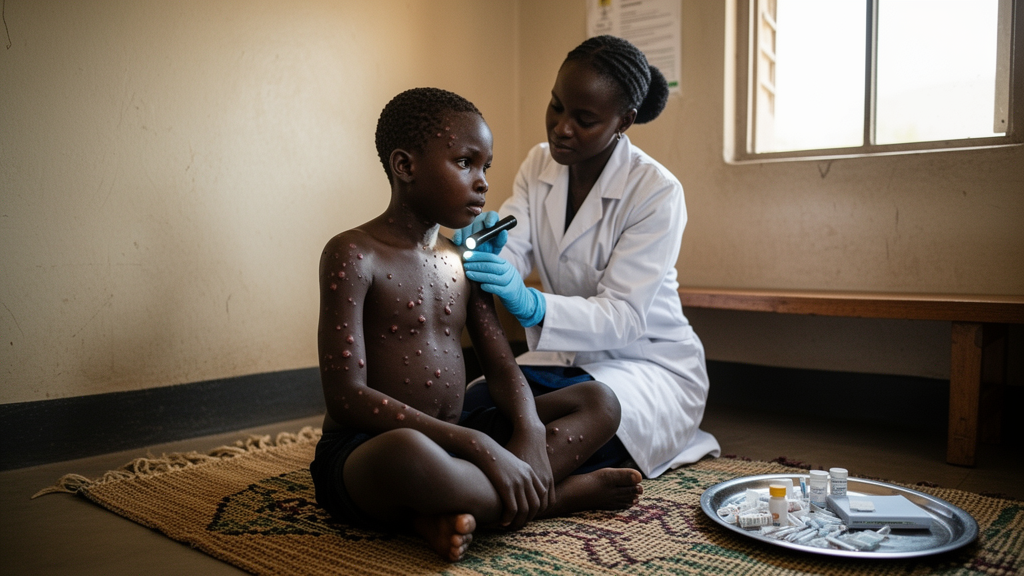
During Sierra Leone’s 2025 mpox epidemic, more than half of the patients who met the clinical case definition for mpox but tested negative for the mpox virus were carrying other rash-causing pathogens, with varicella-zoster virus — the agent of chickenpox and shingles — accounting for the vast majority of those detections. That is the central finding of a retrospective laboratory-based surveillance study published in New Microbes and New Infections, which screened samples from MPXV-negative suspected mpox cases using two commercial multiplex PCR panels across eight health districts.
The study was conducted between June 16 and August 27, 2025, as part of the national epidemic response. Two mobile laboratories, deployed at the regional hospital in Port Loko and at the Koinadugu District Government Hospital, processed clinical specimens — predominantly lesion swabs, along with a small number of vaginal swabs and crust samples — from patients meeting the World Health Organization mpox case definition. During active case searching, the definition was broadened to include anyone presenting with a severe rash, even if other criteria were not met.
In total, 407 suspected mpox cases were sampled and tested for MPXV by quantitative PCR during the study window. Of these, 144 were positive, corresponding to a positivity rate of 35.7 percent, and were excluded from the differential analysis. The remaining 263 MPXV-negative samples — 252 lesion swabs, seven vaginal swabs, and four crust samples — all passed an endogenous control quality check and were retained for further testing.
The researchers used the Allplex Meningitis-V1 Assay, previously validated on cutaneous samples with next-generation sequencing, to detect seven herpesviruses: herpes simplex virus types 1 and 2, varicella-zoster virus, Epstein-Barr virus, cytomegalovirus, and human herpesviruses 6 and 7. A second panel, the Allplex Genital Ulcer Assay, targeted the bacteria Haemophilus ducreyi, Treponema pallidum, and Chlamydia trachomatis, the causative agent of lymphogranuloma venereum, alongside overlapping viral targets. A sample was considered positive if a target was detected with a cycle threshold value below 35, and weak or late amplification signals were re-tested in duplicate. For the four targets covered by both panels, duplicate testing yielded 100 percent concordance.
The results showed that at least one target was identified in 153 of the 263 samples, an overall detection rate of 58.2 percent. Varicella-zoster virus was by far the most frequently detected pathogen, found in 43.3 percent of patients (114 of 263; 95 percent confidence interval 37.3 to 49.6). Among the other herpesviruses, HSV-2 showed the highest detection frequency at 7.2 percent, followed by cytomegalovirus at 6.85 percent and Epstein-Barr virus at 6.1 percent. Lower rates were recorded for HHV-7 (4.6 percent), HSV-1 (1.9 percent), and HHV-6 (0.4 percent). Among bacterial targets, Haemophilus ducreyi was detected in 1.1 percent of cases, while every sample tested negative for Treponema pallidum and Chlamydia trachomatis.
The study population was young: ages ranged from 1 to 80 years with a median of 18 years, and 44.5 percent of participants were aged 15 or younger. Gender information was available for 259 participants, of whom 58.7 percent were male. Statistically significant associations with age emerged for Epstein-Barr virus and HSV-2, both detected at higher proportions in older age groups, with detection rising progressively across the three age strata. Cytomegalovirus and Epstein-Barr virus were the only pathogens showing significant sex-based differences, both more frequent among females. Varicella-zoster virus showed no significant demographic associations, although nearly 48 percent of children aged 15 or younger tested positive compared with 39 percent of patients over 30, a difference that did not reach statistical significance.
Co-detections were common and often complex. Combinations involving varicella-zoster virus were the most frequent, occurring in 19 samples, most often alongside HSV-2 and cytomegalovirus. One sample was positive for five herpesviruses simultaneously — varicella-zoster virus, cytomegalovirus, HSV-2, HHV-7, and Epstein-Barr virus — and two samples carried triple viral infections. Haemophilus ducreyi was exclusively co-detected with varicella-zoster virus, on two occasions, a molecular co-detection the authors describe as rarely reported. Among co-detections not involving varicella-zoster virus, nine of ten included Epstein-Barr virus. The authors caution that, given the small numbers, no inference about biological interaction between co-detected pathogens can be made.
Geographically, the highest sample numbers came from Port Loko and Tonkolili, and detections of at least one target exceeded undiagnosed cases in five of the eight surveyed districts. Varicella-zoster virus was the only pathogen identified in every district where positive cases were found, with the largest counts in Koinadugu, Falaba, and Port Loko. The distribution of other pathogens varied: HSV-2 and cytomegalovirus clustered in Port Loko and Tonkolili, Epstein-Barr virus in Kambia, and HHV-7 in Kambia and Bombali.
One observation carries particular public health weight. The retrospective screening identified Haemophilus ducreyi in three samples collected months before an outbreak of Haemophilus ducreyi-associated skin ulceration was officially declared in Sierra Leone for the first time in December 2025, with the reported likely index case showing symptom onset on October 1, 2025. The authors stress that their findings do not establish an epidemiological link between these three patients and the subsequent outbreak, but they argue that real-time differential testing could potentially have provided an early warning signal prompting further investigation.
The study has notable limitations. Samples and epidemiological data were originally collected for the mpox response, leaving critical clinical information — including symptoms, HIV status, and patient outcomes — incomplete, so the clinical impact of co-detections could not be assessed. MPXV-positive samples were not included in the differential testing, sequencing was not performed, and the study period covered neither the entire outbreak timeline nor every district in Sierra Leone. The authors also note that pathogen distributions can vary seasonally, meaning the findings represent a temporal snapshot rather than a complete annual profile, which may partly explain the absence of Chlamydia trachomatis and Treponema pallidum detections. Even so, the results demonstrate the feasibility of integrating multiplex molecular screening into outbreak response, particularly when combined with mobile laboratory deployment, to reduce diagnostic dead ends and uncover pathogens circulating beneath the epidemiological signal of a dominant outbreak agent.
Subject of Research: Retrospective multiplex PCR screening of MPXV-negative suspected mpox cases in Sierra Leone in 2025 to identify alternative viral and bacterial pathogens.
Article Title: Molecular detection of potential alternative pathogens among MPXV-negative suspected mpox cases in Sierra Leone, 2025
Article References: Harding, D., Ndiaye, M., Faye, M., Gaye, A., Top, F. K., Barry, M. A., Campbell, A. K. O., Kane, M., Chalobah, F., Fofanah, A., Ruhweza, S., Diouf, A. M., Koninga, K., Diagne, M. M., Cissé, M., Koroma, A., Faye, O., Dia, N., Loucoubar, C., … Norman, J. A. (2026). Molecular detection of potential alternative pathogens among MPXV-negative suspected mpox cases in Sierra Leone, 2025. New Microbes and New Infections, 74, Article 101872. https://doi.org/10.1016/j.nmni.2026.101872
Image Credits: AI Generated
DOI: 10.1016/j.nmni.2026.101872
Keywords: mpox, Sierra Leone, varicella-zoster virus, multiplex PCR, herpesviruses, Haemophilus ducreyi, surveillance, mobile laboratories, MPXV-negative cases, rash illness, outbreak response, differential diagnosis
News Source: Kristina Jarvis. (October 29, 2026). Chickenpox Virus Dominated Rash Illnesses Mistaken for Mpox in Sierra Leone. Scienmag.