KIT coordinates Germany-wide DFG Priority Program — Investigation of catalytic systems under fluctuating operation conditions when using wind and solar energy
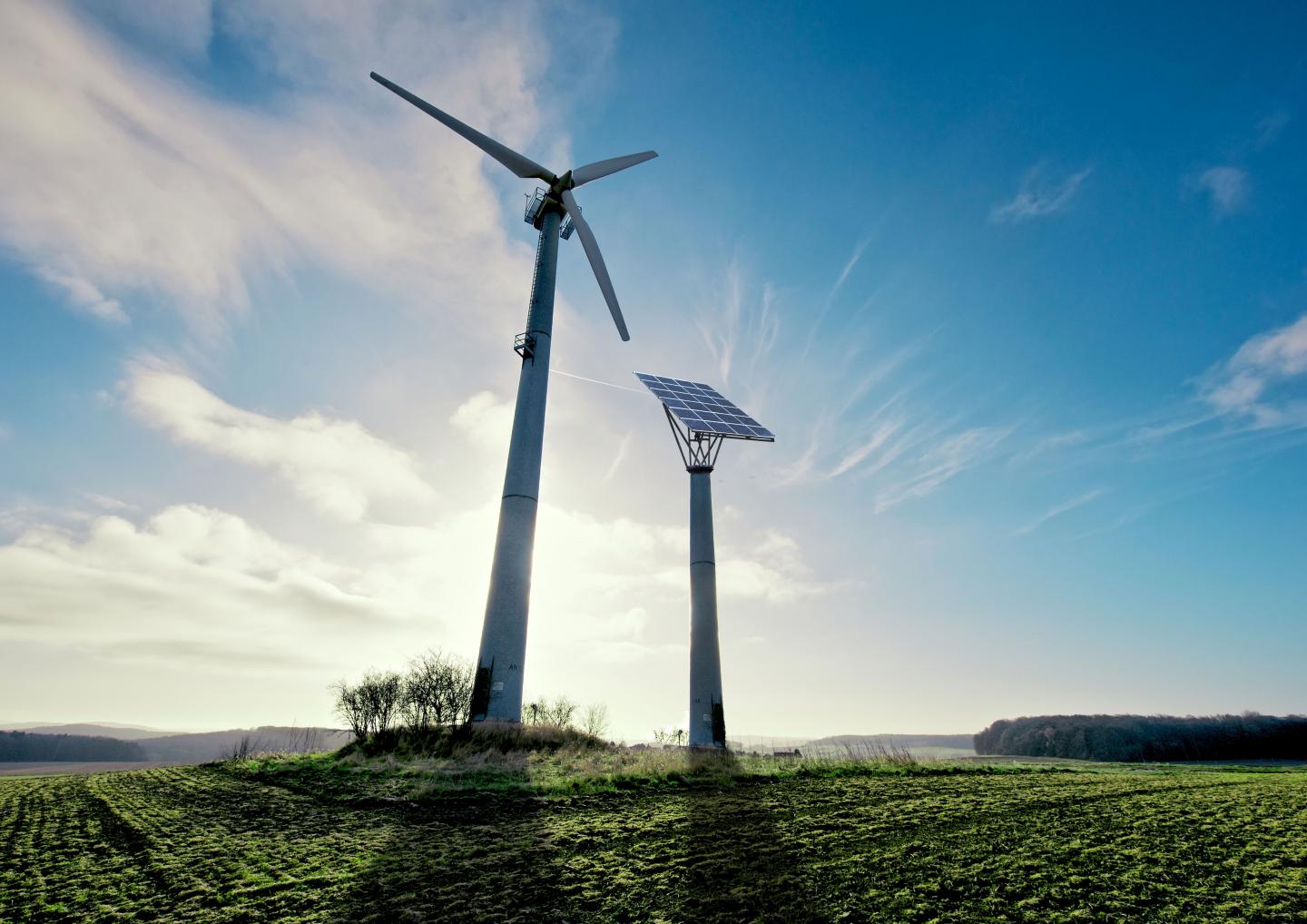
Credit: photo: Pascal Armbruster, KIT
In 2050, 80% of the electric power in Germany has to be based on renewable resources. To reach this goal, it is required to store electric power in the form of chemical energy carriers. Within the priority program “Catalysts and Reactors under Dynamic Conditions for Energy Storage and Conversion” (SPP 2080, DynaKat) funded by the German Research Foundation (DFG), twelve big research consortia study how catalytic reaction systems behave under such conditions. The priority program is coordinated by Karlsruhe Institute of Technology (KIT).
Apart from biomass, sun and wind are the most important renewable energy carriers, but their availability is fluctuating considerably. On windy and sunny days, the amount of electric power produced exceeds the amount that can be fed into the grid. This overproduction of wind power and photovoltaic facilities can be stored in chemicals. Later on, electric power can be made available again or the chemicals can be used as sustainable feedstocks for the production of fuels or platform molecules for chemical industry.
For the conversion of carbon dioxide or hydrogen into energy-storage molecules, such as methane, hydrocarbons, or alcohols, catalysts, electrochemical cells, and reactors are required. However, the influence of dynamic external conditions on catalytic reaction systems, for example caused by fluctuating wind and solar power, has hardly been studied so far. “But we know that the structure of solid catalysts and, hence, their catalytic activity can vary considerably under changing reaction conditions. This is a highly fascinating scientific topic,” says Professor Jan-Dierk Grunwaldt of KIT’s Institutes for Chemical Technology and Polymer Chemistry (ITCP) and of Catalysis Research and Technology (IKFT). The holder of the Chair for Chemical Technology and Catalysis coordinates the DFG Priority Program SPP2080 DynaKat in which, apart from KIT, a number of renowned research institutions from all over Germany are involved, like the Forschungszentrum Jülich, TU Munich, and several Max Planck Institutes, including the Fritz Haber Institute in Berlin. The kickoff meeting with more than 70 participants took place in Karlsruhe in February this year. The twelve interdisciplinary, nationwide research projects are divided into 34 subprojects. Seven of these subprojects are executed by KIT institutes, namely, ITCP, IKFT, and the Institute for Micro Process Engineering (IMVT). DFG will fund the DynaKat Priority Program scheduled for a duration of six years with EUR 8.5 million for three years initially. The institution which attracted the largest number of projects within the SPP2080 is KIT.
“We want to understand and then optimize the catalytic materials to be efficiently used under dynamic conditions,” says Dr. Erisa Saraçi, senior scientist at IKFT and co-organizer of the kickoff meeting at KIT. For this purpose, all processes are studied from the phenomena at the atomic level of the catalyst to the spatial distribution of feed concentrations and to temperature variations on the reactor level. For a basic understanding of processes and development of new materials and reactor designs, classical, established experiments as well as latest spectroscopic methods and modeling approaches are applied.
Integration of early-career researchers plays an important role in the DynaKat DFG Priority Program. At KIT, a block course on “Technologies and Resources for Renewable Energies: From Wind and Solar to Chemical Energy Carriers” is organized for interested students and doctoral researchers. “In research, you will not advance without networking and team work, as the individual sub-disciplines are highly complex,” says Sebastian Weber, doctoral researcher of IKFT/ITCP. Both Saraçi and Weber emphasize the importance of exchanging and combining interdisciplinary expertise. “It is all about bundle competencies and advancing the topic in Germany in order to reach a leading position on an international level,” says program coordinator Grunwaldt.
###
Details on the Priority Program: http://www.
More information on coordinator Jan-Dierk Grunwaldt: http://www.
More about the KIT Energy Center: http://www.
Press contact:
Dr. Martin Heidelberger
Press Officer
Phone: +49 721 608-21169
Email: [email protected]
Being “The Research University in the Helmholtz Association,” KIT creates and imparts knowledge for the society and the environment. It is the objective to make significant contributions to the global challenges in the fields of energy, mobility and information. For this, about 9,300 employees cooperate in a broad range of disciplines in natural sciences, engineering sciences, economics, and the humanities and social sciences. KIT prepares its 25,100 students for responsible tasks in society, industry, and science by offering research-based study programs. Innovation efforts at KIT build a bridge between important scientific findings and their application for the benefit of society, economic prosperity, and the preservation of our natural basis of life.
This press release is available on the internet at http://www.
Media Contact
Monika Landgraf
[email protected]
Original Source
https:/