Marking trees are important hotspots of communication for cheetahs: Here they exchange information with and about other cheetahs via scent marks, urine and scats. A team from the Cheetah Research Project of the Leibniz Institute for Zoo and Wildlife Research (Leibniz-IZW) now showed that several mammalian species on farmland in Namibia maintain a network for intra- and interspecific communication at cheetah trees. Black-backed jackals, African wildcats and warthogs visited and sniffed the cheetahs’ “places to be” more frequently than control trees, the team concluded from photos and videos recorded by wildlife camera traps in a paper in the scientific journal “Mammalian Biology”. A common prey species of the cheetahs, however, avoided these hotspots.
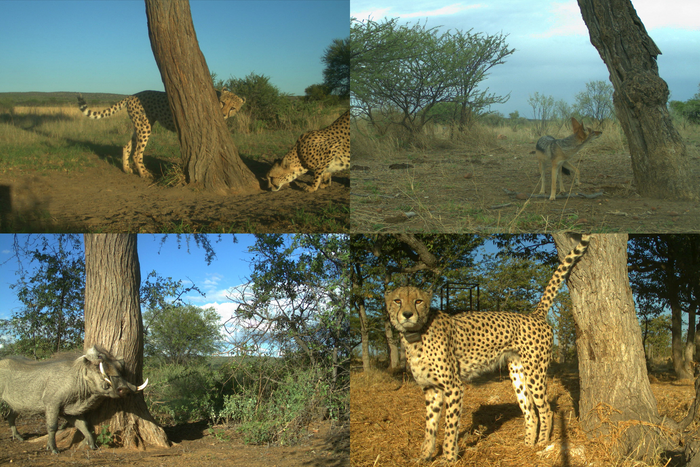
Credit: photos: Leibniz-IZW Cheetah Research Project team
Marking trees are important hotspots of communication for cheetahs: Here they exchange information with and about other cheetahs via scent marks, urine and scats. A team from the Cheetah Research Project of the Leibniz Institute for Zoo and Wildlife Research (Leibniz-IZW) now showed that several mammalian species on farmland in Namibia maintain a network for intra- and interspecific communication at cheetah trees. Black-backed jackals, African wildcats and warthogs visited and sniffed the cheetahs’ “places to be” more frequently than control trees, the team concluded from photos and videos recorded by wildlife camera traps in a paper in the scientific journal “Mammalian Biology”. A common prey species of the cheetahs, however, avoided these hotspots.
Many mammalian species use scent marks, urine or scats to communicate with each other. By doing so, animals leave, receive and exchange information on territory ownership, reproductive receptiveness, health status or diet. Whether and how such olfactory communication is also used by other species than the one having placed the information is not well understood. Scientists from the Leibniz-IZW Cheetah Research Project now observed nine cheetah marking trees and nine similarly looking control trees on farmland in Namibia with wildlife camera traps. They found that some species visited and sniffed cheetah marking trees more frequently than control trees, suggesting they gain important information from cheetah markings. Other species exchanged information at the same frequency at cheetah marking trees and control trees. This indicates that they used prominent trees for their own communication. The scientists concluded that mammals on Namibian farmland maintain communication networks within and between species
During the 65-day survey period, 29 mammalian species visited the cheetah marking and the control trees. There was a higher diversity of species at cheetah marking trees than control trees, but most species visited the trees only a few times. For the analyses only species which visited, sniffed or marked the trees at least 20 times were included. In this subset, 13 species visited, 9 species sniffed and 1 species left information at the cheetah marking and control trees.
With African wild cats (Felis lybica lybica), black-backed jackals (Lupulella mesomelas) and warthogs (Phacochoerus africanus) two small carnivore species and one omnivore rarely preyed by cheetahs visited and sniffed cheetah marking trees more frequently than control trees. „ Small carnivore species might visit cheetah marking trees to assess when cheetahs last visited the area and/or to feed on undigested prey remains in cheetah scats”, says Dr Sarah Edwards, first author of the paper. “Warthogs on the other hand are omnivores and opportunistic scavengers, so they might also feed on undigested prey remains in cheetah scats. Additionally, warthogs are the only species that left olfactory information and did this at the same frequency at cheetah marking and control trees. This suggests that warthogs use large trees as sites for their own communication”, Edwards adds.
In contrast, common duikers (Sylvicapra grimmia), a common and important cheetah prey species, visited cheetah marking trees less frequently than control trees. Leopards – the top predator in the study area – on the other hand, sniffed, urinated, scratched and rubbed body parts at both cheetah marking trees and control trees. “Although leopards visited the trees less than 20 times, it is possible that they used conspicuous trees for their own olfactory communication and at the same time demonstrated at cheetah marking trees their presence towards cheetahs”, says Dr Bettina Wachter, senior author of the paper and head of the Cheetah Research Project.
Interspecific communication has mainly been described between prey and predator or between carnivore species. It often involves prey animals or small carnivores that sniff at markings from predators. While prey animals normally do not mark at predator marking sites, small carnivores and other predator species might counter-mark existing scent marks. If counter-marking is done at conspicuous sites, it might be directed to conspecifics rather than to different species. “In our investigation, we monitored nine cheetah marking trees and nine similar looking control trees nearby on farmland in central Namibia with wildlife cameras. These trees were all conspicuous, isolated, prominent specimens, typical for cheetah marking trees. We used this paired tree setup to investigate whether mammalian species visit these trees for interspecific and/or intraspecific communication”, explains Dr Jörg Melzheimer, initiator of the wildlife camera trap survey.
By using a paired survey design, the scientists demonstrated that some species gain important information from other mammalian species. “Thus, it is likely that mammals maintain communication networks across species”, Wachter and Melzheimer conclude. “These networks might be laid out along cheetah marking trees and also along communication locations of other species such as latrines of brown hyenas or spotted hyenas. Investigations on the interspecific communication of various species in different populations and ecosystems will likely uncover more details on the complexities of communication networks.”
In a previous paper, Melzheimer, Wachter, and colleagues showed that marking trees are important hotspots of intraspecific communication for cheetahs and how they work. They used this to demonstrate that detailed knowledge of the spatial ecology and communication of the big cats can help reduce human-wildlife conflicts. This work was published in December 2020 in the “Proceedings of the National Academy of Sciences of the United States of America”.
Journal
Mammalian Biology
DOI
10.1007/s42991-022-00284-w
Method of Research
Observational study
Subject of Research
Animals
Article Title
Cheetah marking sites are also used by other species for communication: evidence from photographic data in a comparative setup
Article Publication Date
16-Sep-2022