• HOME
  • NEWS
  • EXPLORE
    • CAREER
      • Companies
      • Jobs
    • EVENTS
    • iGEM
      • News
      • Team
    • PHOTOS
    • VIDEO
    • WIKI
  • BLOG
  • COMMUNITY
    • FACEBOOK
    • INSTAGRAM
    • TWITTER
Sunday, May 10, 2026
BIOENGINEER.ORG
No Result
View All Result
  • Login
  • HOME
  • NEWS
  • EXPLORE
    • CAREER
      • Companies
      • Jobs
        • Lecturer
        • PhD Studentship
        • Postdoc
        • Research Assistant
    • EVENTS
    • iGEM
      • News
      • Team
    • PHOTOS
    • VIDEO
    • WIKI
  • BLOG
  • COMMUNITY
    • FACEBOOK
    • INSTAGRAM
    • TWITTER
  • HOME
  • NEWS
  • EXPLORE
    • CAREER
      • Companies
      • Jobs
        • Lecturer
        • PhD Studentship
        • Postdoc
        • Research Assistant
    • EVENTS
    • iGEM
      • News
      • Team
    • PHOTOS
    • VIDEO
    • WIKI
  • BLOG
  • COMMUNITY
    • FACEBOOK
    • INSTAGRAM
    • TWITTER
No Result
View All Result
Bioengineer.org
No Result
View All Result
Home NEWS Science News Biology

Cheap and simple detection of neurotoxic chemicals

Bioengineer by Bioengineer
August 1, 2017
in Biology
Reading Time: 2 mins read
0
Share on FacebookShare on TwitterShare on LinkedinShare on RedditShare on Telegram
IMAGE

Credit: Professor Toshihiro Ihara

There is a limited amount of data on the global health impacts of pesticides, but many injuries and deaths worldwide can be attributed to their misuse. Pesticide contamination of food and water sources is a very serious problem, particularly in third world countries. The detection of these chemicals in the body using cheap and simple methods is a high priority.

Relatively easy methods for analyzing fat soluble chemical compounds are already known. Water soluble pesticides, on the other hand, are slightly more complicated. They often need troublesome pretreatments such as extraction and derivatization prior to instrumental analysis such as gas chromatography/mass spectrometry (GC/MS) and liquid chromatography/mass spectrometry (LC/MS), which is why researchers from Kumamoto University, Konan University, and the Nagasaki Prefectural Police in Japan began examining simpler methods for toxin detection. They focused on Nereistoxin (NRT), a natural neurotoxin found in several pesticides. Typical analysis for NRT requires the use of high performance detectors.

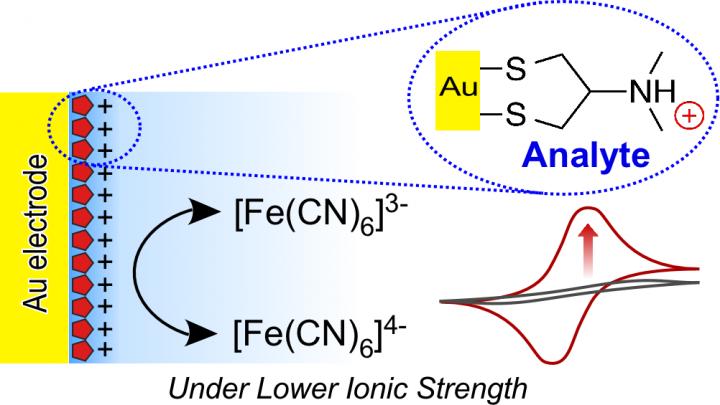
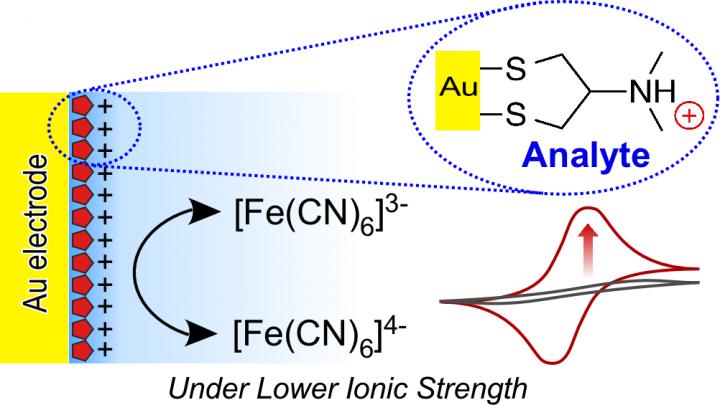
The researchers showed that NRTs adsorbed on the surface of a gold electrode (via an Au-S bond) produced an easily distinguishable electrochemical response that, in the presence of a ferricyanide (0.5 millimolar (mM)) marker anion, was more sensitive than a non-treated gold electrode. A critical condition for this electrochemical technique is an abnormally low electrolyte concentration (1.0 mM KCl). Under these low concentrations, the bare electrode measured a current of nearly zero microamps, whereas an electrode with a surface NRT layer significantly accelerated the electrical response. The NRT layer compensated greatly for the handicap that comes with low KCl levels. This research is valuable not only for its usefulness as a simple and practical sensor, but also for providing a new principle in physical chemistry for sensors.

After confirming the feasibility of the method on other NRT-related neurotoxic pesticides (Cartap, Thiocyclam, and Bensultap) the researchers assessed its ability to detect neurotoxins in human serum. "We initially found an unidentified current when we tested the control serum, but it was quickly eliminated after washing the electrode with sodium hydroxide," said Professor Toshihiro Ihara, leader of the research project. "Fortunately, this was the only treatment required for the detection of 1-25 micro-grams of NRT per milliliter of human serum, which is the sensitivity required to detect NRT poisoning from pesticides and other sources. Other techniques are more complicated, take more time, or use much more complicated materials. We hope that our technique will open doors to other cheap and simple detection methods."

This research may be found in the American Chemical Society's online journal Analytical Chemistry.

###

[Reference]

Shimada, H.; Noguchi, S.; Yamamoto, M.; Nishiyama, K.; Kitamura, Y. & Ihara, T., Electrochemical Sensing of Neurotoxic Agents Based on Their Electron Transfer Promotion Effect on an Au Electrode, Analytical Chemistry, American Chemical Society (ACS), 2017, 89, 5742-5747. DOI: 10.1021/acs.analchem.6b04229

Media Contact

J. Sanderson
[email protected]

http://ewww.kumamoto-u.ac.jp/en/news/

Related Journal Article

http://dx.doi.org/10.1021/acs.analchem.6b04229

Share12Tweet8Share2ShareShareShare2

Related Posts

Ancient Plant Populations Reveal Fresh Insights into Climate Resilience — Biology

Ancient Plant Populations Reveal Fresh Insights into Climate Resilience

May 8, 2026
Rare Brain Disorders in Children Linked to Mutations in Lesser-Known Protein Complex — Biology

Rare Brain Disorders in Children Linked to Mutations in Lesser-Known Protein Complex

May 8, 2026

From Odd Insect to Underwater Predator: The Remarkable Evolution of a Bloodthirsty Fruit Fly

May 8, 2026

SNU Professor Sangwoo Seo’s Team Develops Next-Generation CRISPR Biocontainment Technology to Control Microbial Survival Without DNA Cleavage

May 8, 2026
Please login to join discussion

POPULAR NEWS

  • Research Indicates Potential Connection Between Prenatal Medication Exposure and Elevated Autism Risk

    840 shares
    Share 336 Tweet 210
  • New Study Reveals Plants Can Detect the Sound of Rain

    727 shares
    Share 290 Tweet 181
  • Scientists Investigate Possible Connection Between COVID-19 and Increased Lung Cancer Risk

    68 shares
    Share 27 Tweet 17
  • Salmonella Haem Blocks Macrophages, Boosts Infection

    61 shares
    Share 24 Tweet 15

About

We bring you the latest biotechnology news from best research centers and universities around the world. Check our website.

Follow us

Recent News

Urdu Fall Risk Questionnaire Adapted for Elderly

Key Pharmacological Markers for HIV Prevention in MSM

Taking 8,500 Steps Daily May Aid Long-Term Weight Management, Study Finds

Subscribe to Blog via Email

Success! An email was just sent to confirm your subscription. Please find the email now and click 'Confirm' to start subscribing.

Join 82 other subscribers
  • Contact Us

Bioengineer.org © Copyright 2023 All Rights Reserved.

Welcome Back!

Login to your account below

Forgotten Password?

Retrieve your password

Please enter your username or email address to reset your password.

Log In
No Result
View All Result
  • Homepages
    • Home Page 1
    • Home Page 2
  • News
  • National
  • Business
  • Health
  • Lifestyle
  • Science

Bioengineer.org © Copyright 2023 All Rights Reserved.