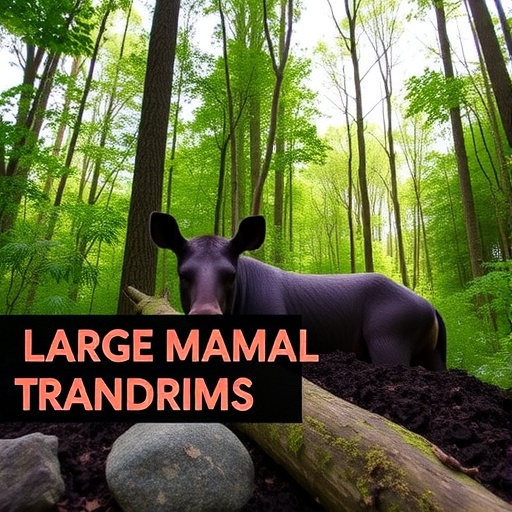
In Brazil’s Atlantic Forest, large mammals are doing far more than moving through the trees. Tapirs, peccaries, deer, and agoutis are acting as living agents of soil transformation, changing the chemistry of the forest floor and potentially increasing the availability of nutrients needed by plants. A new study published in Ecological Monographs has found that the presence of these animals alters litter decomposition, reduces harmful soil acidity, changes the availability of calcium and aluminum, and may improve the fertility of tropical forest soils. The findings reveal that protecting wildlife is not only about preserving individual species or preventing the loss of charismatic animals. It may also be essential for maintaining the invisible chemical processes that keep forests functioning.
The research focused on large terrestrial mammals whose ecological influence is often overlooked because much of their work takes place close to the ground. Herds of white-lipped peccaries can contain more than 100 animals, and when they move through the forest they repeatedly trample vegetation, disturb the soil, search for fallen fruits and seeds, and deposit urine and feces. Tapirs perform similar functions on a larger individual scale, while deer and agoutis contribute through feeding, movement, and the redistribution of organic material. Together, these animals act as ecosystem engineers: organisms that physically modify their environment in ways that affect many other species. Their activities connect animal behavior with decomposition, nutrient cycling, plant growth, and soil chemistry.
To measure this influence, researchers compared forest plots where mammals could move freely with plots enclosed by fences that prevented the entry of large animals. The experiment has been operating since 2009 in the Serra do Mar mountain range in São Paulo state. The latest analysis examined ten open plots and ten fenced plots in Carlos Botelho State Park, a protected area within the extensive Atlantic Forest mosaic of the Vale do Ribeira region. Each plot covered 15 square meters. Motion-triggered camera traps were used to estimate mammal activity and biomass, allowing the researchers to compare chemical changes in the litter and soil with the intensity of animal presence.
The differences between the two conditions were substantial. Soil from plots accessible to mammals was less acidic, showing higher pH values than soil from fenced plots. Soil pH measures the concentration of hydrogen ions and strongly influences how easily plants can absorb nutrients. In highly acidic soils, several elements become chemically unavailable to plants, while others can reach toxic concentrations. The researchers found important changes in calcium and aluminum, two elements closely linked to soil acidity. Calcium contributes to plant cell structure and nutrient balance, whereas soluble aluminum can damage roots and interfere with the uptake of phosphorus and other essential nutrients. Where large mammals were more active, aluminum levels declined and the chemical balance associated with greater fertility improved.
The animals also changed the physical and chemical character of leaf litter, the layer of leaves, branches, fruits, and seeds covering the forest floor. In mammal-accessible plots, researchers observed lower levels of lignin, a complex carbon-rich polymer that strengthens plant tissues and makes them resistant to microbial breakdown. Lignin acts like a protective coating around plant cell walls, slowing decomposition and delaying the release of nutrients into the soil. By trampling and stirring the litter, mammals break large pieces into smaller fragments and distribute them more evenly. This increases the surface area exposed to fungi, bacteria, and soil fauna, accelerating the decomposition of difficult plant material and allowing nutrients to return to the ecosystem more efficiently.
The composition of the litter itself was also more diverse in plots visited by mammals. Leaves, twigs, fruits, and seeds were present in more balanced proportions, rather than being dominated by a narrow category of plant debris. This matters because different types of litter decompose at different speeds and contain different concentrations of carbon, nitrogen, minerals, and structural compounds. A varied litter layer can support a broader community of decomposers and create a more continuous supply of nutrients. The physical disturbance caused by animals therefore appears to operate together with their feeding and waste deposition, producing a chain reaction that begins with movement on the forest floor and extends into microbial activity and plant nutrition.
The study’s authors describe these findings as part of a growing body of evidence that defaunation—the decline or disappearance of animal populations—can alter forests even when the trees remain standing. Previous work from the same long-term experiment has linked the absence of large herbivores to lower soil nitrogen, reduced plant diversity, and changes in interactions between plants and their natural enemies. Another recent study indicated that removing large mammals can make the forest more homogeneous by allowing a smaller number of plant species to dominate. The new results add soil biogeochemistry to that list, showing that wildlife loss may change not only which plants grow, but also the chemical environment in which all plants must live.
The implications extend beyond the Atlantic Forest, one of the world’s most threatened tropical ecosystems. Large mammals are among the animals most frequently targeted by hunters, and their populations have declined across much of their historical range. Forest fragments may therefore appear intact while silently losing the animals that maintain their ecological processes. Without peccaries, tapirs, deer, and agoutis, litter may remain less disturbed, decomposition may slow, soil acidity may increase, and nutrients may become less available. These changes could accumulate gradually, making them difficult to detect until plant communities and forest regeneration are already affected. Conservation strategies that focus only on forest cover may consequently underestimate the importance of restoring animal populations and maintaining their movement through protected landscapes.
The research is now moving below the soil surface. Lead author Letícia Gonçalves Ribeiro is analyzing nematodes, microscopic worm-like organisms that occupy several trophic levels in the soil food web. Some nematodes consume bacteria, others feed on fungi, and predatory species hunt nematodes and other small soil organisms. Preliminary results suggest that plots with large mammals contain more predatory nematodes, a pattern that may indicate a more complete and active soil food web. Because predators depend on the presence of organisms at lower trophic levels, their abundance can provide a biological signal of ecosystem condition. Although the nematode findings have not yet been formally published, they suggest that the influence of large mammals may reach from the visible litter layer to the microscopic organisms responsible for decomposition and nutrient turnover.
The central message of the long-term experiment is that large mammals are not merely consumers of forest resources. Through rooting, trampling, feeding, defecating, urinating, and transporting seeds, they reshape the pathways through which carbon and minerals move between plants, soil, and the atmosphere. Their presence can influence soil pH, reduce potentially toxic aluminum, alter lignin breakdown, diversify litter, and support a richer underground food web. In a biome where hunting continues to remove the animals capable of performing these functions, the study offers a striking warning: a forest can retain its trees while losing the wildlife that keeps its soil alive. Protecting large mammals may therefore be one of the most direct ways to preserve the chemical fertility and long-term resilience of tropical forests.
Subject of Research: The role of large mammals in altering litter decomposition, soil chemistry, nutrient cycling, and fertility in Brazil’s Atlantic Forest.
Article Title: Mammals’ zoogeochemical effects change litter and soil biogeochemistry in a tropical rainforest
Web References: https://esajournals.onlinelibrary.wiley.com/doi/10.1002/ecm.70070; CBioClima; FAPESP News
References: Ecological Monographs, DOI: 10.1002/ecm.70070. FAPESP-supported DEFAU-BIOTA project, “Effects of Defaunation on Soil Carbon and Functional Plant Diversity in the Atlantic Forest.”
Image Credits: Camera traps and Letícia Gonçalves Ribeiro/IB-UNESP
Keywords
Large mammals, Atlantic Forest, tapirs, peccaries, deer, agoutis, soil fertility, soil chemistry, litter decomposition, lignin, nutrient cycling, defaunation, ecosystem engineers, nematodes, tropical forests, biodiversity conservation
Tags: animal-driven soil nutrient dynamicsAtlantic Forest soil chemistryconservation and soil healthecosystem services of large terrestrial animalsforest ecosystem healthimpact of peccaries and tapirsLarge mammalsorganic matter redistribution by mammalssoil acidity reduction in foreststropical forest biodiversity and soil processestropical forest nutrient cyclingwildlife’s role in soil fertility