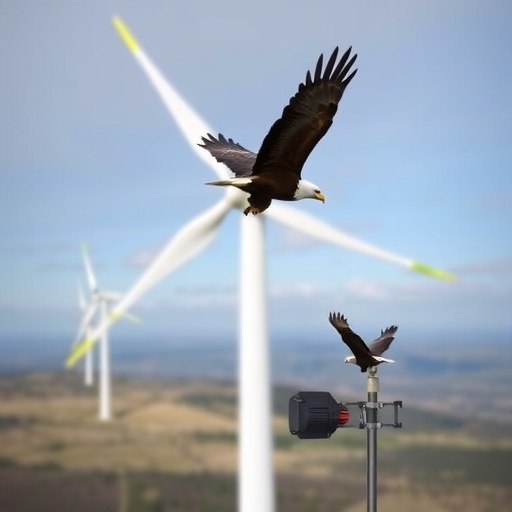
Wind turbines may soon have a new way to warn eagles and other large birds before they enter the most dangerous part of a wind farm. A study published in the Journal of Raptor Research reports that audio deterrent systems installed on commercial turbines persuaded approaching raptors to change course more than half the time. The technology, tested at wind-energy facilities in California and Washington, is designed to interrupt a bird’s flight before it reaches the rotating blades. The findings offer a potentially important tool for reducing wildlife deaths while allowing wind power to expand in regions where strong, reliable winds overlap with critical habitat for protected species.
The concern is particularly serious for large soaring birds, including Bald Eagles (Haliaeetus leucocephalus), Golden Eagles (Aquila chrysaetos), Turkey Vultures (Cathartes aura), and several hawk species. These birds often use rising air currents and strong winds to travel with minimal energy expenditure—the same atmospheric conditions that make many locations attractive for wind development. When a raptor approaches a turbine, however, its flight path can carry it into the rotor-swept zone, the three-dimensional area through which the blades travel. A bird entering this zone may have only seconds to detect the moving blades, understand the danger, and maneuver away. Even a highly capable flier may be unable to avoid a collision if the warning comes too late.
The new research examined DTBird audio deterrents at the Manzana Wind Power Project in southern California and the Goodnoe Hills Wind Farm in south-central Washington. The systems were configured to respond when an eagle- or hawk-sized raptor approached a turbine. Instead of relying solely on visual detection or shutting down the turbine, the technology attempted to alter the bird’s behavior acoustically. It emitted a warning signal described by researchers as a “whistle-whoop,” intended to attract the bird’s attention. If the situation warranted a stronger intervention, the system delivered a louder and more raucous dissuasion signal designed to discourage the bird from continuing toward the turbine.
Wildlife technicians evaluated the birds’ responses by reviewing video clips captured around the turbines. This approach allowed the research team to distinguish between different flight behaviors, such as continuing toward the rotor-swept zone, veering away, changing altitude, or passing safely around the turbine. The researchers then compared the responses with factors including species or size, wind conditions, and the apparent risk associated with each flight path. This behavioral framework is important because a bird that turns away from a turbine is not necessarily avoiding an imminent collision; it may already have been traveling along a safe route. The study therefore focused on whether the deterrents produced meaningful changes in approach behavior under varying levels of risk.
Across the two facilities, the audio systems dissuaded approaching raptors more than 50 percent of the time. Responses varied among birds, but the results included Golden Eagles, Bald Eagles, Turkey Vultures, and multiple hawk species. Larger species appeared more responsive when wind speeds were higher. One possible explanation is that stronger winds make turbine blades spin faster and become more visually conspicuous, while the acoustic warnings provide an additional signal that the structure is dangerous. High winds may also give large birds greater control and maneuverability, allowing them to combine the warning with a rapid change in direction or altitude.
The study also revealed why deterrent technology is unlikely to be a simple one-size-fits-all solution. Birds judged to be at relatively low risk of collision—those already traveling around a turbine or away from the rotor-swept zone—were less likely to respond to the sounds. That pattern is consistent with the idea that the system’s effect depends partly on a bird’s initial flight trajectory. More surprisingly, the birds at the greatest risk did not always show the strongest avoidance response. Researchers suggest that some of these birds may have been too close to the turbine, moving too quickly, or positioned in a way that left insufficient time to react effectively after the warning was delivered.
This timing problem is central to the biology and engineering of collision prevention. An audio signal can attract attention, but it cannot guarantee that a bird will interpret the sound correctly or have enough space to escape. The effectiveness of a deterrent depends on detection range, signal speed, background noise, wind direction, the bird’s distance from the blades, and the bird’s own flight behavior. A warning may be most useful when delivered early enough to trigger a gradual course correction rather than a last-second evasive maneuver. The findings suggest that future systems may need to combine acoustic warnings with automated tracking, turbine-specific risk zones, and algorithms capable of estimating whether an approaching bird is likely to enter the rotor-swept area.
The researchers describe the study as the first evaluation of audio deterrents at wind farms in North America. Jeff Smith and Shilo Felton, the lead authors, say technologies such as this could help reduce the negative effects of wind-energy development on raptors and create a “win-win” for renewable energy and conservation. The work was supported by the U.S. Department of Energy and may provide evidence for the U.S. Fish and Wildlife Service as it considers mitigation strategies under the Bald and Golden Eagle Protection Act. That law requires protection of the two eagle species, creating strong incentives for wind-energy operators to reduce avoidable deaths and demonstrate that their facilities are being managed responsibly.
The findings do not establish that audio deterrents eliminate collisions, nor do they show that a behavioral response automatically translates into a specific reduction in mortality. The researchers emphasize the need for further studies across different facilities, landscapes, turbine designs, seasons, and raptor communities. Long-term monitoring will be necessary to determine whether birds become habituated to repeated warning sounds, whether the systems remain effective during peak migration or breeding periods, and how often a change in flight behavior prevents an actual collision. Even with those questions unresolved, the results identify a practical mitigation strategy at a moment when pressure to decarbonize electricity systems is accelerating. Because raptors occupy high positions in food webs and influence the abundance and behavior of prey species, protecting them has consequences beyond individual birds. If sound-based warnings can be refined and deployed before a raptor reaches the blades, turbines may gain an important new layer of protection for some of North America’s most iconic aerial predators.
Subject of Research: Animals
Article Title: Behavioral Responses of Large Soaring Raptors to Audio Deterrents at Commercial Wind-Energy Facilities in the Western USA
News Publication Date: 20-Aug-2026
Web References: https://doi.org/10.3356/jrr2516
References: Smith, Jeff P., et al. (2026). “Behavioral Responses of Large Soaring Raptors to Audio Deterrents at Commercial Wind-Energy Facilities in the Western USA.” Journal of Raptor Research, 60(3), 1–19. DOI: 10.3356/jrr2516
Image Credits: Cooper J. Smith
Keywords: wind energy, raptors, Golden Eagles, Bald Eagles, bird conservation, audio deterrents, turbine collisions, wildlife mitigation, renewable energy, avian behavior
Tags: audio bird warning technology for wind turbinesbird collision prevention at wind farmsenhancing bird awareness near wind turbinesenvironmental mitigation measures for wind energyGolden Eagle and Bald Eagle conservation strategiesimpact of wind turbines on raptor migrationinnovative solutions for bird safety at wind energy sitesprotecting large soaring birds from wind turbine strikesreducing raptor fatalities in renewable energysustainable wind energy development with wildlife protectionwildlife-friendly wind farm designwind turbine deterrent systems for eagles