


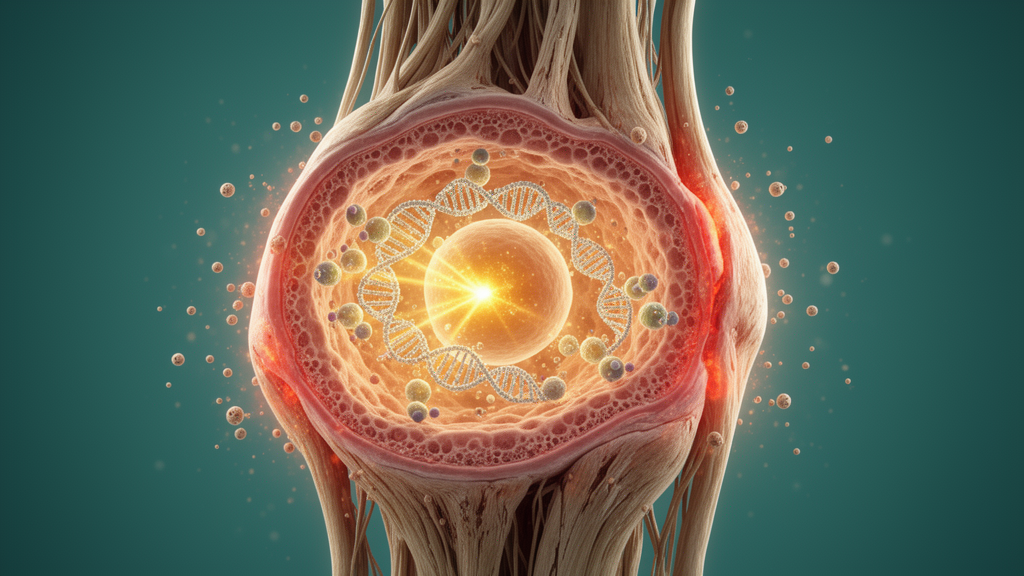
Osteoarthritis has long been framed as a disease of cartilage wear, but a new review argues that the condition is better understood as a disorder of the entire joint, in which mechanical overload, aging, metabolic disturbance and dysregulated immunity converge. At the center of this reframing sits an ancient innate immune sensor: the cGAS–STING pathway, which detects self-DNA that escapes its normal intracellular compartments and converts that exposure into sterile inflammation.
The review, published in Frontiers in Cell and Developmental Biology, interprets current findings through a danger-signal amplification framework rather than treating cGAS–STING as an isolated inflammatory pathway. According to this model, the pathway sits at the interface between cellular damage and inflammation, amplifying initial injury into a self-reinforcing loop that can drive whole-joint remodeling.
The molecular logic is well defined. Mechanical and metabolic stress, oxidative injury and aging can compromise the integrity of mitochondria and the nucleus. When DNA from these compartments leaks into the cytosol, the enzyme cGAS binds it and generates the second messenger 2′3′-cyclic GMP–AMP, or cGAMP. This molecule activates STING, which in turn engages the TBK1–IRF3 axis to drive type I interferon programs and activates NF-κB-dependent inflammatory signaling.
Among the DNA species that can trigger this cascade, the review identifies cytosolic mitochondrial DNA as currently having the strongest experimental support as an endogenous activator of cGAS in osteoarthritis. Damaged or stressed mitochondria releasing their genomes into the cytoplasm therefore represent a key initiating event in the proposed danger-signal loop.
What makes the framework an amplification loop rather than a simple linear pathway is its intersection with other cellular stress programs. The review describes how cGAS–STING signaling connects with inflammasome activation, pyroptosis, cellular senescence and the senescence-associated secretory phenotype. These processes link DNA exposure back to renewed tissue injury, allowing a focal insult to propagate rather than resolve.
The review also extends the model beyond individual cells. Extracellular vesicles, including vesicles that carry mitochondrial DNA, can transport danger signals between joint tissues. Through this route, the authors propose, the process can spread across cartilage, synovium, the infrapatellar fat pad and subchondral bone, converting localized cellular stress into remodeling of the joint as a whole organ.
This systems-level view suggests that potential interventions span several levels. Strategies could aim to prevent mitochondrial DNA damage or escape, restore mitochondrial quality control, directly modulate cGAS or STING, attenuate downstream inflammatory and cell-death programs, or improve tissue-selective local delivery of therapeutics. The breadth of targets reflects the pathway’s position as a hub connecting damage sensing to inflammatory output.
The authors emphasize that a major translational priority is to define when, and in which osteoarthritis endotypes, cGAS–STING activity is sufficiently dominant to justify pathway-directed treatment. Because the pathway also serves physiological innate immune functions, blanket suppression could carry costs. They propose that combining temporal analysis of pathway activity, cell-specific models and mechanism-linked biomarkers may ultimately support stage-adapted therapy that controls danger signals while preserving normal innate immune function.
Subject of Research: The role of the cGAS-STING innate immune DNA-sensing pathway in osteoarthritis inflammation and joint remodeling
Article Title: The role of the cGAS-STING-mediated inflammatory amplification loop in osteoarthritis: from danger-associated DNA sensing to whole-joint remodeling and precision therapy
Article References: Yang, X., Zhang, L., Yu, Y., Wu, S., & Yang, L. (2026). The role of the cGAS-STING-mediated inflammatory amplification loop in osteoarthritis: from danger-associated DNA sensing to whole-joint remodeling and precision therapy. Frontiers in Cell and Developmental Biology, 14, Article 1995231. https://doi.org/10.3389/fcell.2026.1995231
Image Credits: AI Generated
DOI: 10.3389/fcell.2026.1995231
Keywords: osteoarthritis, cGAS-STING, mitochondrial DNA, innate immunity, inflammation, senescence, extracellular vesicles, pyroptosis, type I interferon, joint remodeling, sterile inflammation, precision therapy
News Source: Beatrice Stafford. (October 28, 2026). cGAS-STING DNA Sensing Emerges as a Central Amplifier of Osteoarthritis. Scienmag.



