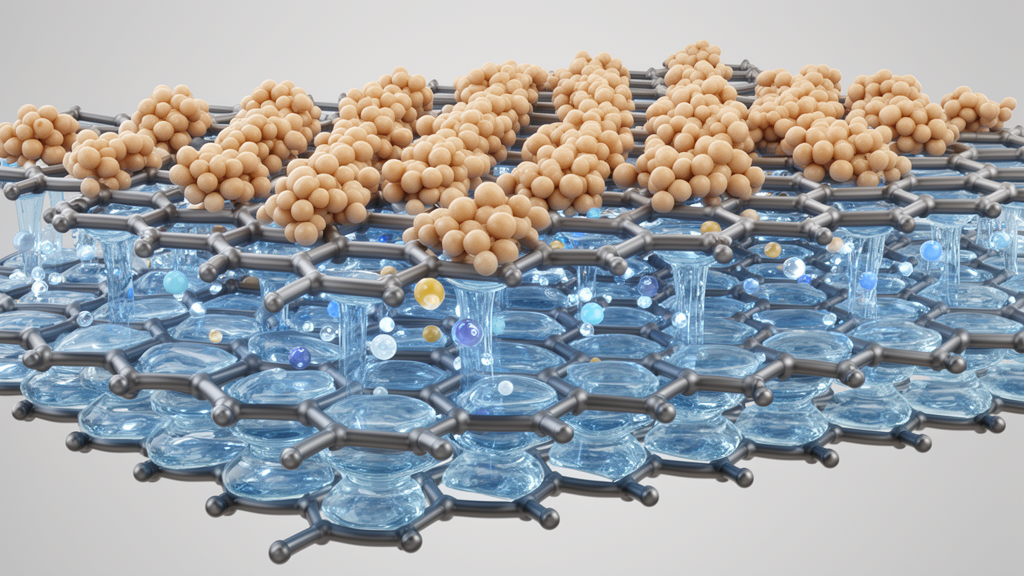
Finite-element simulations of a hybrid electrode made from cerium dioxide and reduced graphene oxide produced a peak areal capacitance of 2,758.7 mF cm−2 and a specific capacitance of 511.30 F g−1. The modelled electrode also yielded an energy density of 137.84 μWh cm−2, a power density of 58 mW cm−2 and 71% capacitance retention as the scan rate increased from 10 to 100 mV s−1. These results describe a simulated two-dimensional supercapacitor structure rather than performance measured in a manufactured device.
The study investigated CeO2/rGO as a candidate material for advanced electrochemical energy storage, combining the electrochemical activity of cerium dioxide with the electrical conductivity and large surface area of reduced graphene oxide. Researchers used finite-element modelling software to simulate the composite’s electrochemical behaviour and cyclic voltammetry performance. The model incorporated ion diffusion and interfacial charge-transfer kinetics, allowing the research to examine how the two components jointly influenced the electrode’s simulated capacitive behaviour.
Simulated cyclic-voltammetry profiles formed quasi-rectangular geometries. The researchers interpreted this shape as indicating electric double-layer capacitive behaviour together with pseudocapacitive contributions. The rate test showed that the model retained 71% of its capacitance when the scan rate rose from 10 to 100 mV s−1.
The authors associated the simulated results with a synergistic effect between the two materials: cerium dioxide supplied electrochemical activity, while reduced graphene oxide contributed conductivity and surface area. Within the model, this combination supported efficient charge transport and the reported hybrid capacitive performance. The central limitation is that the evidence comes entirely from finite-element simulation of a two-dimensional structure; the supplied study does not establish how the same values would translate to a physical electrode or assembled supercapacitor under real operating conditions.
The work therefore identifies a computationally promising hybrid electrode for supercapacitor applications, not a demonstrated practical device.
Subject of Research: Finite-element simulation of a CeO2–reduced graphene oxide supercapacitor electrode
Article Title: Simulation of CeO2/rGO hybrid electrodes for advanced supercapacitor applications
Article References: Pandeeswari, M., & Sathyakam, P. U. (2026). Simulation of CeO2/rGO hybrid electrodes for advanced supercapacitor applications. Ionics. https://doi.org/10.1007/s11581-026-07601-0
Image Credits: AI Generated
DOI: 10.1007/s11581-026-07601-0
Keywords: supercapacitors, cerium dioxide, reduced graphene oxide, finite-element modelling, cyclic voltammetry, areal capacitance, ion diffusion, charge transfer, energy density, electrochemical storage, Simulation, CeO2
News Source: Neil Sanderson. (October 22, 2026). CeO2–Graphene Simulation Reports Strong Supercapacitor Performance. Scienmag.