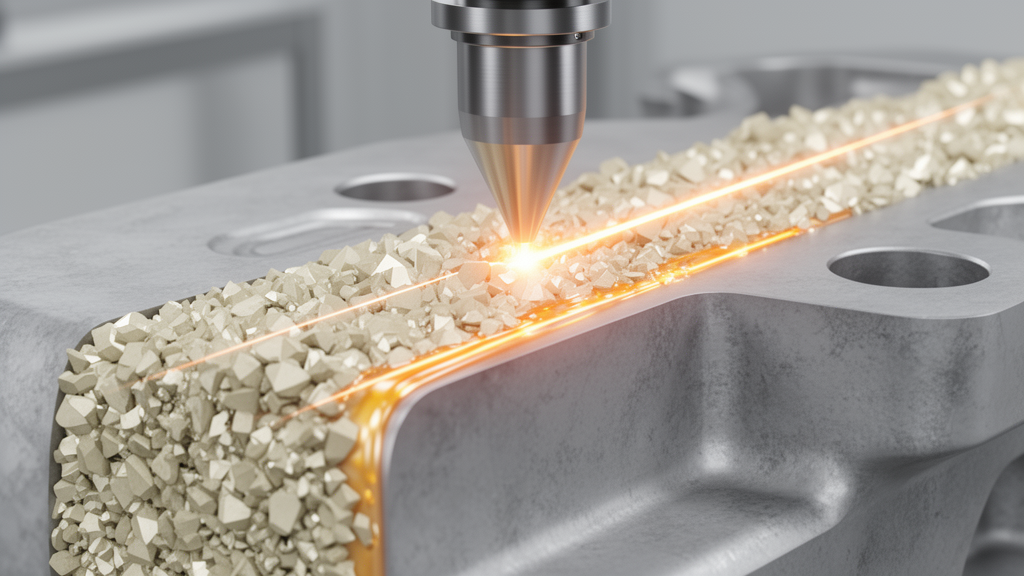
Adding silicon nitride to a titanium-rich refractory multi-component composite coating changed its phase composition, refined its grain structure and improved its performance on TC4 titanium alloy, according to a laboratory study in the Journal of Materials Science. The researchers fabricated four laser-clad coatings containing 0, 5, 10 and 15 wt% Si3N4, designated S0, S5, S10 and S15, respectively. Across the four compositions, microhardness was 2.19 to 2.64 times that of the TC4 substrate, every coating outperformed the bare alloy in wear tests, and electrochemical testing indicated superior corrosion resistance. S15 produced the best corrosion performance among the coatings examined.
Phase analysis found that S0 consisted entirely of α-Ti. The three Si3N4-containing coatings, S5, S10 and S15, contained α-Ti together with Ti5Si3, while β-Ti was detected in S10 and S15. The measured average grain size decreased from 3.44 μm in S0 to 1.86 μm in S10, demonstrating a substantial refinement associated with the 10 wt% formulation relative to the unreinforced coating. Because grain-size values for S5 and S15 are not included in the available study abstract, the results do not establish which of those four compositions had the finest grains overall. The phase observations nevertheless show that Si3N4 incorporation was associated with the appearance of titanium silicide and, at the two highest tested contents, β-Ti.
The hardness results demonstrate the benefit of the coating system as a whole rather than the contribution of Si3N4 alone. Even S0, which contained no Si3N4, was substantially harder than the TC4 substrate, indicating that the titanium-rich refractory composite itself provided a large hardness advantage. The range of 2.19- to 2.64-fold enhancement applied to all four coatings. Si3N4 addition also refined the measured microstructure and introduced Ti5Si3, but the reported abstract does not identify a single coating as the hardest or establish a direct relationship between its grain size and its mechanical performance.
Wear testing likewise favored the coated surfaces over uncoated TC4 under both conditions evaluated. At room temperature, the wear rates of S0 and S10 were 44.8% and 68.3% lower than that of TC4. In 3.5 wt% NaCl solution, the corresponding wear rates were 47.5% and 69.4% lower. These figures show that both the unreinforced composite coating and the formulation containing 10 wt% Si3N4 reduced wear under the reported test conditions. They do not isolate the effect of Si3N4 from every other property of S10, nor do they provide a complete performance ranking for S5 and S15. The broader supported conclusion is that all four laser-clad coatings consistently outperformed TC4 in the wear tests summarized by the study.
Electrochemical testing indicated that all four coatings had better corrosion resistance than TC4, with S15 showing the strongest result. The authors associated this improvement with a protective surface film containing stable SiO2 alongside TiO2, HfO2, Nb2O5 and Ta2O5. According to the proposed mechanism, these oxides act synergistically to inhibit the penetration of corrosive ions, linking the Si3N4-containing coating to improved electrochemical performance. The findings remain limited to laboratory-made coatings on TC4 and the specific compositions and tests examined; they do not establish long-term durability in industrial environments or show how the same coatings would perform on other substrate materials.
Subject of Research: Effects of Si3N4 content on the microstructure, hardness, wear resistance and corrosion behavior of laser-clad titanium-rich composite coatings on TC4 alloy.
Article Title: Effects of Si3N4 content on microstructure and properties of laser-clad Ti-rich refractory multi-component composite coatings on TC4
Article References: Li, R., Su, Y., Li, J., Tang, J., & Cheng, P. (2026). Effects of Si3N4 content on microstructure and properties of laser-clad Ti-rich refractory multi-component composite coatings on TC4. Journal of Materials Science. https://doi.org/10.1007/s10853-026-13883-6
Image Credits: AI Generated
DOI: 10.1007/s10853-026-13883-6
Keywords: Si3N4, laser cladding, TC4 titanium alloy, refractory composites, grain refinement, microhardness, wear resistance, corrosion resistance, Ti5Si3, surface engineering, Effects, content
News Source: Neil Sanderson. (October 22, 2026). Si3N4 Content Altered Laser-Clad Coating Performance on TC4 Titanium. Scienmag.