• HOME
  • NEWS
  • EXPLORE
    • CAREER
      • Companies
      • Jobs
    • EVENTS
    • iGEM
      • News
      • Team
    • PHOTOS
    • VIDEO
    • WIKI
  • BLOG
  • COMMUNITY
    • FACEBOOK
    • INSTAGRAM
    • TWITTER
Saturday, May 23, 2026
BIOENGINEER.ORG
No Result
View All Result
  • Login
  • HOME
  • NEWS
  • EXPLORE
    • CAREER
      • Companies
      • Jobs
        • Lecturer
        • PhD Studentship
        • Postdoc
        • Research Assistant
    • EVENTS
    • iGEM
      • News
      • Team
    • PHOTOS
    • VIDEO
    • WIKI
  • BLOG
  • COMMUNITY
    • FACEBOOK
    • INSTAGRAM
    • TWITTER
  • HOME
  • NEWS
  • EXPLORE
    • CAREER
      • Companies
      • Jobs
        • Lecturer
        • PhD Studentship
        • Postdoc
        • Research Assistant
    • EVENTS
    • iGEM
      • News
      • Team
    • PHOTOS
    • VIDEO
    • WIKI
  • BLOG
  • COMMUNITY
    • FACEBOOK
    • INSTAGRAM
    • TWITTER
No Result
View All Result
Bioengineer.org
No Result
View All Result
Home NEWS Science News Chemistry

Cellphone converts into powerful chemical detector

Bioengineer by Bioengineer
May 4, 2021
in Chemistry
Reading Time: 3 mins read
0
IMAGE
Share on FacebookShare on TwitterShare on LinkedinShare on RedditShare on Telegram

With only $50 worth of components, an ordinary cellphone transforms into a sophisticated scientific instrument, capable of identifying chemicals, drugs, and pathogens
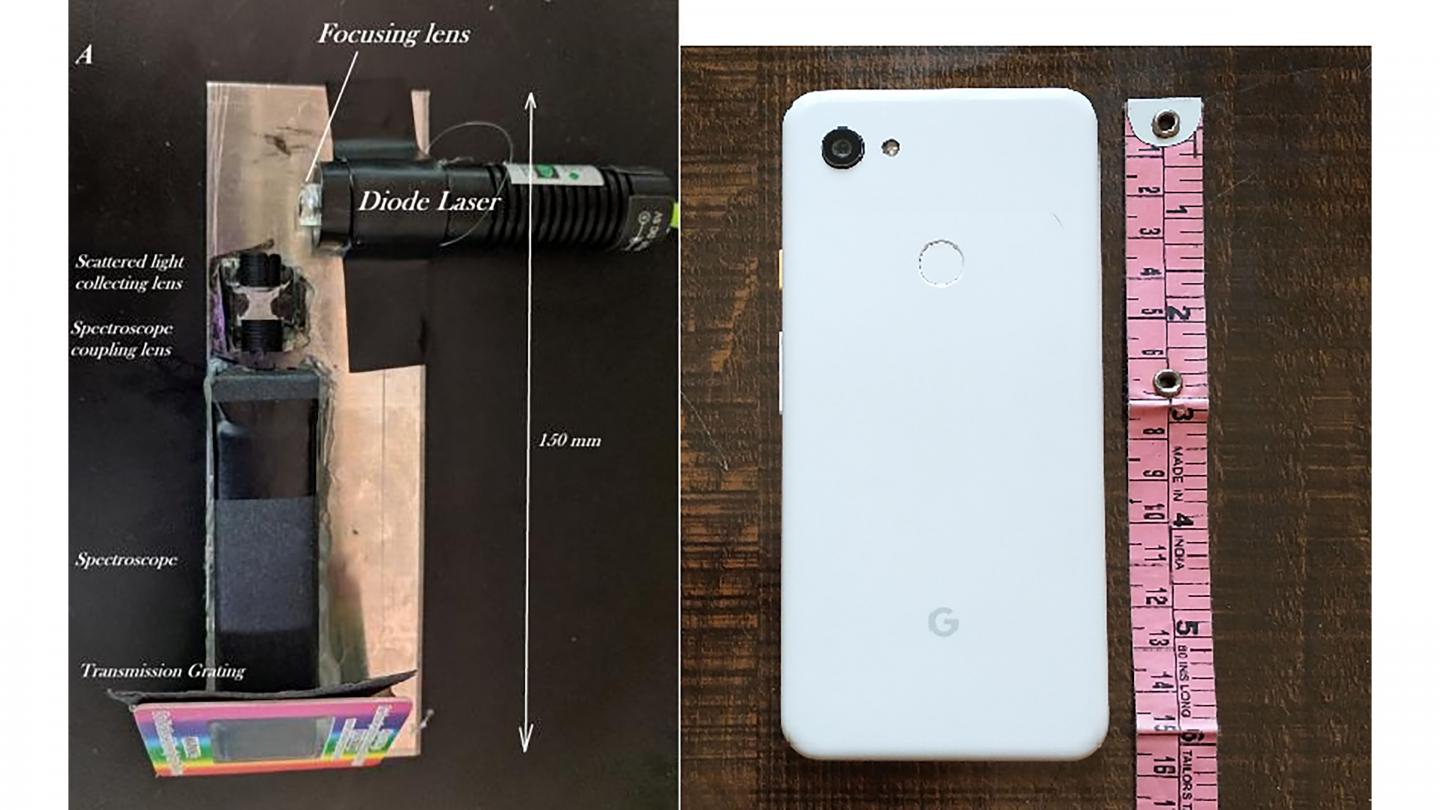
IMAGE

Credit: Peter Rentzepis

WASHINGTON, May 4, 2021 — Scientists from Texas A&M have developed an extension to an ordinary cellphone that turns it into an instrument capable of detecting chemicals, drugs, biological molecules, and pathogens. The advance is reported in Reviews of Scientific Instruments, by AIP Publishing.

Modern cellphones include high-quality cameras capable of detecting low levels of light and eliminating digital noise through software processing of the captured images. Recent work has taken advantage of this sensitivity to produce cellphone cameras that can be used as portable microscopes and heart rate detectors.

The current advance is based on two types of spectroscopy. One type, known as fluorescence spectroscopy, measures the fluorescent light emitted by a sample. Another, known as Raman spectroscopy, is useful for detecting molecules, such as DNA and RNA, that do not fluoresce or emit light at very low intensities. Both types were used to develop this cellphone detector.

The system includes an inexpensive diode laser as a light source, oriented at right angles to the line connecting the sample and the cellphone camera. The right-angle arrangement prevents back reflected light from entering the camera.

“In addition, this right-angle excitation geometry has the advantage of being easier to use for the analysis of samples where a bulk property is to be measured,” said author Peter Rentzepis.

The investigators studied a variety of samples using their constructed cellphone detector, including common solvents such as ethanol, acetone, isopropyl alcohol, and methanol. They recorded the Raman spectra of solid objects, including a carrot and a pellet of bacteria.

Carrots were chosen for this study because they contain the pigment carotene. The laser light used in their system has a wavelength that is easily absorbed by this orange pigment and by pigments in the bacteria.

The investigators compared the sensitivity of their system to the most sensitive industrial Raman spectrometers available. The ratio of signal to noise for the commercial instrument was about 10 times higher than the cellphone system.

The sensitivity of the cellphone detector could, however, be doubled by using a single RGB channel for analysis. The system has a rather limited dynamic range, but the investigators note that this problem can be easily overcome through several HDR, or High Dynamic Range, applications that combine images from multiple exposures.

The additional components, including the laser, add a cost of only about $50 to the price of a typical cellphone, making this system an inexpensive but accurate tool for detecting chemicals and pathogens in the field.

###

The article “Cell-phone camera Raman spectrometer” is authored by Dinesh Dhankhar, Anushka Nagpal, and Peter M. Rentzepis. The article will appear in Review of Scientific Instruments on May 4, 2021 (DOI: 10.1063/5.0046281). After that date, it can be accessed at https://aip.scitation.org/doi/10.1063/5.0046281.

ABOUT THE JOURNAL

Review of Scientific Instruments publishes novel advancements in scientific instrumentation, apparatuses, techniques of experimental measurement, and related mathematical analysis. Its content includes publication on instruments covering all areas of science including physics, chemistry, materials science, and biology. See https://aip.scitation.org/journal/rsi.

Media Contact
Larry Frum
[email protected]

Related Journal Article

http://dx.doi.org/10.1063/5.0046281

Tags: BiologyChemistry/Physics/Materials SciencesDiagnosticsMedicine/HealthTechnology/Engineering/Computer Science
Share12Tweet8Share2ShareShareShare2

Related Posts

Study Reveals How Valproate Affects Early Brain Development: Insights into the Antiepileptic Drug’s Impact — Chemistry

Study Reveals How Valproate Affects Early Brain Development: Insights into the Antiepileptic Drug’s Impact

May 22, 2026
Sustainable Chemistry: Iron Replaces Noble Metals in Catalytic Reactions — Chemistry

Sustainable Chemistry: Iron Replaces Noble Metals in Catalytic Reactions

May 22, 2026

Advancing Thin-Film Device Manufacturing with Imaging Ellipsometry for Enhanced Process Control

May 22, 2026

Simple Adjustment in 3D Printing Enhances Fit of Dental Crowns

May 22, 2026
Please login to join discussion

POPULAR NEWS

  • blank

    New Study Reveals Plants Can Detect the Sound of Rain

    734 shares
    Share 293 Tweet 183
  • ESMO 2025: mRNA COVID Vaccines Enhance Efficacy of Cancer Immunotherapy

    311 shares
    Share 124 Tweet 78
  • Research Indicates Potential Connection Between Prenatal Medication Exposure and Elevated Autism Risk

    847 shares
    Share 339 Tweet 212
  • Common Food Preservatives Associated with Elevated Blood Pressure and Increased Heart Disease Risk

    55 shares
    Share 22 Tweet 14

About

We bring you the latest biotechnology news from best research centers and universities around the world. Check our website.

Follow us

Recent News

Lumacaftor/Ivacaftor Safe, Effective in Preschoolers: Study

Evaluating Mobility Plan Impact in Swiss Geriatric Clinic

Boosting Crop Yield Accuracy with MHCNN-LSTM-MHA Model

Subscribe to Blog via Email

Enter your email address to subscribe to this blog and receive notifications of new posts by email.

Join 83 other subscribers
  • Contact Us

Bioengineer.org © Copyright 2023 All Rights Reserved.

Welcome Back!

Login to your account below

Forgotten Password?

Retrieve your password

Please enter your username or email address to reset your password.

Log In
No Result
View All Result
  • Homepages
    • Home Page 1
    • Home Page 2
  • News
  • National
  • Business
  • Health
  • Lifestyle
  • Science

Bioengineer.org © Copyright 2023 All Rights Reserved.