
• HOME
  • NEWS
  • EXPLORE
    • CAREER
      • Companies
      • Jobs
    • EVENTS
    • iGEM
      • News
      • Team
    • PHOTOS
    • VIDEO
    • WIKI
  • BLOG
  • COMMUNITY
    • FACEBOOK
    • INSTAGRAM
    • TWITTER
Friday, May 15, 2026
BIOENGINEER.ORG
No Result
View All Result
  • Login
  • HOME
  • NEWS
  • EXPLORE
    • CAREER
      • Companies
      • Jobs
        • Lecturer
        • PhD Studentship
        • Postdoc
        • Research Assistant
    • EVENTS
    • iGEM
      • News
      • Team
    • PHOTOS
    • VIDEO
    • WIKI
  • BLOG
  • COMMUNITY
    • FACEBOOK
    • INSTAGRAM
    • TWITTER
  • HOME
  • NEWS
  • EXPLORE
    • CAREER
      • Companies
      • Jobs
        • Lecturer
        • PhD Studentship
        • Postdoc
        • Research Assistant
    • EVENTS
    • iGEM
      • News
      • Team
    • PHOTOS
    • VIDEO
    • WIKI
  • BLOG
  • COMMUNITY
    • FACEBOOK
    • INSTAGRAM
    • TWITTER
No Result
View All Result
Bioengineer.org
No Result
View All Result
Home NEWS Science News Cancer

Cell mechanism regulating protein synthesis in stress conditions discovered

Bioengineer by Bioengineer
September 19, 2018
in Cancer
Reading Time: 2 mins read
0
Share on FacebookShare on TwitterShare on LinkedinShare on RedditShare on Telegram
IMAGE

Credit: UAB

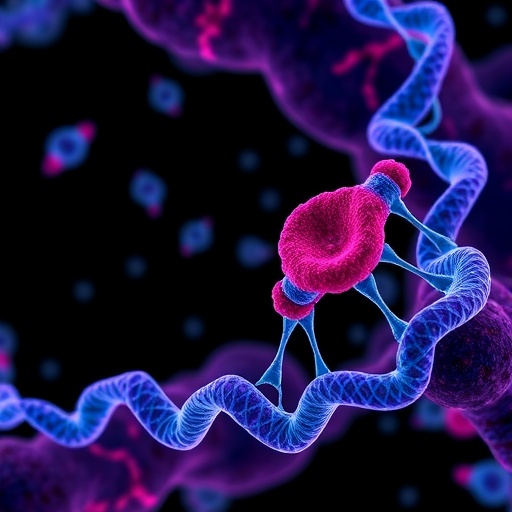
The different genes within the genome must be expressed in precise levels and in the exact moment if the complex balance regulating cell activity is to be maintained. The messenger RNA (mRNA) conveys genetic information from DNA to ribosomes, where proteins are synthesised through the union of amino acids. These amino acids are supplied by fragments of transfer RNA (tRNA), which decode the information contained within the mRNA codons (group of three bases sequencing each amino acid) in order to chain them correctly and synthesise each protein.

The study headed by researchers Marc Torrent from the Department of Biochemistry and Molecular Biology of the Universitat Autònoma de Barcelona, and Madan Babu from the Medical Research Council Cambridge, United Kingdom, for the first time describes the mechanism used by cells to optimise the production of proteins in stressful situations by altering tRNA abundance.

The research, conducted with Saccharomyces cerevisae yeast, suggests that the mRNAs coded by proteins needed in times of stress prefer a different set of codons. This is correlated to the changes produced in the relative abundance of the different tRNAs.

These observations suggest that the cell is capable of regulating the abundance of different tRNAs and adjusting the level of protein expression while adapting to the new conditions. Thus, the change in abundance in different tRNAs is an independent mechanism of regulation allowing a selective modification of translation rates and, therefore, can increase or diminish the relative abundance of the proteins needed in different conditions of stress.

These observations have very notable implications. On the one hand, the regulation mechanism is important because the alteration of tRNA abundance can cause diverse cell dysfunctions. For example, a deregulation of tRNA levels could provoke an abnormal progression of the cell cycle, giving way to proliferative diseases such as cancer: In fact, other studies already observed that the overexpression of the transfer RNA iMet and Brf1, a transcription factor of the complex RNA polymerase III, causes the formation of tumours in vivo. On the other hand, the tRNA is also related to apoptosis, programmed cell death which halts the proliferation of tumours. It has been demonstrated that the tRNA can join the cytochrome complex and prevent the activation of caspases, protease enzymes playing essential roles in programmed cell death.

Therefore, the levels of tRNA in cell also can play a relevant role in the ability of cells to respond to apoptotic stimuli related to the proliferation of tumours.

###

Media Contact

Marc Torrent
[email protected]
34-935-814-147
@UAB_info

http://www.uab.es

Related Journal Article

http://dx.doi.org/10.1126/scisignal.aat6409
Share13Tweet8Share2ShareShareShare2

Related Posts

Stem Cells: Key Link Between Exercise and Tumors

May 14, 2026

Expanding Proton Therapy Access: Five New Centres Planned Across Romania, Greece, Italy, Northern Ireland, and Poland to Serve Patients Europe-Wide

May 14, 2026

Rare Case of Extraluminal Esophageal Cancer Invading Spine Detected Despite Normal Endoscopy

May 14, 2026

Nanotechnology Special Issue Highlights Smart Platforms Driving Advances in Precision Cancer Therapy

May 14, 2026
Please login to join discussion

POPULAR NEWS

  • Research Indicates Potential Connection Between Prenatal Medication Exposure and Elevated Autism Risk

    842 shares
    Share 337 Tweet 211
  • New Study Reveals Plants Can Detect the Sound of Rain

    729 shares
    Share 291 Tweet 182
  • Salmonella Haem Blocks Macrophages, Boosts Infection

    62 shares
    Share 25 Tweet 16
  • Breastmilk Balances E. coli and Beneficial Bacteria in Infant Gut Microbiomes

    58 shares
    Share 23 Tweet 15

About

We bring you the latest biotechnology news from best research centers and universities around the world. Check our website.

Follow us

Recent News

Precision Therapies Offer New Hope Against Drug-Resistant Bacteria

UCLA to Head $9M Study Investigating the Connection Between Pesticides, Air Pollutants, and Parkinson’s Disease Risk

Stem Cells: Key Link Between Exercise and Tumors

Subscribe to Blog via Email

Enter your email address to subscribe to this blog and receive notifications of new posts by email.

Join 82 other subscribers
  • Contact Us

Bioengineer.org © Copyright 2023 All Rights Reserved.

Welcome Back!

Login to your account below

Forgotten Password?

Retrieve your password

Please enter your username or email address to reset your password.

Log In
No Result
View All Result
  • Homepages
    • Home Page 1
    • Home Page 2
  • News
  • National
  • Business
  • Health
  • Lifestyle
  • Science

Bioengineer.org © Copyright 2023 All Rights Reserved.