Plant shoots grow from hidden reserves of stem cells tucked into the axils of leaves, and a new study in Arabidopsis shows that these bud precursor cells stay pluripotent only as long as they keep dividing. The work, published in Nature Plants, reveals a cell-cycle-coupled epigenetic resetting mechanism in which active proliferation periodically erases repressive histone marks that would otherwise silence a key meristem identity gene. When cell division slows or stops, the silencing wins, the marker gene switches off, and the cells commit to differentiation—an outcome that both mathematical modelling and experimental data confirm can become irreversible after prolonged quiescence.
The research challenges a paradigm well established in adult mammalian stem cells, where cell proliferation generally promotes differentiation while proliferative quiescence preserves stem cell identity. In Arabidopsis bud precursor cells, the opposite holds: meristematic cell fate maintenance depends on active cell-cycle progression. The team identified two opposing mechanisms that balance levels of trimethylated histone H3 Lys27 to regulate transcription of SHOOT MERISTEMLESS, a shoot meristem marker gene. On one side, two classes of transcription factors recruit Polycomb repressive complex 2, known as PRC2, to epigenetically silence the gene. On the other side, cell proliferation itself reduces trimethylated histone H3 K27 levels, counteracting that silencing with each round of division.
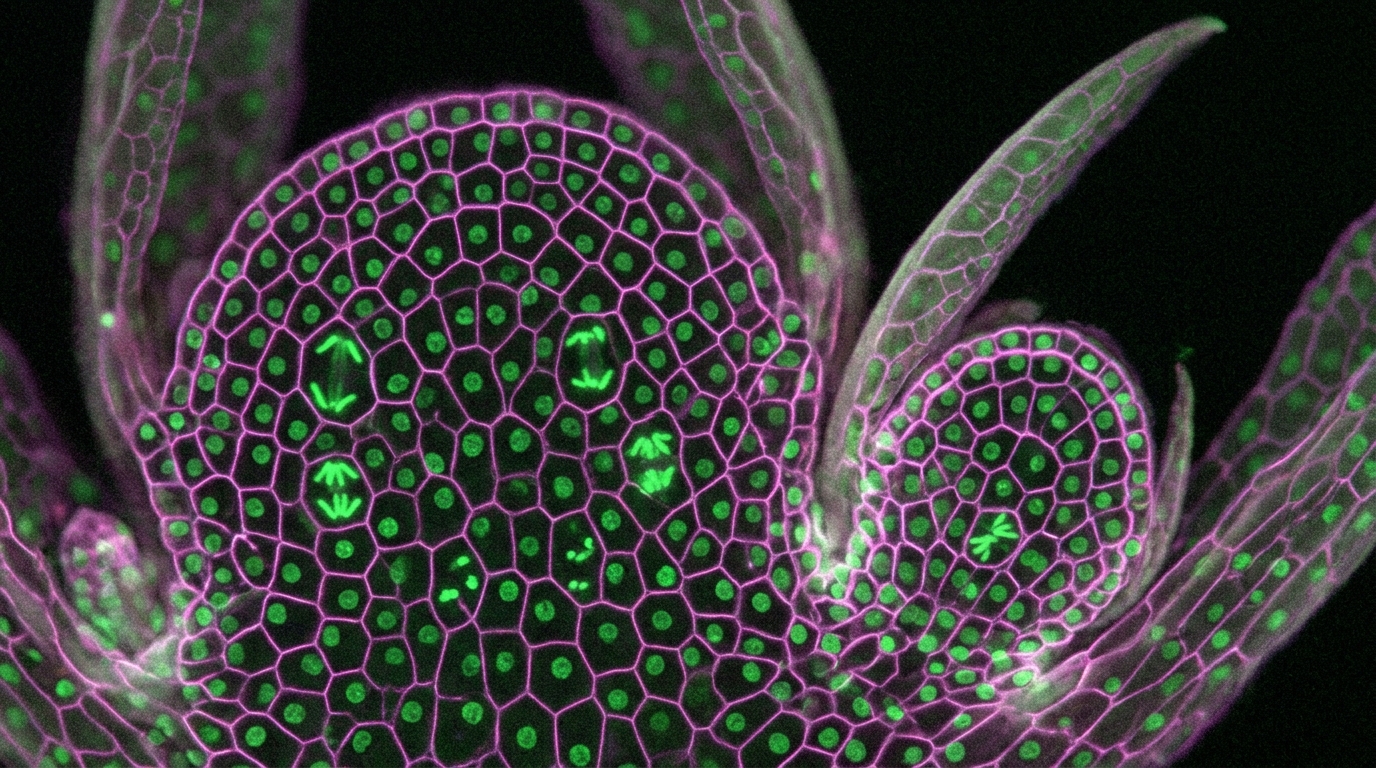
The experimental evidence traces a clear chain from division rate to gene expression. Imaging showed that slow cell division is maintained in the leaf axils, the sites where new branches originate. When researchers altered the rate of cell division, STM expression changed accordingly. In plants engineered to carry pCUC3::KRP4-mTQ2, a construct that inhibits cyclin-dependent kinase activity and arrests the cell cycle, silencing of STM expression in the leaf axils correlated with the presence of H3K27me3 and the PRC2 complex at the locus. Conversely, cell division arrest resulted in increased H3 K27 trimethylation, reinforcing the repressive chromatin state.
To move beyond correlation, the researchers built a hybrid histone modification–STM expression–cell division model that captured the dynamics of the system and generated testable predictions, which they then validated experimentally. The model and the data converged on a central conclusion: the cell fate switch is bistable, meaning the system settles into one of two stable states—pluripotent meristematic identity or differentiated fate—and prolonged quiescence triggers irreversible differentiation. This bistability explains why a bud precursor that pauses too long in its cell cycle cannot simply resume meristematic identity when division restarts; the epigenetic silencing has locked in.
Pharmacological validation sharpened the picture. Treatment with trichostatin A, a histone deacetylase inhibitor, enabled re-expression of STM, indicating that chromatin state, not loss of the transcriptional machinery, kept the gene silent in arrested cells. By contrast, ectopic expression of ATH1, one of the transcription factors involved in recruiting PRC2, did not by itself enable re-expression of the marker gene, underscoring that the balance of histone marks, rather than the mere presence of silencing factors, determines the outcome.
The authors propose that in plants, sequence-dependent PRC2 recruitment enables precise silencing of fate-determining genes, while cell proliferation maintains pluripotency through periodic resetting of epigenetic marks.
Because the study was performed in Arabidopsis bud precursor cells, its conclusions concern that system specifically, though the authors frame the mechanism as a general principle for plants. The result is a mechanistic account of how a growing plant keeps its future branches in a state of perpetual readiness, and what happens at the molecular level when that readiness is lost.
Subject of Research: Cell-cycle-coupled epigenetic resetting of H3K27me3 maintains meristematic cell fate in Arabidopsis shoot branching
Article Title: Cell-cycle-driven epigenetic resetting maintains meristematic cell fate for shoot branching
Article References: Guo, Y., Yang, Y., Shi, B., Wang, H., Cao, X., Peng, Z., He, Y., Xiao, J., Tao, L., Umeda, M., Sablowski, R., Jiao, Y., & Wang, Y. (2026). Cell-cycle-driven epigenetic resetting maintains meristematic cell fate for shoot branching. Nature Plants. https://doi.org/10.1038/s41477-026-02445-y
Image Credits: AI Generated
DOI: 10.1038/s41477-026-02445-y
Keywords: Arabidopsis, shoot branching, cell cycle, epigenetics, H3K27me3, Polycomb repressive complex 2, SHOOT MERISTEMLESS, meristem, pluripotency, cell fate, bistability, histone marks
News Source: Juliet Wilcox. (November 5, 2026). Cell division resets epigenetic marks to keep plant stem cells ready for branching. Scienmag.