• HOME
  • NEWS
  • EXPLORE
    • CAREER
      • Companies
      • Jobs
    • EVENTS
    • iGEM
      • News
      • Team
    • PHOTOS
    • VIDEO
    • WIKI
  • BLOG
  • COMMUNITY
    • FACEBOOK
    • INSTAGRAM
    • TWITTER
Monday, June 29, 2026
BIOENGINEER.ORG
No Result
View All Result
  • Login
  • HOME
  • NEWS
  • EXPLORE
    • CAREER
      • Companies
      • Jobs
        • Lecturer
        • PhD Studentship
        • Postdoc
        • Research Assistant
    • EVENTS
    • iGEM
      • News
      • Team
    • PHOTOS
    • VIDEO
    • WIKI
  • BLOG
  • COMMUNITY
    • FACEBOOK
    • INSTAGRAM
    • TWITTER
  • HOME
  • NEWS
  • EXPLORE
    • CAREER
      • Companies
      • Jobs
        • Lecturer
        • PhD Studentship
        • Postdoc
        • Research Assistant
    • EVENTS
    • iGEM
      • News
      • Team
    • PHOTOS
    • VIDEO
    • WIKI
  • BLOG
  • COMMUNITY
    • FACEBOOK
    • INSTAGRAM
    • TWITTER
No Result
View All Result
Bioengineer.org
No Result
View All Result
Home NEWS Science News

Casting light on the brain’s inner workings

Bioengineer by Bioengineer
February 11, 2020
in Science News
Reading Time: 3 mins read
0
IMAGE
Share on FacebookShare on TwitterShare on LinkedinShare on RedditShare on Telegram

Biomedical engineering researchers have developed a device that could provide unique insight into the mechanisms of pain, depression, addiction and certain diseases by observing the brain at the single-neuron level
IMAGE

Credit: University of Arizona Gutruf Lab


The mammalian brain is the most complex organ in the body, capable of processing thousands of stimuli simultaneously to analyze patterns, predict changes and generate highly measured action. How the brain does all this – within fractions of a second – is still largely unknown.

Implants that can probe the brain at the individual neuron level are not widely available to researchers. Studying neuron activity while the body is in motion in an everyday setting is even more difficult, because monitoring devices typically involve wires connecting a study participant to a control station.

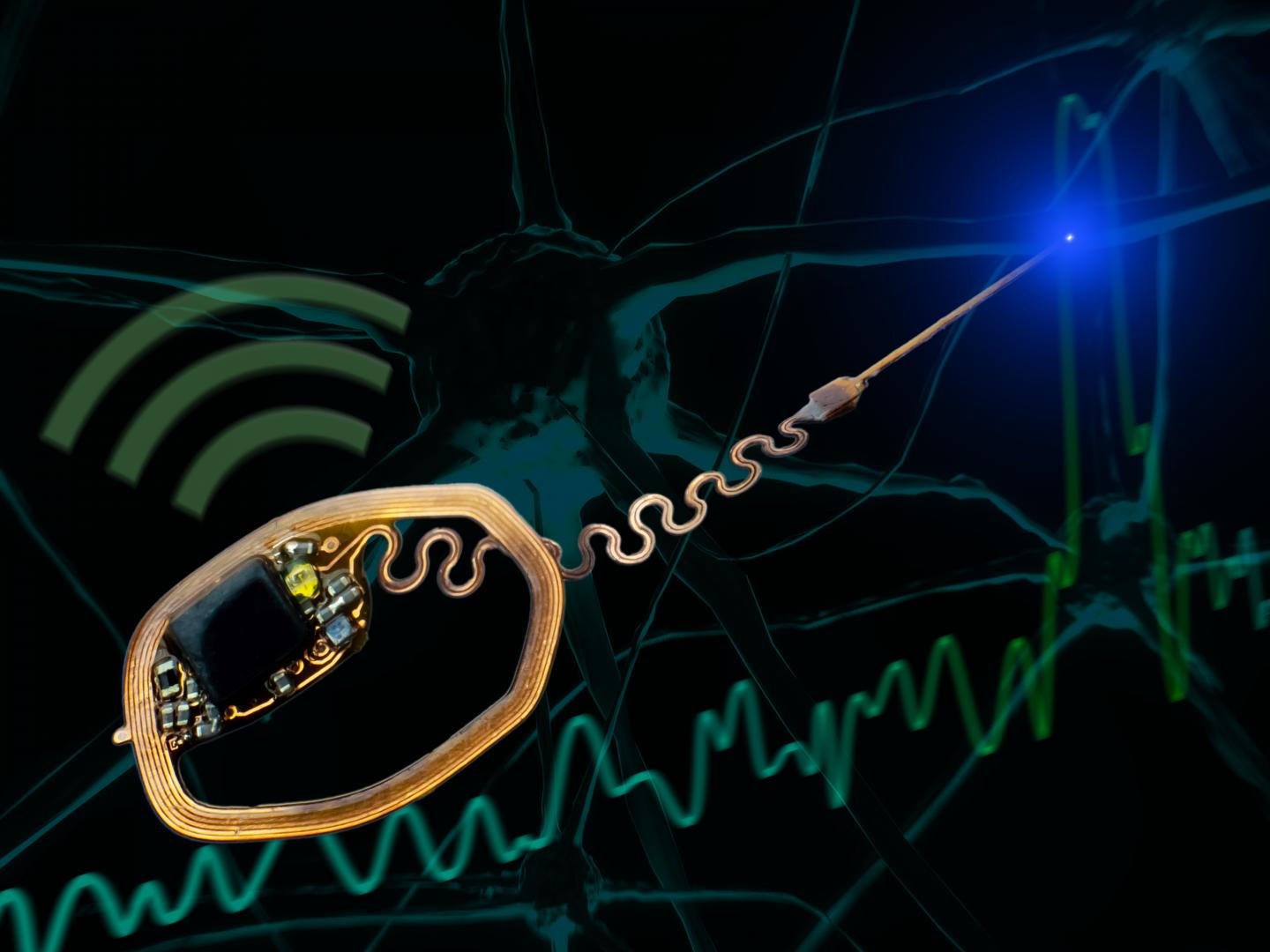
Researchers at the University of Arizona, George Washington University and Northwestern University have created an ultra-small, wireless, battery-free device that uses light to record individual neurons so neuroscientists can see how the brain is working. The technology is detailed in a study in the Proceedings of the National Academy of Sciences.

“As biomedical engineers, we are working with collaborators in neuroscience to improve tools to better understand the brain, specifically how these individual neurons – the building blocks of the brain – interact with each other while we move through the world around us,” said lead study author Alex Burton, a University of Arizona biomedical engineering doctoral student and member of the Gutruf Lab.

The process first involves tinting select neurons with a dye that changes in brightness depending on activity. Then, the device shines a light on the dye, making the neurons’ biochemical processes visible. The device captures the changes using a probe only slightly wider than a human hair, then processes a direct readout of the neuron’s activity and transmits the information wirelessly to researchers.

“The device is smaller than a single M&M and only one-twentieth of the weight,” Burton said.

The device can be tiny, and even flexible like a sheet of paper, because it does not need a battery. It harvests energy from external oscillating magnetic fields gathered by a miniature antenna on the device. This allows researchers to study brain activity without the use of restrictive equipment and gives neuroscientists a platform to gain insight into the underpinning mechanisms of the brain.

“When creating the device, we used materials and methods that are readily available and cheap enough to enable large-scale adaptation of the tool by the scientific community,” said study senior author Philipp Gutruf, who leads the Gutruf Lab and is an assistant professor of biomedical engineering and member of the university’s BIO5 Institute. “We hope that the technology can make a difference in fighting neurodegenerative diseases such as Alzheimer’s and Parkinson’s and cast light on the biological mechanisms, such as pain, addiction and depression.”

###

Media Contact
Emily Dieckman
[email protected]
520-621-1992

Original Source

https://news.engineering.arizona.edu/news/tiny-wireless-devices-cast-light-brain-s-inner-workings

Related Journal Article

http://dx.doi.org/10.1073/pnas.1920073117

Tags: AlzheimerBiomedical/Environmental/Chemical EngineeringBiotechnologyneurobiology
Share12Tweet8Share2ShareShareShare2

Related Posts

Tracking Lanthanide-Labeled Microplastics in Plants

June 25, 2026

POSTECH Researchers Slash Cost of Reconstituted Cell-Free Systems by 95%

June 25, 2026

AI and Physics Collaborate to Design Advanced Hydrogen Storage Materials

June 25, 2026

Natural Hallucinogens: Evolution’s Ecological Tools, Not Mere Chemical Byproducts

June 25, 2026
Please login to join discussion

POPULAR NEWS

  • Saying Goodbye to PGY-6: Pediatric Fellowship Realities

    103 shares
    Share 41 Tweet 26
  • Multi-Hospital Study Reveals Long Covid Burden Is Twice as High as Current Estimates

    92 shares
    Share 36 Tweet 23
  • Detection of EDCs in Breast Milk and Infant Urine Up to Six Months Highlights Early Exposure Risks

    77 shares
    Share 31 Tweet 19
  • New Drug Candidate Developed at McMaster Shows Potential for Treating Brain Cancer

    58 shares
    Share 23 Tweet 15

About

We bring you the latest biotechnology news from best research centers and universities around the world. Check our website.

Follow us

Recent News

Tracking Lanthanide-Labeled Microplastics in Plants

POSTECH Researchers Slash Cost of Reconstituted Cell-Free Systems by 95%

AI and Physics Collaborate to Design Advanced Hydrogen Storage Materials

Subscribe to Blog via Email

Success! An email was just sent to confirm your subscription. Please find the email now and click 'Confirm' to start subscribing.

Join 82 other subscribers
  • Contact Us

Bioengineer.org © Copyright 2023 All Rights Reserved.

Welcome Back!

Login to your account below

Forgotten Password?

Retrieve your password

Please enter your username or email address to reset your password.

Log In
No Result
View All Result
  • Homepages
    • Home Page 1
    • Home Page 2
  • News
  • National
  • Business
  • Health
  • Lifestyle
  • Science

Bioengineer.org © Copyright 2023 All Rights Reserved.