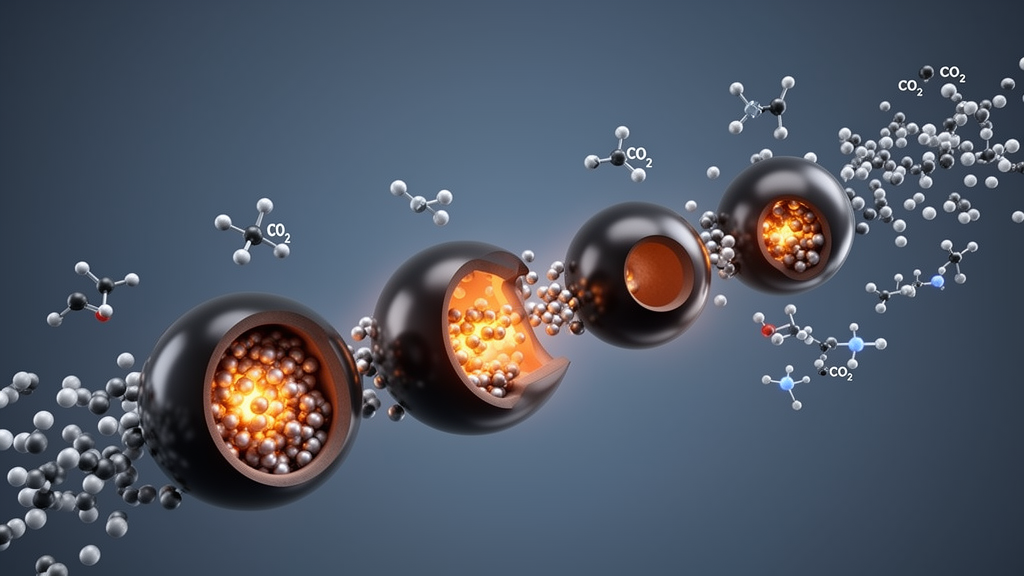
Chemists have wrapped a bimetallic iron–cobalt catalyst inside graphitic carbon nanospheres and used it to turn carbon dioxide and hydrogen into light olefins, the short-chain building blocks of plastics and solvents that are normally squeezed out of fossil feedstocks by steam or catalytic cracking. The new study, published as open-access research in Discover Catalysis on 12 July 2026, reports that among a series of catalysts with different iron-to-cobalt ratios, the composition with one part iron to two parts cobalt delivered the highest carbon dioxide conversion and the strongest selectivity toward C2–C4 olefins, outperforming both purely iron and purely cobalt analogues prepared the same way.
The work matters because catalytic hydrogenation of carbon dioxide to light olefins is widely viewed as a promising route for converting a greenhouse gas into value-added chemicals, yet it remains genuinely difficult. Carbon dioxide is thermodynamically very stable, and hydrogenation reactions tend to compete toward methane and paraffins rather than the olefins industry wants. Iron-based catalysts are attractive because they are cheap, environmentally compatible and active in Fischer–Tropsch-type chemistry, in which carbon dioxide is first converted to carbon monoxide through the reverse water–gas shift reaction and then coupled into longer hydrocarbon chains. Iron carbide phases, particularly Hägg carbide Fe5C2, are widely recognized as the active sites for chain growth and olefin formation, but monometallic iron catalysts often show limited hydrogen activation and only moderate control over product selectivity.
Cobalt is a known promoter for iron because it activates hydrogen strongly and modifies the electronic properties of iron sites, and previous studies of iron–cobalt catalysts on oxide supports have reported improved carbon dioxide conversion and olefin selectivity. Separately, materials scientists have pursued nanoconfinement: encapsulating metal nanoparticles inside carbon shells or porous carbon frameworks to suppress the sintering, phase transformation and carbon deposition that deactivate iron catalysts at high temperature. The authors of the new study argue that combining these two strategies—bimetallic synergy and carbon nanosphere confinement—had remained relatively underexplored for carbon dioxide hydrogenation, and that controlling iron–cobalt interaction inside a confined carbon nanostructure could stabilize the active iron carbide phases that make the chemistry work.
The synthesis itself is a solution-based recipe built on resorcinol–formaldehyde polymerization. The team mixed resorcinol with aqueous formaldehyde and controlled volumes of iron and cobalt metal complex solutions to reach iron-to-cobalt molar ratios of 5:1, 3:1, 2:1, 1:1, 1:2, 1:3 and 1:5, keeping the resorcinol-to-total-metal ratio fixed at 3:1. Adding ammonium hydroxide to pH 10 and curing at 85 °C for three hours produced a polymer–metal composite, which was then carbonized at 850 °C for five hours. During carbonization, the incorporated metals are proposed to drive partial graphitization of the carbon framework, yielding carbon nanosphere-confined iron–cobalt core–shell structures. Monometallic carbon-nanosphere iron and cobalt catalysts were made by the same route for comparison.
Catalytic testing took place in a continuous-flow fixed-bed quartz reactor at atmospheric pressure, with roughly 200 milligrams of catalyst fed a mixture of carbon dioxide, hydrogen and nitrogen in a 1:3:1 molar ratio at 40 milliliters per minute. Catalysts were first activated in 50% hydrogen in nitrogen at 350 °C for two hours, and the reactor temperature was then stepped up from 275 to 400 °C. Products were analyzed online by gas chromatography with flame ionization and thermal conductivity detectors, and six consecutive injections were recorded at each temperature to ensure reproducibility. Across the composition series, the 1:2 iron-to-cobalt catalyst—named CNS–Fe1Co2—showed the highest light olefin selectivity together with the highest carbon dioxide conversion while keeping carbon monoxide selectivity comparable to the other formulations, and subsequent temperature screening found the best olefin selectivity at 350 °C.
Head-to-head comparison with the monometallic catalysts under identical conditions reinforced the picture. CNS–Fe1Co2 performed comparatively better toward light olefin formation, particularly at intermediate temperatures, while monometallic iron showed stronger reverse water–gas shift behavior with lower hydrocarbon productivity and monometallic cobalt leaned toward methane because of its stronger hydrogenation activity. The highest light olefin yield over CNS–Fe1Co2 reached 2.07% at 350 °C, corresponding to a maximum space–time yield of 0.287 micromoles per gram of catalyst per second under atmospheric pressure. The authors are candid that these numbers are moderate compared with literature systems run at elevated pressures with alkali promoters, but they emphasize the clear improvement over the monometallic counterparts and the mechanistic insight gained under relatively mild conditions.
Stability testing added a further argument for the bimetallic, confined design. CNS–Fe1Co2 started at roughly 32% carbon dioxide conversion, declined during the first ten hours on stream as the catalyst underwent reduction, carburization and surface restructuring, and then stabilized at about 16% conversion for more than 60 hours. The monometallic iron and cobalt catalysts deactivated more pronouncedly and continuously over the same period, a pattern the authors attribute to phase instability, carbon deposition and gradual structural evolution. The team notes that a 60-hour test does not establish long-term industrial durability, and that operando characterization would be needed to fully map deactivation pathways, but within the tested window the confined bimetallic catalyst held up noticeably better.
Extensive characterization explains why. Transmission electron microscopy showed iron–cobalt cores averaging about 50 nanometers in diameter wrapped in carbon shells roughly 20 nanometers thick, with partially graphitized domains and defect sites that may aid reactant diffusion while preserving confinement. After reaction, the cores remained well dispersed with no evidence of severe sintering or core–shell collapse, although the spent shell was somewhat thicker and less uniform, consistent with moderate carbon deposition. Nitrogen physisorption gave low but differentiated surface areas—3.73 square meters per gram for CNS–Fe1Co2 versus 1.76 for CNS–Fe and 1.06 for CNS–Co—with micropore volumes below 0.001 cubic centimeters per gram, and energy-dispersive X-ray and ICP-MS analyses confirmed the bimetallic composition survived testing intact.
The chemical evolution during reaction emerged clearly from diffraction and spectroscopy. Fresh catalysts showed spinel iron oxide and cobalt oxide phases, but after hydrogenation the spent iron-containing catalysts displayed a broad diffraction feature near 43.5–45.0 degrees two-theta consistent with carburized iron phases, most likely χ-Fe5C2, alongside an X-ray photoelectron spectroscopy signal near 708.2 electronvolts assigned to carburized iron species. Cobalt spectra shifted from Co3O4 toward CoO and partially reduced or metallic cobalt, which is known to dissociate hydrogen and may assist reduction of neighboring iron. Hydrogen temperature-programmed reduction revealed the mechanistic signature: whereas the monometallic catalysts reduced in multiple sequential steps, CNS–Fe1Co2 showed a single dominant merged reduction feature near 400 °C, indicating strong iron–cobalt interaction and cooperative reduction within the confined structure.
Carbon management also favored the bimetallic catalyst. Thermogravimetric analysis showed the fresh CNS–Fe1Co2 lost less than 1% mass up to about 550 °C, and the spent sample gained only an additional roughly 2% mass-loss feature near 500 °C from newly formed, less ordered carbonaceous deposits—evidence that severe coke accumulation is unlikely to be the dominant deactivation pathway. Spent monometallic cobalt, by contrast, began losing weight near 150 °C and lost close to 7% overall, indicating far heavier carbon accumulation. Raman spectroscopy told a consistent story: D and G bands intensified after reaction, signaling a mix of amorphous and partially graphitic deposits, yet the overall spectral shape and the graphitic diffraction feature near 26 degrees two-theta remained intact, showing the carbon nanosphere framework was largely preserved. The authors stress that their mechanism—a reverse water–gas shift step on iron oxide species followed by Fischer–Tropsch-type chain growth on carburized iron, aided by cobalt-driven hydrogen activation—is inferred from ex situ characterization and literature precedent rather than operando measurement, and that surface-impregnated control catalysts on empty nanospheres showed essentially no activity, hinting that true confinement is central to the design.
Subject of Research: Carbon nanosphere-encapsulated iron–cobalt core–shell catalysts for CO2 hydrogenation to light olefins
Article Title: Carbon nanosphere-encapsulated Fe–Co catalysts for CO2 hydrogenation
Article References: Lugo, J., Davide, T., Jimenez, J. D., Moran, K., Mosbah, H., Razzaq, H., Robinson, J., Ramer, N. J., Senanayake, S. D., Lu, P., & Zhang, C. (2026). Carbon nanosphere-encapsulated Fe–Co catalysts for CO2 hydrogenation. Discover Catalysis, 3(1), Article 13. https://doi.org/10.1007/s44344-026-00045-8
Image Credits: AI Generated
DOI: 10.1007/s44344-026-00045-8
Keywords: CO2 hydrogenation, light olefins, iron–cobalt catalysts, carbon nanospheres, nanoconfinement, iron carbide, Fischer–Tropsch synthesis, reverse water–gas shift, catalyst stability, XRD, XPS, H2-TPR
News Source: Bethany Barker. (October 28, 2026). Carbon nanosphere shells stabilize iron–cobalt catalysts that convert CO2 into light olefins. Scienmag.