• HOME
  • NEWS
  • EXPLORE
    • CAREER
      • Companies
      • Jobs
    • EVENTS
    • iGEM
      • News
      • Team
    • PHOTOS
    • VIDEO
    • WIKI
  • BLOG
  • COMMUNITY
    • FACEBOOK
    • INSTAGRAM
    • TWITTER
Tuesday, May 19, 2026
BIOENGINEER.ORG
No Result
View All Result
  • Login
  • HOME
  • NEWS
  • EXPLORE
    • CAREER
      • Companies
      • Jobs
        • Lecturer
        • PhD Studentship
        • Postdoc
        • Research Assistant
    • EVENTS
    • iGEM
      • News
      • Team
    • PHOTOS
    • VIDEO
    • WIKI
  • BLOG
  • COMMUNITY
    • FACEBOOK
    • INSTAGRAM
    • TWITTER
  • HOME
  • NEWS
  • EXPLORE
    • CAREER
      • Companies
      • Jobs
        • Lecturer
        • PhD Studentship
        • Postdoc
        • Research Assistant
    • EVENTS
    • iGEM
      • News
      • Team
    • PHOTOS
    • VIDEO
    • WIKI
  • BLOG
  • COMMUNITY
    • FACEBOOK
    • INSTAGRAM
    • TWITTER
No Result
View All Result
Bioengineer.org
No Result
View All Result
Home NEWS Science News Biology

Carbon cycling in wet soils

Bioengineer by Bioengineer
June 25, 2020
in Biology
Reading Time: 2 mins read
0
IMAGE
Share on FacebookShare on TwitterShare on LinkedinShare on RedditShare on Telegram

IMAGE

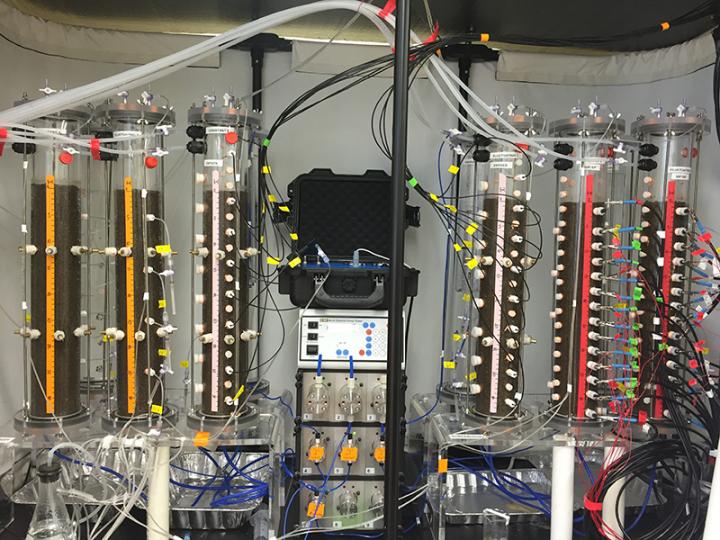
Credit: Courtesy of Adrian Mellage

Under changing, increasingly dynamic climatic conditions, temperate soils are forecast to experience a high degree of variability in moisture conditions due to periods of drought and/or flood. These periodic shifts between well-drained and waterlogged conditions have the potential to enhance carbon cycling by microbes and influence soil quality and land-derived greenhouse gas emissions.

In a recently published study in Vadose Zone Journal, researchers subjected a soil column to controlled periods of waterlogging versus drainage. The team showed that dynamic water saturation led to pronounced pulses of carbon dioxide emissions and higher depletion of soil organic carbon at the depth exposed to fluctuating water saturation. The research was carried out in a novel experimental setup, in which the water saturation conditions experienced by the soil column were manipulated while monitoring oxygen content, redox potential and porewater composition.

Remarkably, the depth region of the soil columns exposed to dynamic waterlogging developed lower microbial biomass relative to static conditions, but these remaining microbes exhibited a higher activity. In contrast to expected results, dynamic waterlogging conditions did not result in a higher diversity of the microbial community.

The ability to understand the factors controlling the cycling of nutrients and carbon under dynamic environmental conditions can be achieved by applying novel experimental techniques such as these. The findings suggest that the enhanced carbon cycling under dynamic waterlogging is driven by a more active, and not a more abundant or compositionally more diverse, microbial community. Ultimately, these effects of dynamic waterlogging can be incorporated into global scale predictive models to improve our predictive capabilities of the biosphere’s response to environmental change.

###

Adapted from Pronk, GJ, Mellage, A, Milojevic, T, et al. Carbon turnover and microbial activity in an artificial soil under imposed cyclic drainage and imbibition. Vadose Zone J. 2020; 19:e20021

Media Contact
Rachel Schutte
[email protected]

Related Journal Article

http://dx.doi.org/10.1002/vzj2.20021

Tags: AgricultureClimate ChangeEarth ScienceEcology/EnvironmentGeology/SoilHydrology/Water ResourcesMicrobiologyResearch/Development
Share12Tweet8Share2ShareShareShare2

Related Posts

Fischer’s Blue Butterflies Less Attractive on Non-Native Diet, Study Finds — Biology

Fischer’s Blue Butterflies Less Attractive on Non-Native Diet, Study Finds

May 19, 2026

How One Protein Uses Embryonic Brain Language to Maintain Plasticity in Adult Neurons

May 19, 2026

Scientists Can Now Monitor America’s Dolphin Populations Using DNA Floating in Seawater

May 19, 2026

New Insights into How Smoking Causes Lung Stiffness

May 19, 2026
Please login to join discussion

POPULAR NEWS

  • Research Indicates Potential Connection Between Prenatal Medication Exposure and Elevated Autism Risk

    845 shares
    Share 338 Tweet 211
  • New Study Reveals Plants Can Detect the Sound of Rain

    731 shares
    Share 292 Tweet 182
  • Salmonella Haem Blocks Macrophages, Boosts Infection

    62 shares
    Share 25 Tweet 16
  • Breastmilk Balances E. coli and Beneficial Bacteria in Infant Gut Microbiomes

    58 shares
    Share 23 Tweet 15

About

We bring you the latest biotechnology news from best research centers and universities around the world. Check our website.

Follow us

Recent News

Fischer’s Blue Butterflies Less Attractive on Non-Native Diet, Study Finds

How One Protein Uses Embryonic Brain Language to Maintain Plasticity in Adult Neurons

One in Five Pregnant Individuals Miss Proper Syphilis Screening, Study Finds

Subscribe to Blog via Email

Enter your email address to subscribe to this blog and receive notifications of new posts by email.

Join 82 other subscribers
  • Contact Us

Bioengineer.org © Copyright 2023 All Rights Reserved.

Welcome Back!

Login to your account below

Forgotten Password?

Retrieve your password

Please enter your username or email address to reset your password.

Log In
No Result
View All Result
  • Homepages
    • Home Page 1
    • Home Page 2
  • News
  • National
  • Business
  • Health
  • Lifestyle
  • Science

Bioengineer.org © Copyright 2023 All Rights Reserved.