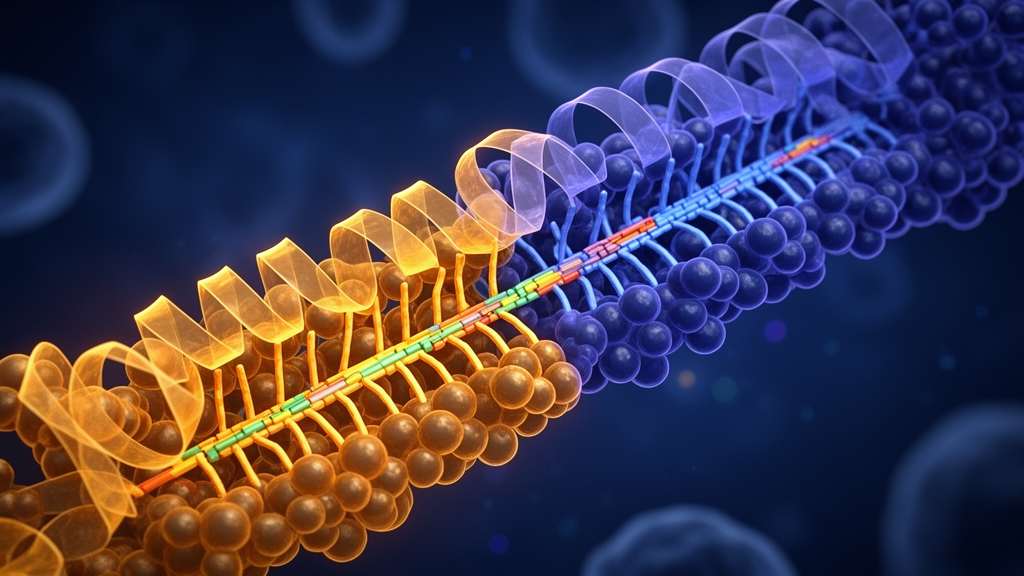
Scientists at the Translational Genomics Research Institute, part of City of Hope, have shown that the artificial intelligence platform AlphaFold3 can predict whether a T cell receptor will recognize a specific antigen based solely on genetic sequence.
The recognition process at the heart of adaptive immunity depends on a three-part molecular complex. A display molecule called MHC grabs a fragment of a virus, bacterium, or tumor cell and holds it out for inspection. A T cell then checks that fragment with its receptor, the TCR. If the receptor fits the MHC molecule and its peptide cargo just right, the T cell registers the encounter as a threat and launches an attack aimed at it. Scientists call this triad the MHC:peptide:TCR complex, a set of three molecules that only work as a team, and it is one of the main ways the immune system recognizes what it needs to fight.
The unique structure of each T cell receptor enables the immune system to distinguish among billions of potential antigens. While researchers have experimentally determined the structures of some TCRs and the antigens they recognize, many others are known only through their genetic sequences. Predicting whether a given receptor would recognize an arbitrary antigen has therefore remained a significant challenge. John Altin, Ph.D., an associate professor in TGen’s Immunology and Microbiome Division and a senior author of the study, described the state of the field bluntly: before this work, if you knew nothing about the target antigen and wanted to know whether a TCR sequence was specific to it, the best you could do was a random guess.
AlphaFold transformed structural biology by enabling researchers to predict three-dimensional molecular structures from genetic sequences. The third version of the platform, introduced in 2024, was designed specifically to predict interactions among multiple molecules, which makes it particularly well suited for modeling MHC:peptide:TCR complexes.
To evaluate the platform’s performance, the TGen team first tested AlphaFold3 using triads whose structures had already been determined experimentally. After confirming its accuracy on these known cases, the researchers analyzed a larger group of immune complexes to identify structural features associated with T cell recognition and non-recognition of specific antigens.
The investigators then challenged the model using high-quality genetic sequences from previously uncharacterized immune complexes, including eight MHC class II-antigen pairs derived from the bacterium that causes tuberculosis. Tuberculosis presented an especially rigorous test because the pathogen contains numerous antigens, while the MHC molecules responsible for presenting those antigens vary significantly among individuals and populations worldwide. It is also a disease where new vaccines and diagnostics are sorely needed. The researchers found that AlphaFold3 was able to model these immune complexes with sufficient accuracy to predict whether a T cell receptor would recognize antigens known only from their genetic sequences.
“Now we can do clearly better than chance,” Altin said. “It’s remarkable that a general structural model like AlphaFold 3 works on such a specialized task, and we expect it to improve from here.” The antigens examined in the tuberculosis work, he noted, fall within large unexplored or underexplored regions of the antigen space, something the team is very interested in. The study demonstrates how AlphaFold3 can accurately model the complex three-part molecular interaction that lies at the center of the body’s adaptive immune response, and by revealing how these molecules fit together, the approach may help researchers better predict which immune cells can recognize and respond to specific pathogens or cancer targets.
If further validated, the approach could help accelerate research into infectious diseases, cancer immunotherapy and vaccine development by enabling scientists to identify promising immune targets more efficiently. By helping researchers better understand how immune cells recognize threats, the technology may provide a powerful new tool for studying the immune responses that protect the body from disease.
The researchers have been working simultaneously on a second triad challenge, said Kamel Lahouel, Ph.D., an assistant professor in TGen’s Early Detection and Prevention Division and co-author of the study. “We have also been very interested in the particular step that comes before the TCR gets involved, which is how to predict the binding affinity between the peptide and an MHC class II molecule,” Lahouel said. In a joint effort across TGen research groups involving teams led by Lahouel, Altin, and Cristian Tomasetti, Ph.D., the researchers are building on AlphaFold3’s structural modeling with downstream graph-based neural networks, trained using data on hundreds of thousands of peptide interactions from Altin’s PepSeq assays, to develop a predictor of MHC class II-peptide binding affinity.
The research was supported by the National Institutes of Health through grants R21AI149311, R01AI173002, and 75N93024C00054. The content is solely the responsibility of the authors and does not necessarily represent the official views of the National Institutes of Health. The study, titled “General prediction of T cell receptor antigen specificity from sequence using AlphaFold 3,” was published in Science Advances on 30 October 2026, and was classified as computational simulation and modeling research with cells as its subject of investigation.
Subject of Research: Prediction of T cell receptor antigen specificity from sequence using the AI platform AlphaFold3
Article Title: TGen scientists use AlphaFold3 to predict complex immune interactions
Article References: TGen scientists use AlphaFold3 to predict complex immune interactions. Original publication (Bibliographic details unavailable.)
Image Credits: AI Generated
DOI: Not provided
Keywords: AlphaFold3, TGen, T cell receptor, antigen specificity, MHC:peptide:TCR complex, tuberculosis, immunology, Science Advances, AI structural biology, cancer immunotherapy, vaccine development, peptide-MHC binding
News Source: Nathaniel Bowman. (November 12, 2026). AlphaFold3 predicts T cell receptor antigen specificity from sequence alone. Scienmag.