Researchers have developed a hybrid machine-learning framework combining multiple linear regression with an artificial neural network to predict failure loads in adhesive-bonded composite joints from limited experimental data. Published in Discover Mechanical Engineering, the study demonstrated that using multiple linear regression to augment a small experimental dataset substantially enhanced artificial neural network accuracy.
Adhesive-bonded joints are increasingly utilized across aerospace and automotive structures as lightweight alternatives to traditional mechanical fasteners. These bonded assemblies offer numerous operational advantages, including more uniform stress distributions, greater design flexibility, reduced overall structural weight, and enhanced resistance to environmental corrosion. Among bonded configurations, the single-lap joint is widely investigated because of its geometric simplicity and practical fabrication. However, its mechanical behavior under tensile loading is inherently complex. Structural eccentricity induces out-of-plane bending moments, generating steep peel and shear stress concentrations along the adhesive layer. These non-uniform stress states, combined with composite anisotropy and adhesive deformation, make accurate analytical prediction of joint failure load exceptionally challenging.
Evaluating the load-carrying capacity of bonded composite joints requires analyzing multiple interacting parameters, including overlap geometry, adhesive bond-line thickness, substrate stiffness, and surface preparation. Because conventional physical testing across numerous combinations requires costly specimen fabrication and testing time, the researchers utilized a Taguchi Design of Experiments approach. An L9 orthogonal array was selected to evaluate three primary variables across three discrete levels through nine distinct experimental combinations. The experimental design considered overlap length, adhesive layer thickness, and adherend tensile strength. While the Taguchi method efficiently reveals primary linear trends and main effects with minimal experimental trials, the researchers noted that L9 arrays provide limited information regarding higher-order nonlinear interactions across the design domain, underscoring the need for advanced data-driven predictive modeling.
To manufacture composite substrates with controlled mechanical properties, the authors fabricated glass fiber-reinforced polyester plates using a hand lay-up technique. The composite system combined woven E-glass fabric with unsaturated polyester resin to form laminates at nominal thicknesses of 3, 4, and 5 millimeters. Varying the matrix proportion while keeping fiber volume constant established fiber volume fractions of 60 percent, 45 percent, and 36 percent. Void volume fractions measured in accordance with ASTM D2734 were 0.6 percent, 0.8 percent, and 0.9 percent for the respective thicknesses, with all values remaining below the 1 percent threshold confirming laminate fabrication quality. Standard tensile tests conducted on the fabricated plates revealed measured tensile strengths of 360 megapascals, 250 megapascals, and 226 megapascals for the 3, 4, and 5 millimeter laminates, providing the baseline adherend property levels for subsequent joint testing.
Specimen preparation utilized Araldite standard two-part epoxy adhesive, selected for structural compatibility with glass fiber substrates. Adhesive layer thicknesses of 0.20, 0.35, and 0.50 millimeters were established using calibrated stainless-steel spacer shims and an assembly alignment fixture to ensure bond-line uniformity. Overlap lengths were set to 20, 35, and 50 millimeters, representing standard geometric ranges applied in lightweight industrial engineering. Cured laminates were cut to final dimensions with a hand hacksaw following ASTM D5868, abraded along bond lines with 150-grit sandpaper to enhance mechanical adhesion, and smoothed with abrasive paper. Composite end tabs fabricated from the same glass fiber material were adhesively bonded to the grip sections, minimizing stiffness mismatch and preventing premature failure during mechanical clamping. Curing was conducted under ambient laboratory conditions under light compressive pressure to ensure uniform contact.
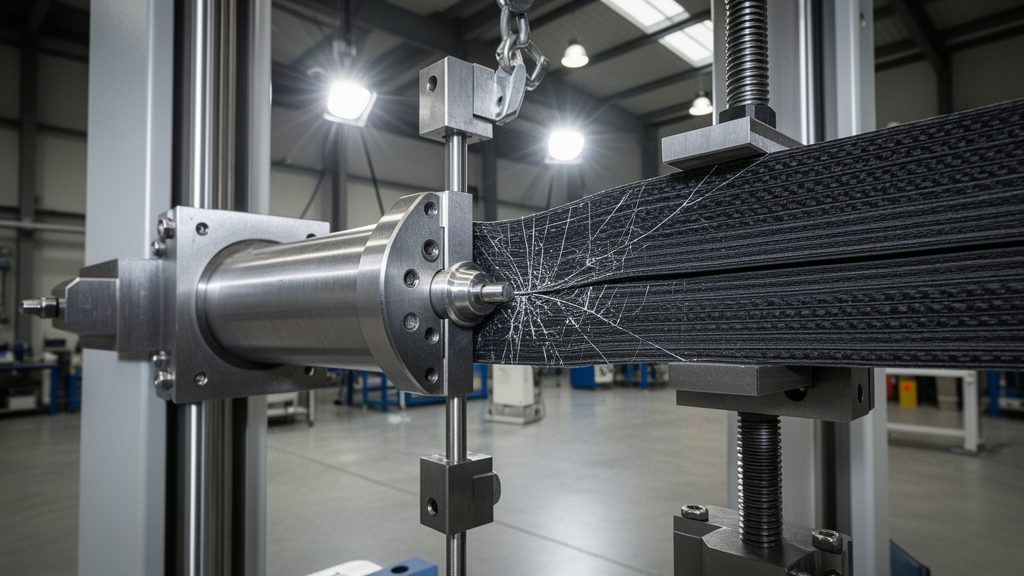
Mechanical testing was performed on a UTEST electromechanical universal testing machine possessing a 5000-newton capacity, with specimens carefully aligned to avoid unintended bending moments. Quasi-static tensile loading was applied at a constant crosshead speed of 2 millimeters per minute. Each of the nine Taguchi L9 design combinations was tested across three identical specimens to calculate mean failure loads and standard deviations, defining the failure load as the maximum recorded force. Measured failure loads varied substantially across configurations, reaching a peak value of 6.8 kilonewtons in specimens combining a 50-millimeter overlap length, a 0.20-millimeter adhesive layer thickness, and a 360-megapascal adherend tensile strength. The experimental results indicated that while increasing overlap length consistently expanded the bonded area and improved load transfer, excessive adhesive thickness and lower adherend strength noticeably degraded structural capacity.
Statistical analysis of variance conducted via a general linear model confirmed that the experimental parameters significantly influenced joint capacity at a 95 percent confidence level, yielding a p-value below 0.05. Percentage contributions demonstrated that overlap length was the primary governing variable, accounting for approximately 47 percent of total failure load variation. Adherend tensile strength was the second most influential factor, followed by adhesive layer thickness. The researchers noted that adherend tensile strength must be interpreted as reflecting combined laminate thickness and fiber volume fraction, as thicker and higher-fiber laminates provide greater flexural rigidity that resists out-of-plane joint rotation and suppresses localized peel-stress concentrations. Conversely, increased adhesive thickness produced negative effects on joint strength, attributable to heightened adhesive compliance, unfavorable shear stress distributions, and greater susceptibility to fabrication voids.
Visual examination of fractured joint surfaces characterized the predominant failure modes across the nine configurations, identifying cohesive adhesive rupture, adhesive-substrate interfacial debonding, and mixed failure patterns. No catastrophic through-thickness laminate fractures occurred. Specimens with a 20-millimeter overlap exhibited predominantly cohesive or mixed characteristics, with 0.20-millimeter adhesive layers showing substantial adhesive residue and rough fracture surfaces. Under a 35-millimeter overlap, specimens with 0.35-millimeter adhesive layers demonstrated predominantly cohesive failure. For the 50-millimeter overlap series, specimens combining 0.20-millimeter adhesive thickness and 360-megapascal adherends displayed localized fiber tearing along the composite surface alongside adhesive fracture. This localized tearing demonstrated that joint strength approached the structural capacity of the composite substrate under optimal parameter combinations, though the authors emphasized that macroscopic visual classifications do not represent microscopic fracture mechanisms.
Using the nine experimental observations, the team constructed a multiple linear regression model in Minitab 19 at a 95 percent confidence level to formulate an explicit mathematical relationship between input factors and failure load. Fitted regression coefficients confirmed that overlap length and adherend tensile strength correlated positively with failure load, while adhesive layer thickness exhibited an inverse relationship. Statistically, the regression model achieved a coefficient of determination of 89.37 percent and an adjusted value of approximately 80 percent. Although the equation provided a practical tool for rapid linear estimation, unexplained residual variance indicated that single linear models cannot fully capture the nonlinear stress interactions governing joint failure.
To overcome sample size constraints without additional physical testing, the researchers utilized the validated regression equation to augment the experimental dataset. Evaluating the regression model across all three-level permutations of the three parameters generated 18 supplementary data points, establishing a complete 27-sample full-factorial dataset. The authors designed an artificial neural network within MATLAB’s Neural Network Fitting Toolbox using a 3-5-1 feed-forward backpropagation architecture featuring three input neurons, five hidden neurons, and one output neuron. The network utilized hyperbolic tangent sigmoid activation in the hidden layer, linear activation in the output layer, and the Levenberg-Marquardt training algorithm. Input and output variables were normalized between negative one and one and partitioned into 19 training samples, four validation samples, and four testing samples. Network training demonstrated stable convergence, achieving an optimal validation mean squared error of 0.0089 at epoch six.
Evaluating both predictive models directly against the original nine experimental measurements demonstrated that the hybrid MLR-ANN framework achieved superior accuracy over the standalone regression equation. The standalone multiple linear regression model exhibited a root mean square error of 0.370 kilonewtons, a mean absolute error of 0.273 kilonewtons, a mean absolute percentage error of 5.44 percent, a correlation coefficient of 89.37 percent, and prediction error bounds from minus 13.08 percent to plus 13.03 percent. In comparison, the hybrid model reduced the root mean square error to 0.276 kilonewtons, lowered the mean absolute error to 0.126 kilonewtons, decreased the mean absolute percentage error to 2.14 percent, raised the correlation coefficient to 98.2 percent, and compressed the error range to between minus 12.29 percent and plus 0.77 percent. The authors underscored that these predictive gains reflect enhanced model training within the investigated design envelope rather than independent discovery of unmeasured physical phenomena.
The authors emphasized several limitations governing their findings and outlined directions for subsequent investigations. Because the empirical data originated from a Taguchi L9 design, the model primarily evaluates main parameter effects and cannot comprehensively capture higher-order variable interactions. Furthermore, the augmented training points remain mathematically dependent on the underlying regression assumptions, meaning the hybrid network must be regarded as a regression-supported model rather than an independently validated predictive tool. The scope was additionally limited to three variables, omitting important operational factors such as service temperature, moisture exposure, surface treatments, and resin curing variations. Future studies will focus on expanding experimental sample sizes, incorporating additional physical parameters, benchmarking against nonlinear regression techniques, and testing hybrid methodologies against independent datasets to advance computational modeling in composite joint engineering.
Subject of Research: Predicting failure loads of adhesive-bonded composite joints using regression-augmented neural networks
Article Title: MLR based data augmentation for artificial neural network prediction of failure load in adhesive bonded GFRP single lap joints
Article References: Said, M. A., Kolhe, K. P., Tsegaw, A. A., & Bogale, T. M. (2026). MLR based data augmentation for artificial neural network prediction of failure load in adhesive bonded GFRP single lap joints. Discover Mechanical Engineering, 5(1), Article 180. https://doi.org/10.1007/s44245-026-00368-8
Image Credits: AI Generated
DOI: 10.1007/s44245-026-00368-8
Keywords: single-lap joints, adhesive-bonded joints, glass fiber-reinforced polymer, artificial neural networks, multiple linear regression, data augmentation, failure load prediction, Taguchi L9 orthogonal array, analysis of variance, Levenberg-Marquardt algorithm, overlap length, adhesive thickness, adherend tensile strength, epoxy adhesive, composite laminates, cohesive failure, structural engineering
News Source: Cassandra Pierce. (November 12, 2026). Regression Data Augmentation Boosts Neural Network Prediction for Composite Joint Failure Loads. Scienmag.