• HOME
  • NEWS
  • EXPLORE
    • CAREER
      • Companies
      • Jobs
    • EVENTS
    • iGEM
      • News
      • Team
    • PHOTOS
    • VIDEO
    • WIKI
  • BLOG
  • COMMUNITY
    • FACEBOOK
    • INSTAGRAM
    • TWITTER
Friday, November 20, 2026
BIOENGINEER.ORG
No Result
View All Result
  • Login
  • HOME
  • NEWS
  • EXPLORE
    • CAREER
      • Companies
      • Jobs
        • Lecturer
        • PhD Studentship
        • Postdoc
        • Research Assistant
    • EVENTS
    • iGEM
      • News
      • Team
    • PHOTOS
    • VIDEO
    • WIKI
  • BLOG
  • COMMUNITY
    • FACEBOOK
    • INSTAGRAM
    • TWITTER
  • HOME
  • NEWS
  • EXPLORE
    • CAREER
      • Companies
      • Jobs
        • Lecturer
        • PhD Studentship
        • Postdoc
        • Research Assistant
    • EVENTS
    • iGEM
      • News
      • Team
    • PHOTOS
    • VIDEO
    • WIKI
  • BLOG
  • COMMUNITY
    • FACEBOOK
    • INSTAGRAM
    • TWITTER
No Result
View All Result
Bioengineer.org
No Result
View All Result
Home NEWS Science News Technology

Semantic Segmentation Method Supports Navigation Baseline Extraction in Non-Fruiting Lycium Barbarum Gardens

by
November 13, 2026
in Technology
Reading Time: 2 mins read
0
Semantic Segmentation Method Supports Navigation Baseline Extraction in Non-Fruiting Lycium Barbarum Gardens

Semantic Segmentation Method Supports Navigation Baseline Extraction in Non-Fruiting Lycium Barbarum Gardens

Share on FacebookShare on TwitterShare on LinkedinShare on RedditShare on Telegram

A deep learning semantic segmentation model developed for Lycium barbarum gardens during the non-fruiting period achieved a mean intersection over union of 90.10 ± 5.43% on an independent internal test set of 230 images. In evaluations across two previously unseen field sites, the model recorded initial mean intersection over union values of 86.84% and 84.60%, which increased to 92.43% and 90.23% following fine-tuning with a small set of newly annotated images. The study, conducted by researchers from North Minzu University, Hefei University of Technology, and Ningxia University, evaluated how automated vision models can provide technical support for navigation baseline extraction in autonomous agricultural robotic systems.

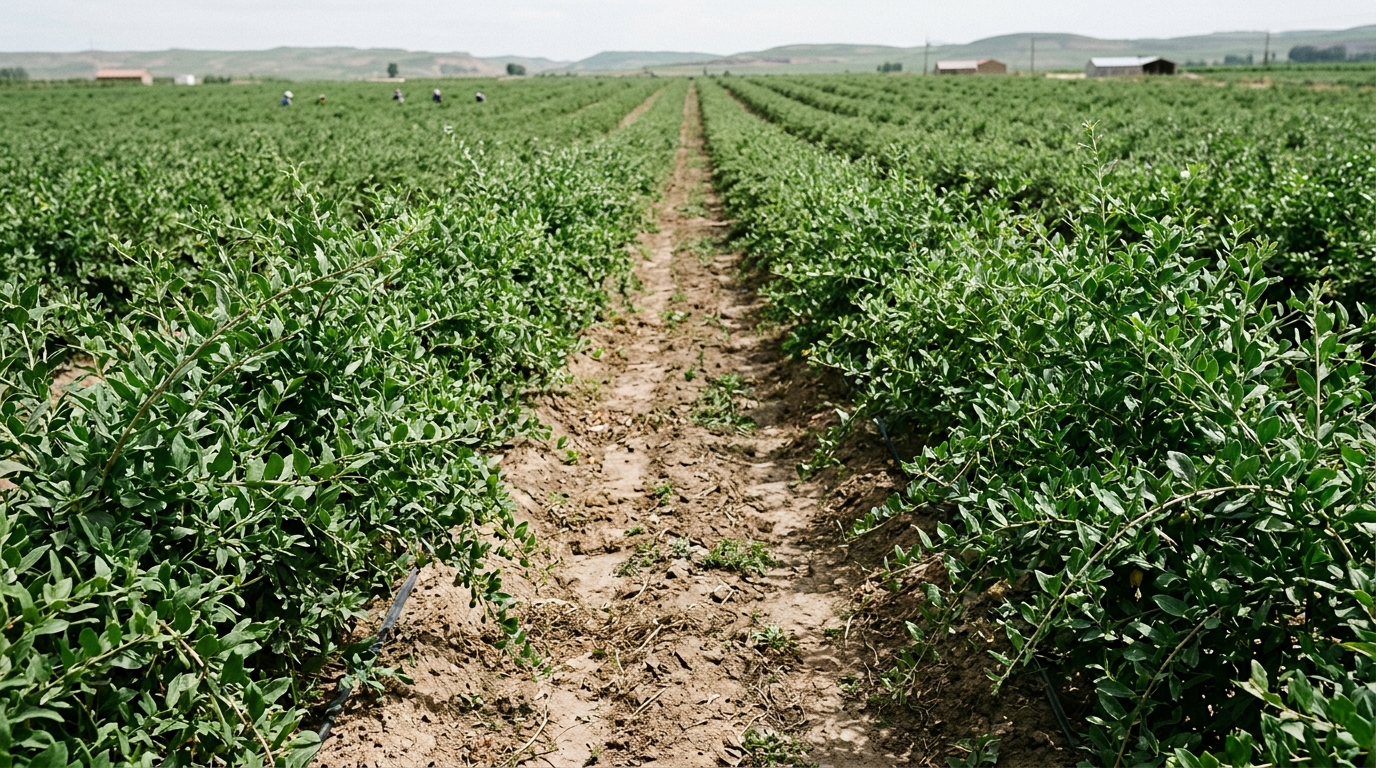
The investigation addressed field conditions specific to the non-fruiting phase of Lycium barbarum cultivation, where visual distinction between plant-column and path regions is significantly diminished. During this growth period, orchard scenes are characterized by sparse foliage, exposed branches, fallen leaves, weeds, similar soil backgrounds, and variable illumination. The authors observed that these complex background factors weaken visual contrast, rendering conventional agricultural segmentation techniques based primarily on color or texture features unreliable for autonomous machine guidance.

To overcome these visual challenges, the research team designed an encoder–decoder convolutional neural network tailored to complex orchard environments. The model architecture incorporates depthwise separable convolutions, skip connections, and multi-scale contextual feature extraction to enhance feature representation across field scenes. Alongside the network design, the researchers established a region-based annotation strategy that labeled continuous plant-column and path areas to satisfy the geometric requirements of navigation baseline extraction.

The training and evaluation data were gathered from multiple Lycium barbarum gardens across different years, crop growth stages, lighting conditions, irrigation schemes, and soil types. To strengthen model robustness against field variability, data augmentation was applied during the training phase. Cross-garden generalization was then assessed on two unseen field environments to observe how effectively the trained architecture mitigated domain shifts between different growing sites.

On the independent internal test set, the model attained a precision of 95.24 ± 2.66%, a recall of 94.64 ± 3.14%, a Dice coefficient of 94.68 ± 3.15%, and a mean pixel accuracy of 94.64 ± 3.14%. The authors noted that minor discrepancies near boundaries may reflect potential annotation ambiguity, while concluding that the method provides reliable region-level segmentation and technical support for navigation baseline extraction in agricultural robotic systems.

Subject of Research: Semantic segmentation for robotic navigation in non-fruiting Lycium barbarum gardens

Article Title: Research on segmentation method for Lycium barbarum garden images during non-fruiting period

Article References: Li, M., Liu, Z., Yang, S., Qi, J., Chen, Y., & Ma, Y. (2026). Research on segmentation method for Lycium barbarum garden images during non-fruiting period. Frontiers in Artificial Intelligence, 9, Article 1769631. https://doi.org/10.3389/frai.2026.1769631

Image Credits: AI Generated

DOI: 10.3389/frai.2026.1769631

Keywords: Lycium barbarum, semantic segmentation, agricultural robotics, visual navigation, deep learning, encoder-decoder network, baseline extraction, precision agriculture, Research, segmentation, method, Lycium

News Source: Denise Maddox. (November 13, 2026). Semantic Segmentation Method Supports Navigation Baseline Extraction in Non-Fruiting Lycium Barbarum Gardens. Scienmag.


Tags: agricultural roboticsbaseline extractiondeep learningencoder-decoder networkLyciumLycium barbarummethodprecision agricultureresearchsegmentationsemantic segmentationvisual navigation
Share12Tweet7Share2ShareShareShare1

Related Posts

Plant-Disjoint Audit Shows High Accuracy in Automated Coconut Disease Recognition Model

Plant-Disjoint Audit Shows High Accuracy in Automated Coconut Disease Recognition Model

November 20, 2026
Polysiloxane Nanocomposites With Low Graphene Content Boost Flexible Triboelectric Output

Polysiloxane Nanocomposites With Low Graphene Content Boost Flexible Triboelectric Output

November 20, 2026

Upcycled Magnetic Biochar Achieves Ninety Percent Polystyrene Microplastic Removal in Tests

November 20, 2026

3D Geomechanical Model Reveals Crustal Stress Patterns at Shazaoyuan Granite Site

November 20, 2026

POPULAR NEWS

  • CMOS Potts Chip Harnesses Multiphase Oscillations for Low-Power Memory and Graph Optimization

    CMOS Potts Chip Harnesses Multiphase Oscillations for Low-Power Memory and Graph Optimization

    29 shares
    Share 12 Tweet 7
  • Optimized Radiolabeling Improves iPSMA Homogeneity and Supports Single Vial Cold Kit Formulation

    29 shares
    Share 12 Tweet 7
  • Cross-Sectional Bahrain Survey Links Weather, Demands, and Gender to Activity Rates

    29 shares
    Share 12 Tweet 7
  • Biologists Propose Teleonome Framework to Assess Animal Welfare and Agency

    29 shares
    Share 12 Tweet 7

About

We bring you the latest biotechnology news from best research centers and universities around the world. Check our website.

Follow us

Recent News

Electrosprayed Starch Microparticles Stabilize Blackberry Extract and Protect Bioactive Antioxidants

Clinicians Propose Framework to Protect Medicaid Care Amid Projected Federal Cuts

Plant-Disjoint Audit Shows High Accuracy in Automated Coconut Disease Recognition Model

Subscribe to Blog via Email

Enter your email address to subscribe to this blog and receive notifications of new posts by email.

Join 89 other subscribers
  • Contact Us

Bioengineer.org © Copyright 2023 All Rights Reserved.

Welcome Back!

Login to your account below

Forgotten Password?

Retrieve your password

Please enter your username or email address to reset your password.

Log In
No Result
View All Result
  • Homepages
    • Home Page 1
    • Home Page 2
  • News
  • National
  • Business
  • Health
  • Lifestyle
  • Science

Bioengineer.org © Copyright 2023 All Rights Reserved.