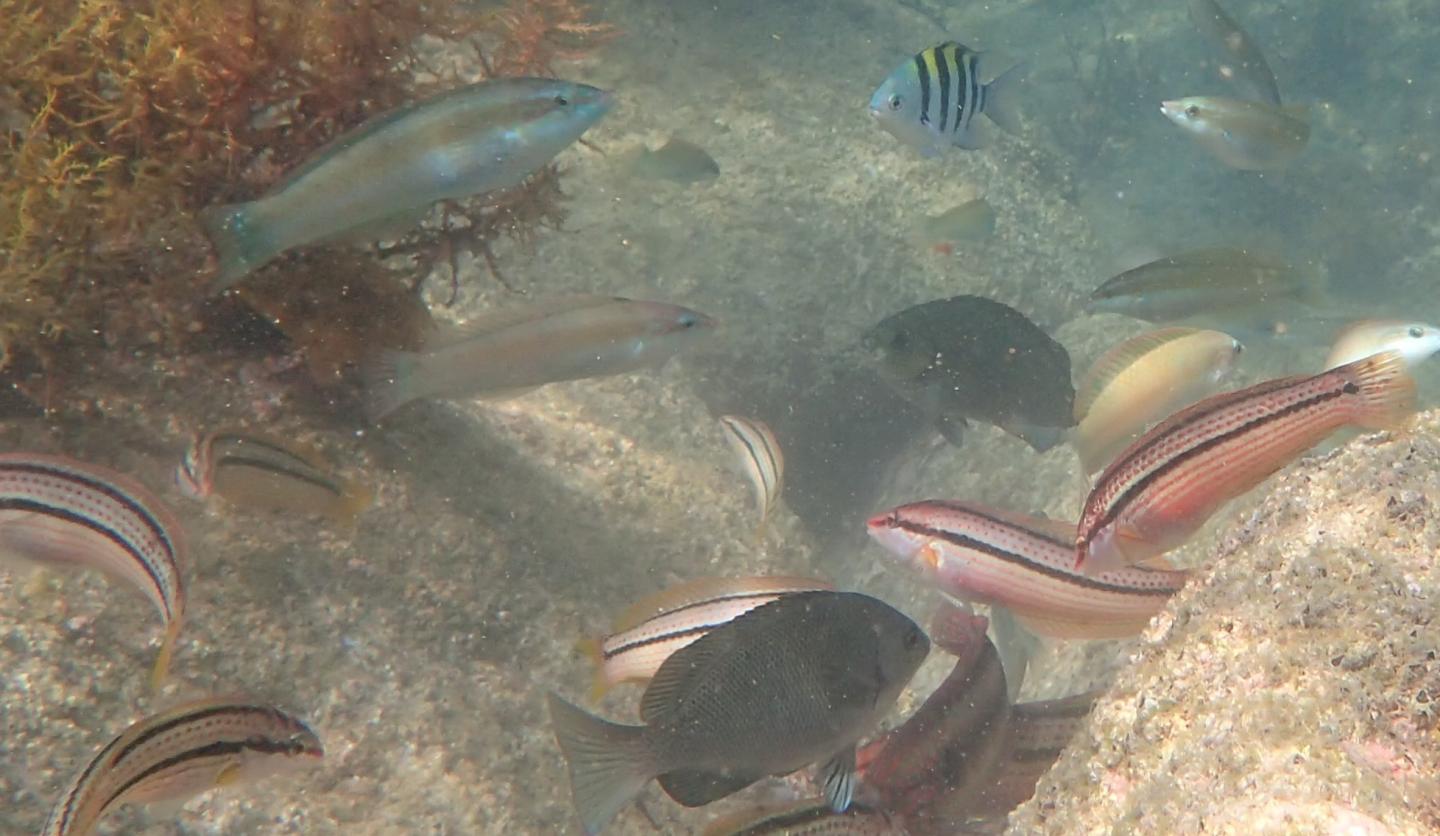
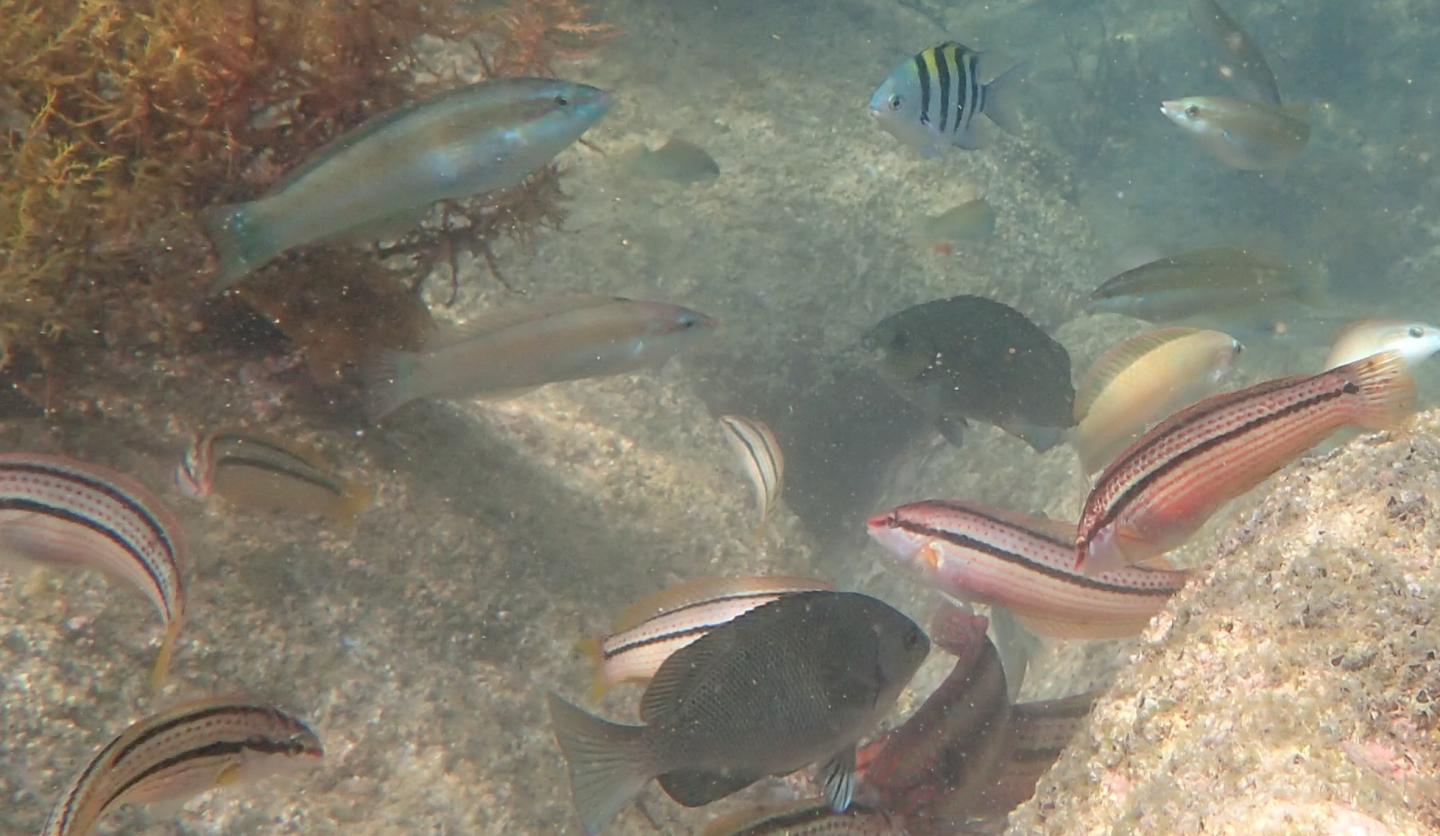
Credit: Kyoto University / Reiji Masuda
Kyoto, Japan — In a study spanning twelve years, researchers from Kyoto University, and with Ryukoku University have developed a method to calculate the fluctuating stability of a natural ecological community in Maizuru Bay.
Their findings, published in Nature, provide insight into and new methodologies for ecological and population research.
How biological communities are maintained is a big question in ecology. While current studies suggest community stability can be influenced by species diversity and interactions, these ideas have almost never been tested in natural ecosystems.
"Previous research focused on issues such as the birth-death process, like when a predator eats prey, and inside a somewhat controlled environment," explains lead author Masayuki Ushio. "Even then, it is challenging to measure the rapidly changing interactions of multiple species in nature."
A key reason for this is that natural ecosystems do not typically exhibit equilibrium dynamics, and so the most viable way to measure changes is to keep constant records of organisms in a particular location.
Fortunately, Reiji Masuda of the Field Science Education and Research Center has been doing just that in Maizuru Bay. For twelve years, he has been diving into the waters every two weeks, recording the populations of all the fish and jellyfish he encountered.
"I initially started these observations in 2002 to see what organisms lived in the area and how they change over time," Masuda describes. "When I showed my work to Masayuki Ushio and Michio Kondoh at Ryukoku University, they suggested we work together and build a model to chart the interactions between the organisms."
The model was constructed by applying a time series analysis tool — empirical dynamic modeling, or EDM — to the Maizuru Bay data set. EDM is designed to analyze the fluctuating dynamics of a natural ecosystem, without setting any defined equations. This was then further developed to analyze the ecosystem's dynamic stability.
What they found was a complex web of interactions, where organisms have positive or negative effects on each other, and more importantly, showed that short-term changes in the network influences overall community dynamics.
"We could even see that things such as diversity, species interactions, and stability itself fluctuate throughout time," says Ushio. "This suggests that these properties are key to understanding the mechanisms underlying the functioning of natural ecosystems."
The team's methods can be readily applied to other fields, from neuroscience, microbiology, to economics.
"This is by far one of the most comprehensive looks at how much an ecosystem can change in the natural world," concludes team leader Michio Kondoh. "I was surprised to see that community stability, which is often assumed to be constant, is in fact changing over time. The robustness of ecological communities depends on timing and seasons."
###
The paper "Fluctuating interaction network and time-varying stability of a natural fish community" appeared 07 February 2018 in the journal Nature, with doi: 10.1038/nature25504
About Kyoto University
Kyoto University is one of Japan and Asia's premier research institutions, founded in 1897 and responsible for producing numerous Nobel laureates and winners of other prestigious international prizes. A broad curriculum across the arts and sciences at both undergraduate and graduate levels is complemented by numerous research centers, as well as facilities and offices around Japan and the world. For more information please see: http://www.kyoto-u.ac.jp/en
Media Contact
Raymond Kunikane Terhune
[email protected]
81-757-535-728
@KyotoU_News
http://www.kyoto-u.ac.jp/en
Related Journal Article
http://dx.doi.org/10.1038/nature25504