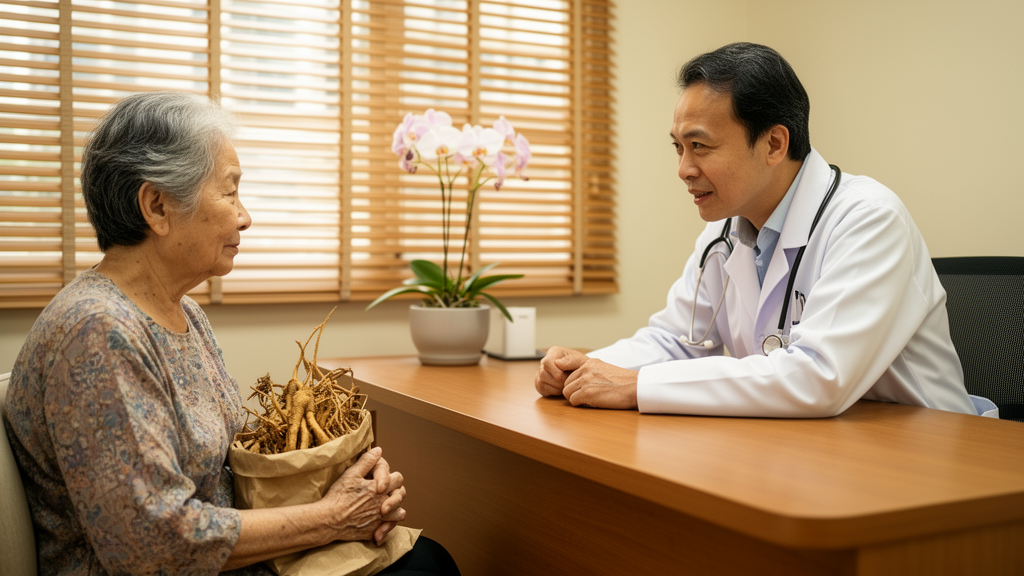
More than half of all cancer patients in Singapore turn to traditional or complementary therapies after receiving their diagnosis, yet most of them never tell their oncologists. That silent gap between what patients do and what their doctors know has long been one of the most underappreciated safety problems in modern cancer care. Herbal formulations, acupuncture, dietary supplements and other traditional practices can interact with chemotherapy drugs, alter blood counts, or complicate symptom assessment, but only if clinicians know about them. A new qualitative study from the National Cancer Centre Singapore, published in Supportive Care in Cancer, has now mapped out exactly what needs to change, drawing on the collective judgment of twenty-two stakeholders spanning oncology, palliative care, nursing, pharmacy, allied health, Traditional Chinese Medicine, research and service coordination.
The study took the form of a multi-stakeholder roundtable, a format designed to bring rival professional perspectives into the same room and force them to negotiate priorities rather than talk past each other. The session was audio-recorded, transcribed verbatim and analyzed using reflexive thematic analysis, a qualitative method in which researchers actively acknowledge how their own clinical and cultural backgrounds shape the interpretation of the data. From that process, five distinct themes emerged, and together they sketch a blueprint for how a pluralistic health system, one in which biomedical and traditional medicine coexist, can begin to make integrative oncology a routine, coordinated part of cancer treatment rather than an unregulated parallel track.
The first priority identified by participants was strikingly simple: conversations about integrative oncology therapies need to happen earlier and recur throughout the cancer care trajectory. At present, discussions about herbal medicine or acupuncture, when they happen at all, tend to occur at a single point in treatment, often triggered by a complication rather than by proactive planning. Cancer care is dynamic. Regimens change, symptoms evolve, and a therapy that was harmless during surgery may become risky during chemotherapy. Stakeholders argued that asking about traditional therapy use should become as habitual as asking about allergies or medications, repeated at diagnosis, at each treatment transition and into survivorship, so that risks can be reassessed continuously rather than discovered retrospectively.
The second theme addressed the practical plumbing that would be needed to connect two systems that currently operate largely in isolation. Participants called for shared documentation and bidirectional referral pathways between conventional cancer centers and community practitioners of traditional medicine. In the current arrangement, a patient might see a Traditional Chinese Medicine physician in a charity clinic, an oncologist at a public hospital and a general practitioner in between, with none of them able to see what the others have prescribed. The stakeholders envisioned a system in which a community practitioner who identifies a red flag, such as an herb with anticoagulant properties in a patient about to undergo surgery, could escalate the case directly to a specialist, and in which oncologists could refer patients downward to trusted community providers for supportive care. Without this infrastructure, coordination depends entirely on the patient’s memory and willingness to disclose.
The third theme revealed something deeper about how medical decisions are actually made in Singapore’s cultural context. Integrative oncology choices, participants noted, are frequently shaped not by patients alone but by family members and wider community networks. A spouse may insist on a particular herbal tonic; adult children may research supplements online; extended family may offer well-meaning advice rooted in tradition. Western bioethics tends to treat patient autonomy as an individual matter, but in many Asian families, decision-making is relational, distributed across the people who love and care for the patient. The stakeholders concluded that support services must accommodate this reality rather than fight it, engaging families as partners in safety conversations instead of treating their involvement as an obstacle to autonomous choice.
Cost and clinical legitimacy formed the fourth theme, and it exposed a feedback loop with real consequences for equity. Patients were described as reluctant to pay out of pocket for integrative therapies unless they carried some form of oncology endorsement. In a health system where out-of-pocket spending is a significant component of financing, this means that the therapies most likely to be used are those that are cheapest or most visible, not necessarily those with the best evidence. Research from Southeast Asia has documented how complementary medicine costs following a cancer diagnosis can impose substantial financial strain on households in the region. The roundtable participants suggested that real-world outcomes data on integrative oncology uptake within conventional care would be essential for informing any future subsidy mechanisms, because payers and policymakers need evidence of benefit before they will fund a service.
The fifth theme positioned cancer centers themselves as the engines of credibility and training. Participants viewed institutions such as the National Cancer Centre Singapore as instrumental in providing the clinical legitimacy that evidence-informed integrative therapies currently lack, and in building a workforce capable of delivering them. This matters because the field of integrative oncology, as formally defined in a 2017 consensus statement, is not about endorsing everything labeled natural; it is about rigorously evaluating mind-body practices, natural products and lifestyle interventions and integrating those with demonstrated benefit into standard supportive care. International guidelines from the Society for Integrative Oncology and the American Society of Clinical Oncology already recommend specific approaches for managing anxiety, depression, fatigue and pain in cancer patients. The gap identified in Singapore is not a lack of evidence but a lack of institutional machinery to translate that evidence into routine practice.
What makes the Singapore case particularly instructive is the nature of its health system. The country operates a pluralistic model in which Western biomedicine and Traditional Chinese Medicine coexist within a regulated framework, and the government has publicly encouraged the use of evidence-based traditional Chinese medicine alongside Western practice. Traditional Chinese Medicine institutions, including charity organizations such as the Singapore Thong Chai Medical Institution and the Singapore Chung Hwa Medical Institution, both of which were represented among the roundtable participants, serve large patient populations. Meanwhile, national initiatives to transform primary care are creating new expectations for coordinated, longitudinal care across providers. In this environment, the study’s authors argue, the goal should not be to eliminate traditional therapy use but to make pre-existing use safer, more visible and better coordinated.
The safety rationale for this approach is well documented in the international literature. Systematic reviews have consistently found that disclosure of complementary medicine use to medical providers is low worldwide, with many patients believing their doctors would disapprove or that the information is irrelevant. Studies specific to Singapore have reported high rates of complementary and alternative medicine use among adult cancer patients, often self-directed and undisclosed. Pharmacists and oncologists know that certain herbal products can induce or inhibit the cytochrome P450 enzymes that metabolize many chemotherapy agents, potentially altering drug exposure, yet none of this can be managed if the exposure itself is hidden. The roundtable findings suggest that the solution lies less in lecturing patients about disclosure and more in building a system in which disclosure is easy, non-judgmental and clinically rewarded.
The study, which was determined exempt from formal ethical review by the SingHealth Centralized Institutional Review Board and funded without external grants, arrives at a moment when integrative oncology is moving from the margins of cancer medicine toward its mainstream. Global surveys of supportive care providers show growing interest in modalities ranging from acupuncture to mindfulness, and clinical trials in Singapore, such as work evaluating Traditional Chinese Medicine interventions for cancer-related fatigue, are generating local evidence. The roundtable’s conclusions are clear-eyed about what remains undone: real-world data on uptake and outcomes, sustainable financing mechanisms, shared records and trained personnel. But they also carry a message that resonates far beyond Singapore. Wherever patients live in cultures where traditional medicine is embedded, the choice facing health systems is not whether patients will use these therapies, because they already do, but whether the system will meet them where they are and make that use safe.
Subject of Research: Stakeholder priorities for integrating traditional and complementary therapies into cancer care in Singapore's pluralistic health system
Article Title: Stakeholder priorities for advancing integrative oncology across a pluralistic health system: a qualitative study from Singapore
Article References: Ke, Y., Fok, R. W. Y., Ho, S., Tan, R. Y. C., Ramalingam, M. B., Thum, M. C. M., Ng, D. Q., Tan, Y. P., Tan, E. U. T., Chong, W. Q., Yee, C. M., Zheng, H. F., Peh, W. L. W., Ang, S. K., Chay, W. Y., Tan, T. J. Y., Neo, P. S. H., Zhong, L., Chee, C. E., … Deng, G. (2026). Stakeholder priorities for advancing integrative oncology across a pluralistic health system: a qualitative study from Singapore. Supportive Care in Cancer, 34(10), Article 939. https://doi.org/10.1007/s00520-026-11167-y
Image Credits: AI Generated
DOI: 10.1007/s00520-026-11167-y
Keywords: integrative oncology, traditional Chinese medicine, complementary medicine, cancer care, Singapore, patient safety, qualitative research, supportive care, health policy, care coordination, patient disclosure, pluralistic health system
News Source: Nathaniel Bowman. (October 18, 2026). Cancer Patients Hide Their Herbal Remedies. Singapore Wants to Change That. Scienmag.