• HOME
  • NEWS
  • EXPLORE
    • CAREER
      • Companies
      • Jobs
    • EVENTS
    • iGEM
      • News
      • Team
    • PHOTOS
    • VIDEO
    • WIKI
  • BLOG
  • COMMUNITY
    • FACEBOOK
    • INSTAGRAM
    • TWITTER
Saturday, May 2, 2026
BIOENGINEER.ORG
No Result
View All Result
  • Login
  • HOME
  • NEWS
  • EXPLORE
    • CAREER
      • Companies
      • Jobs
        • Lecturer
        • PhD Studentship
        • Postdoc
        • Research Assistant
    • EVENTS
    • iGEM
      • News
      • Team
    • PHOTOS
    • VIDEO
    • WIKI
  • BLOG
  • COMMUNITY
    • FACEBOOK
    • INSTAGRAM
    • TWITTER
  • HOME
  • NEWS
  • EXPLORE
    • CAREER
      • Companies
      • Jobs
        • Lecturer
        • PhD Studentship
        • Postdoc
        • Research Assistant
    • EVENTS
    • iGEM
      • News
      • Team
    • PHOTOS
    • VIDEO
    • WIKI
  • BLOG
  • COMMUNITY
    • FACEBOOK
    • INSTAGRAM
    • TWITTER
No Result
View All Result
Bioengineer.org
No Result
View All Result
Home NEWS Science News Chemistry

Can AI be used to predict ocean waves?

Bioengineer by Bioengineer
April 3, 2023
in Chemistry
Reading Time: 2 mins read
0
Artificial intelligence methods may become a new development direction for ocean waves prediction
Share on FacebookShare on TwitterShare on LinkedinShare on RedditShare on Telegram

The ability to model and predict the size of ocean waves is important for the fishing industry from both logistic and economic perspectives. Essentially, the bigger the waves, the more expensive the fish. Existing ocean wave models use numerical methods to solve the equations of wind wave action and ocean wave energy to obtain future predictions of ocean waves. However, although good results can be achieved, such models require large amounts of computing resources and are time-consuming and costly. But is there an alternative method that could make wave predictions more quickly whilst at the same time ensuring roughly the same level of accuracy?
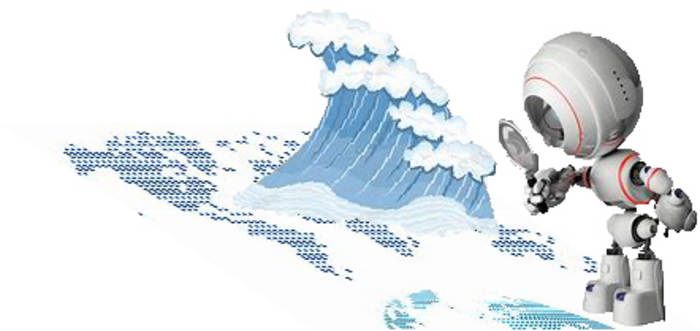
Artificial intelligence methods may become a new development direction for ocean waves prediction

Credit: OUYANG Lin

The ability to model and predict the size of ocean waves is important for the fishing industry from both logistic and economic perspectives. Essentially, the bigger the waves, the more expensive the fish. Existing ocean wave models use numerical methods to solve the equations of wind wave action and ocean wave energy to obtain future predictions of ocean waves. However, although good results can be achieved, such models require large amounts of computing resources and are time-consuming and costly. But is there an alternative method that could make wave predictions more quickly whilst at the same time ensuring roughly the same level of accuracy?


In a paper recently published in Atmospheric and Oceanic Science Letters, Professor Luo Jingjia and coauthors from the Climate and Applied Frontier Research Institute (ICAR) of Nanjing University of Information Science & Technology (NUIST) attempted to solve this problem based on their recent preliminary work on using artificial intelligence (AI) methods to predict ocean waves.


“By comparing several methods, our two-stage ConvLSTM model demonstrates good accuracy in predicting ocean waves,” says Professor Luo. “We also conducted real-time experiments and found that the effect of using the winds predicted by the model as a substitute was also good.”


“Next, we plan to integrate our AI model into NUIST climate forecast system model by using the winds predicted by it as the input of the AI model to predict ocean waves, which will be more economical and time-saving than operating the ocean wave model,” adds Professor Luo.


Journal

Atmospheric and Oceanic Science Letters

DOI

10.1016/j.aosl.2023.100347

Article Title

Wave forecast in the Atlantic Ocean using a double-stage ConvLSTM network

Share12Tweet8Share2ShareShareShare2

Related Posts

Using Epigenetics to Monitor Environmental Arsenic Exposure — Chemistry

Using Epigenetics to Monitor Environmental Arsenic Exposure

May 1, 2026
Innovative Nanoreactor Design Enhances Catalysis by Optimizing Transport and Reaction Kinetics — Chemistry

Innovative Nanoreactor Design Enhances Catalysis by Optimizing Transport and Reaction Kinetics

May 1, 2026

Swift Creation of Conductive Organic Compounds via Mechanochemistry

May 1, 2026

Scientists Reveal Atomic Mechanism Behind Water-Induced Hydroxylation in CoOx Nanostructures

May 1, 2026

POPULAR NEWS

  • Research Indicates Potential Connection Between Prenatal Medication Exposure and Elevated Autism Risk

    832 shares
    Share 333 Tweet 208
  • New Study Reveals Plants Can Detect the Sound of Rain

    714 shares
    Share 285 Tweet 178
  • Scientists Investigate Possible Connection Between COVID-19 and Increased Lung Cancer Risk

    67 shares
    Share 27 Tweet 17
  • Salmonella Haem Blocks Macrophages, Boosts Infection

    61 shares
    Share 24 Tweet 15

About

We bring you the latest biotechnology news from best research centers and universities around the world. Check our website.

Follow us

Recent News

Physical Disorders, ADLs, Cognition, Depression in Nursing Homes

Precise Spatiotemporal Cardiac Repair and Regeneration

Paul and Shelia Schlosberg Family Foundation Advances Military Brain Health with Pioneering $3 Million Grant

Subscribe to Blog via Email

Enter your email address to subscribe to this blog and receive notifications of new posts by email.

Join 82 other subscribers
  • Contact Us

Bioengineer.org © Copyright 2023 All Rights Reserved.

Welcome Back!

Login to your account below

Forgotten Password?

Retrieve your password

Please enter your username or email address to reset your password.

Log In
No Result
View All Result
  • Homepages
    • Home Page 1
    • Home Page 2
  • News
  • National
  • Business
  • Health
  • Lifestyle
  • Science

Bioengineer.org © Copyright 2023 All Rights Reserved.