Powdered activated carbon is one of the most effective catalysts ever tested for destroying stubborn organic pollutants with ozone, but a cloud of fine carbon particles swirling through a wastewater reactor is an engineer’s nightmare. The powder is hard to handle, poses an inhalation risk, clogs fixed beds with pressure losses, and demands a solid–liquid separation step after every treatment run.
The catalysts themselves were made by direct ink writing, a 3D printing technique that extrudes a viscous paste through a fine nozzle. The researchers mixed a commercial activated carbon (Norit W35 from Cabot) with 20 percent by weight of either sodium carboxymethyl cellulose (CMC) or sodium alginate (ALG), using deionised water as the solvent. Rheological measurements with a parallel-plate rheometer confirmed that both inks were pseudoplastic—their viscosity fell as shear rate rose—which is exactly the behaviour direct ink writing requires. At rest the inks behaved like solids, storing deformation energy; pushed through the 0.4 mm printing tip they flowed like liquids; and on exiting the nozzle they recovered their solid-like state, holding their printed shape without spreading or shrinking as they dried over 24 hours.
Thermogravimetric analysis showed the synthesis was faithful to the recipe: the alginate-based pellets, named AC_20ALG, retained 16.8 wt% binder, close to the theoretical 20 percent, while the CMC-based pellets, AC_20CMC, incorporated 27.0 wt%. Nitrogen physisorption at −196 °C revealed that both binders slightly diluted the total surface area by blocking some of the activated carbon’s pores, but the microporous character of the carbon survived essentially intact, with the pore size distribution practically unchanged. The pristine carbon itself had a broad, polydisperse particle size distribution—an average diameter of 16.48 μm with a span of roughly 2.6—and a point of zero charge of about 8.77, meaning its surface is positively charged under the acidic reaction conditions used.
The target pollutant was oxalic acid, a diprotic acid that matters because it is a classic recalcitrant intermediate: when ozone oxidises larger organic contaminants in water, oxalic acid is one of the stubborn end-products that conventional treatment struggles to remove. The experiments ran in a semi-batch reactor of roughly one litre, holding 700 mL of a 1 mM oxalic acid solution, with ozone generated from pure oxygen and sparged through the liquid at 50 g O₃ per m³ and 150 cm³ per minute. Catalyst mass was adjusted, based on the thermogravimetrically measured binder content, so that every test used an effective 100 mg of carbon material. Oxalic acid concentration was tracked by high-performance liquid chromatography with UV–vis detection.
The first stirring trials exposed the problem the whole study set out to solve. With a standard magnetic stirrer running at 400 rpm—the speed optimised in earlier work with powder catalysts—the 3D-printed pellets simply disintegrated. Shear stress tore them apart, shedding loose carbon particles into the liquid, and even reducing the speed to 300 rpm did not help; below that, the pellets settled uselessly on the reactor floor. The powdered remnants of the printed catalysts did degrade oxalic acid, but they performed worse than pristine powdered carbon, because the binder had blocked some of the active sites. Mechanical stability, not chemistry, was the bottleneck.
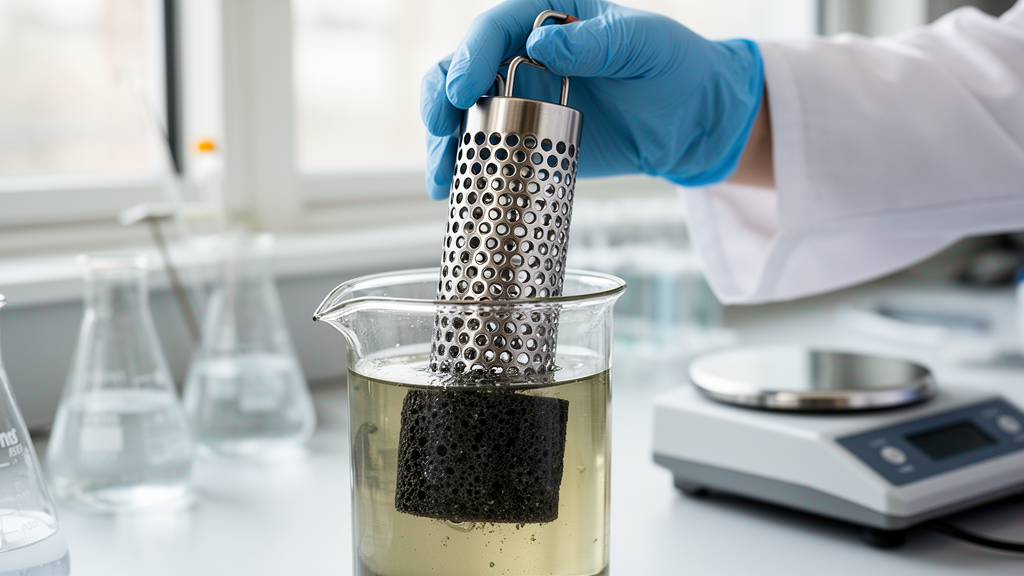
The team’s solution was elegantly mechanical: a perforated-case magnetic stirrer. Designed in SolidWorks and built with an 80 × 80 μm² mesh net, the device encloses the catalyst pellets in a basket while a magnetic bar at its base drives rotation. Liquid and ozone bubbles pass freely through the perforations and contact the solid, but the stirrer’s shear never reaches the pellets directly. Optical microscopy confirmed the mesh dimensions. The maximum stable operating speed for the new stirrer was 250 rpm, and single-ozonation tests across a range of speeds identified 200 rpm as the optimum for gas–liquid mass transfer.
With AC_20ALG pellets inside the perforated cage at 200 rpm, the results were striking: 90 percent of the oxalic acid was removed within 180 minutes. Adsorption alone accounted for only about 3 percent, confirming genuine catalytic activity. Only the alginate-bound pellets survived; the CMC-based pellets crumbled even inside the cage.
The chemistry behind the catalytic effect was probed with scavenger experiments. When 1 mM tert-butanol was added to the oxalic acid solution, the removal rate dropped markedly, indicating that hydroxyl radicals, rather than direct reaction with ozone at the carbon surface, dominate the oxidation pathway. This is consistent with the accepted picture of how carbon materials activate ozone: oxygen-containing surface groups act as electron donors or acceptors depending on pH, enabling redox interactions that yield hydroxyl radicals or surface-bound reactive oxygen species, while structural defects such as edges, lattice vacancies and sp2/sp3 hybridisation imbalance serve as additional reactive centres for ozone decomposition. Under the acidic reaction conditions, with the carbon’s point of zero charge at 8.77, the positively charged surface attracts the negatively charged oxalate species, raising their local concentration at the solid–liquid interface and facilitating their attack by radicals generated there.
The hydrodynamic analysis added a quantitative dimension to the stirrer comparison. The researchers calculated impeller Reynolds numbers for both devices, first treating the fluid as pure liquid and then refining the calculation to account for the continuous gas feed, using an empirical formulation for turbulent gas–liquid systems with constants drawn from earlier bubble-flow studies. Both stirrers induced a turbulent regime, and the corrected density and viscosity values barely differed from those of pure water. The instructive result was the divergence with speed: the Reynolds number for the perforated-case stirrer rose more steeply than for the standard bar, because the perforations and external blades create localised pressure differences, high-shear zones and microturbulence that increase flow resistance. The authors interpret this as a double-edged property—the same turbulence that improves ozone dissolution and liquid renewal around the pellets also threatens their structural integrity at elevated speeds, which may explain the decline in catalytic performance observed at 250 rpm after 90 minutes, attributed to mechanical abrasion, loss of active sites or agglomeration.
Reusability testing addressed the practical question of whether the catalyst survives repeated use. Over three consecutive ozonation cycles at 200 rpm, oxalic acid removal after 180 minutes was 90, 91 and 92 percent, a remarkably stable performance even though visible fissures appeared on the pellets after the third run—the reason only three cycles were attempted. Two explanations are offered for the maintained activity despite physical degradation: detached fragments may have remained dispersed as fine particles, enlarging the contact area, or the fissures allowed gas and liquid to penetrate the pellet interior, exposing fresh active sites. Thermogravimetric analysis of the spent catalyst quantified the cost of this exposure: alginate content fell from 27.0 wt% in the fresh pellets to 20.4 wt% after three cycles, a 6.6 percentage-point loss attributed to deterioration of the outer alginate layers in direct contact with water and ozone. Scanning electron microscopy corroborated this, showing fissures and localised surface erosion in the gel-like linking zones between carbon particles after three runs, though the overall printed framework did not collapse.
The authors are candid that mechanical stability remains the outstanding limitation. They suggest future work could replace alginate with a more ozone-resistant binder, such as polylactic acid, or optimise the binder content. Even so, they argue the direct ink writing route is well suited to scale-up: it operates at ambient conditions, uses water as the dispersion medium, and allows the catalyst macrostructure to be controlled digitally. Alginate can be sourced sustainably from brown seaweeds and algal residues, offering waste valorisation and reducing reliance on synthetic binders. These features, the team suggests, make the strategy potentially transferable to pilot-scale manufacture of structured catalysts for semi-batch or continuous ozonation reactors, where larger monolithic supports or modular printed inserts could replace conventional granular catalysts.
Several caveats frame the significance of the work. The experiments were conducted on a single model pollutant, oxalic acid, at laboratory scale in roughly one-litre batches; performance against real wastewater matrices, with their competing organic matter and variable chemistry, was not tested. The reported removal refers to the disappearance of dissolved oxalic acid measured by chromatography, and the long-term durability of the printed pellets beyond three cycles remains unresolved. What the study demonstrates is narrower but concrete: that the mechanical fragility which has kept 3D-printed carbon catalysts out of stirred ozonation systems can be addressed by redesigning the mixing hardware rather than the catalyst itself, and that a perforated cage operating at a carefully chosen speed can keep such catalysts intact long enough to do useful chemistry.
Subject of Research: Development of 3D-printed activated carbon catalysts and a perforated-case magnetic stirrer for catalytic ozonation of oxalic acid in semi-batch water treatment.
Article Title: A novel stirrer for feasible use of 3D-printed carbon-based catalysts within semi-batch systems
Article References: Barbosa, J. R. M., Pereira, M. F. R., Ribeiro, A. M., & Soares, O. S. G. P. (2026). A novel stirrer for feasible use of 3D-printed carbon-based catalysts within semi-batch systems. Discover Catalysis, 3(1), Article 7. https://doi.org/10.1007/s44344-026-00036-9
Image Credits: AI Generated
DOI: 10.1007/s44344-026-00036-9
Keywords: 3D printing, activated carbon, catalytic ozonation, water treatment, direct ink writing, alginate binder, oxalic acid, semi-batch reactor, magnetic stirrer, catalyst stability, advanced oxidation, shear stress
News Source: Bethany Barker. (October 29, 2026). Caged Catalyst: Perforated Stirrer Unlocks 3D-Printed Carbon Catalysts for Water Treatment. Scienmag.