• HOME
  • NEWS
  • EXPLORE
    • CAREER
      • Companies
      • Jobs
    • EVENTS
    • iGEM
      • News
      • Team
    • PHOTOS
    • VIDEO
    • WIKI
  • BLOG
  • COMMUNITY
    • FACEBOOK
    • INSTAGRAM
    • TWITTER
Sunday, May 10, 2026
BIOENGINEER.ORG
No Result
View All Result
  • Login
  • HOME
  • NEWS
  • EXPLORE
    • CAREER
      • Companies
      • Jobs
        • Lecturer
        • PhD Studentship
        • Postdoc
        • Research Assistant
    • EVENTS
    • iGEM
      • News
      • Team
    • PHOTOS
    • VIDEO
    • WIKI
  • BLOG
  • COMMUNITY
    • FACEBOOK
    • INSTAGRAM
    • TWITTER
  • HOME
  • NEWS
  • EXPLORE
    • CAREER
      • Companies
      • Jobs
        • Lecturer
        • PhD Studentship
        • Postdoc
        • Research Assistant
    • EVENTS
    • iGEM
      • News
      • Team
    • PHOTOS
    • VIDEO
    • WIKI
  • BLOG
  • COMMUNITY
    • FACEBOOK
    • INSTAGRAM
    • TWITTER
No Result
View All Result
Bioengineer.org
No Result
View All Result
Home NEWS Science News Chemistry

Bush-crickets’ ears unlock the science to developing revolutionary hearing sensors

Bioengineer by Bioengineer
February 11, 2020
in Chemistry
Reading Time: 3 mins read
0
IMAGE
Share on FacebookShare on TwitterShare on LinkedinShare on RedditShare on Telegram

IMAGE

Credit: Dr Thorin Jonsson


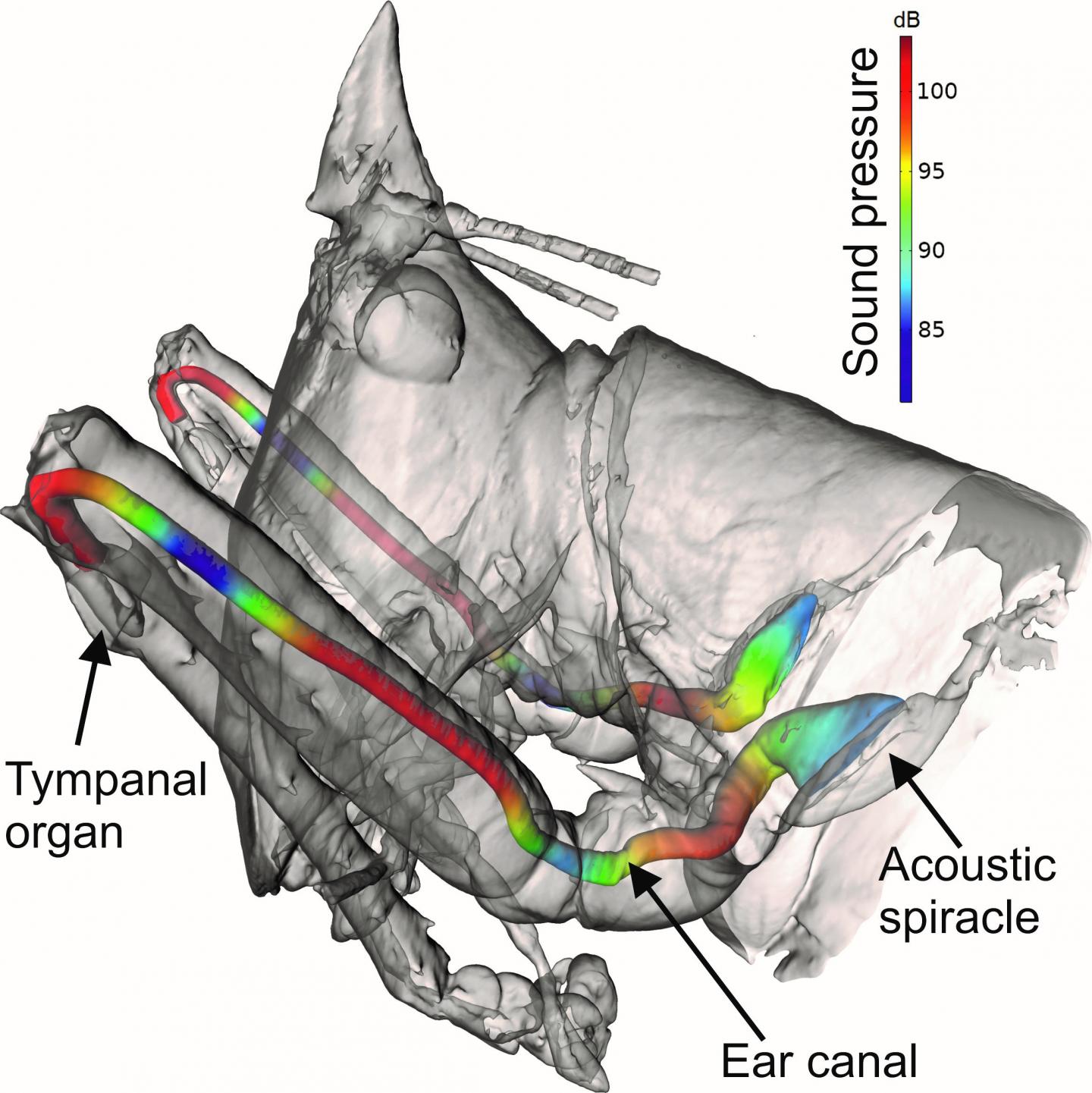
New research has found that bush-crickets’ ear canals have evolved to work in the same way as mammals’ ears to amplify sound and modulate sound pressure – and the findings could help scientists make better acoustic sensors for human use.

Bush-crickets are insects that depend on acoustic communication for survival, with the males singing to attract distant females. They have very small ‘ears’ in their forelegs, which work in a similar way to humans with an outer, middle and inner ear, and many species have transparent ‘skins’, enabling scientists to measuring ear processes.

An international team of sensory biologists and mathematicians found that the insects’ horn-shaped outer ear, called the acoustic trachea tube, captures sound in the same way as mammals’ ear canals by amplifying and transforming the pressure waves, which are then passed along to the surface of the eardrum to provide the animal with directional hearing.

Until now, the mechanism responsible for such changes in sound pressure levels which affects directional hearing has been unknown. The findings could revolutionise how auditory devices identify the location or origin of a detected sound, aiding the challenging design of wireless acoustic sensor networks used for monitoring and surveillance purposes.

The team carried out the study on a species called Copiphora gorgonensis, which are found in the Colombian rainforest. They used 3D x-ray imaging to capture the structure of the bush-cricket’s ears, coupled with mathematical analysis to determine how the sound worked inside the acoustic tube.

The research was part of a €1.9million European Research Council-funded project led by Professor Fernando Montealegre-Zapata, an entomologist specialising in sensory biology and biophysics at the University of Lincoln, UK. It was carried out in partnership with the University of Bristol, and University of Graz in Austria.

Dr Emine Celiker, a Research Fellow in numerical modelling in the School of Life Sciences at the University of Lincoln, conducted the study. She said: “The research is the first step in using combined experimental and mathematical techniques to determine the mechanism crickets use to hear their species’ songs.

“Our findings provide a strong indication that the bush-cricket ear processes sound in the same way a mammal’s does, making its study vital for the development of new auditory sensors. We were able to take recordings of the auditory process using laser doppler vibrometry which measures the vibrations of soundwaves on the surface of the ear canal.

“By applying mathematical modelling of the ears combined with real-life experiments, we also found that the ear canal filters out sound frequencies relevant to the species’ survival, selectively amplifying only frequencies that are behaviourally relevant for the animals – like their mating song or the high-frequency calls of predatory bats.

“Traditionally it is well known that horns increase the volume of sound, and for bush-cricket hearing it has been suspected that this is also the case due to the geometry of its acoustic tube. We verified this after a thorough investigation of the processes involved in the sound amplification. The findings have huge potential to be applied in enhancing acoustic sensors such listening devices.”

The findings have been published in Biophysical Journal.

###

Media Contact
Cerri Evans
[email protected]
0044-012-558-86165

Related Journal Article

http://dx.doi.org/10.1016/j.bpj.2019.11.3394

Tags: Algorithms/ModelsBiomechanics/BiophysicsComputer ScienceEntomologyHearing/SpeechResearch/DevelopmentSoftware EngineeringTechnology/Engineering/Computer ScienceTheory/DesignZoology/Veterinary Science
Share12Tweet8Share2ShareShareShare2

Related Posts

Miniature Sensor Uses Light to Detect Touch — Chemistry

Miniature Sensor Uses Light to Detect Touch

May 8, 2026
Iron Minerals Determine Whether Dissolved Organic Matter Fuels Microbes or Becomes Long-Term Carbon Storage — Chemistry

Iron Minerals Determine Whether Dissolved Organic Matter Fuels Microbes or Becomes Long-Term Carbon Storage

May 8, 2026

Kate Evans Appointed Associate Lab Director for Biological and Environmental Systems Science at ORNL

May 8, 2026

Advancing Multiscale Modeling and Overcoming Operational Challenges in Autothermal CO₂-to-Methanol Reactors

May 8, 2026
Please login to join discussion

POPULAR NEWS

  • Research Indicates Potential Connection Between Prenatal Medication Exposure and Elevated Autism Risk

    840 shares
    Share 336 Tweet 210
  • New Study Reveals Plants Can Detect the Sound of Rain

    727 shares
    Share 290 Tweet 181
  • Scientists Investigate Possible Connection Between COVID-19 and Increased Lung Cancer Risk

    68 shares
    Share 27 Tweet 17
  • Salmonella Haem Blocks Macrophages, Boosts Infection

    61 shares
    Share 24 Tweet 15

About

We bring you the latest biotechnology news from best research centers and universities around the world. Check our website.

Follow us

Recent News

Evaluating Digoxin Use in Patients with Symptomatic Rheumatic Heart Disease

Evaluating the Effectiveness and Safety of Digitalis Glycosides in Treating Heart Failure

Urdu Fall Risk Questionnaire Adapted for Elderly

Subscribe to Blog via Email

Enter your email address to subscribe to this blog and receive notifications of new posts by email.

Join 82 other subscribers
  • Contact Us

Bioengineer.org © Copyright 2023 All Rights Reserved.

Welcome Back!

Login to your account below

Forgotten Password?

Retrieve your password

Please enter your username or email address to reset your password.

Log In
No Result
View All Result
  • Homepages
    • Home Page 1
    • Home Page 2
  • News
  • National
  • Business
  • Health
  • Lifestyle
  • Science

Bioengineer.org © Copyright 2023 All Rights Reserved.