• HOME
  • NEWS
  • EXPLORE
    • CAREER
      • Companies
      • Jobs
    • EVENTS
    • iGEM
      • News
      • Team
    • PHOTOS
    • VIDEO
    • WIKI
  • BLOG
  • COMMUNITY
    • FACEBOOK
    • INSTAGRAM
    • TWITTER
Thursday, March 26, 2026
BIOENGINEER.ORG
No Result
View All Result
  • Login
  • HOME
  • NEWS
  • EXPLORE
    • CAREER
      • Companies
      • Jobs
        • Lecturer
        • PhD Studentship
        • Postdoc
        • Research Assistant
    • EVENTS
    • iGEM
      • News
      • Team
    • PHOTOS
    • VIDEO
    • WIKI
  • BLOG
  • COMMUNITY
    • FACEBOOK
    • INSTAGRAM
    • TWITTER
  • HOME
  • NEWS
  • EXPLORE
    • CAREER
      • Companies
      • Jobs
        • Lecturer
        • PhD Studentship
        • Postdoc
        • Research Assistant
    • EVENTS
    • iGEM
      • News
      • Team
    • PHOTOS
    • VIDEO
    • WIKI
  • BLOG
  • COMMUNITY
    • FACEBOOK
    • INSTAGRAM
    • TWITTER
No Result
View All Result
Bioengineer.org
No Result
View All Result
Home NEWS Science News Biology

Bumblebees aversion to pumpkin pollen may help plants thrive

Bioengineer by Bioengineer
March 11, 2020
in Biology
Reading Time: 3 mins read
0
IMAGE
Share on FacebookShare on TwitterShare on LinkedinShare on RedditShare on Telegram

IMAGE

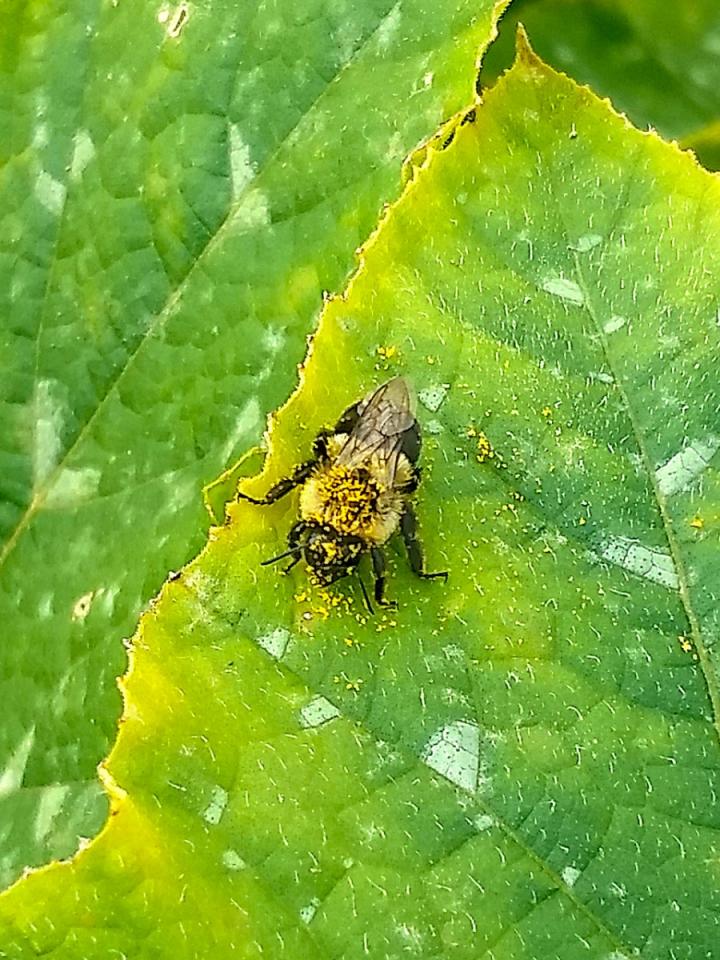
Credit: Kristen Brochu, Cornell University


ITHACA, N.Y. – Cornell University researchers have found that squash and pumpkin pollen have physical, nutritional and chemical defense qualities that are harmful to bumblebees. The results of their recent study suggest that deterring bumblebees from collecting and eating pollen may provide an evolutionary benefit to cucurbit plants.

“When bumblebees are fed cucurbit pollen, it causes all kinds of problems,” said Bryan Danforth, professor of entomology and the paper’s senior author. “Adults have damaged and distorted digestive tracts and colonies fed cucurbit pollen failed to rear any offspring.”

Bumblebees do visit pumpkin and squash flowers for the nectar, and though they don’t collect the pollen, some might inadvertently get on their legs. However, these bees that visit plants for nectar but don’t collect pollen may be good pollinators, as stray pollen on their bodies may end up pollinating the next flower.

“I actually saw them in the field using their legs to groom it off their bodies and then wipe it on a leaf,” said first author Kristen Brochu, a former Cornell doctoral student in Danforth’s lab and a postdoctoral researcher at Pennsylvania State University. “Not only are they not collecting it, they actually hate it.”

In the study, Brochu and colleagues created diets that represented different defenses to test which cucurbit pollen characteristics deterred bumblebees. Microcolonies of five bees were each fed a separate treatment. The bees fed wildflower pollen thrived, as expected. Under a natural cucurbit diet, the cumulative effect of the pollen’s physical defenses, poor nutritional content and chemicals led to bees ejecting their offspring from their brood cells and killing them. Bumblebees do this when stressed, possibly because they can’t take care of the larvae, Brochu said.

In a third treatment, the team extracted the chemicals from the cucurbit pollen and added them to the control diet of nutritionally rich wildflower pollen. With the crushed pollen diet, where the pollen’s physical defenses were removed, eggs and larvae failed to mature. “Over the course of the 50 days of the experiment, in both the crushed and natural cucurbit treatment, no offspring made it to adulthood,” Brochu said.

In the crushed treatment, the adults also died at a higher rate, possibly due to a release of additional toxic chemicals.

For the sake of bumblebees, she said, pumpkin and squash growers may think twice about bringing commercial bumblebees into their fields and may provide wildflower strips as alternative food sources.

###

The study, “Pollen Defenses Negatively Impact Foraging and Fitness in a Generalist Bee,” published in the journal Nature Scientific Reports.

Study co-authors include Brian Nault, professor of entomology at Cornell AgriTech, and Jessica Peterson, a former postdoctoral researcher in Nault’s lab who is an invertebrate ecologist at the Minnesota Department of Natural Resources.

Cornell University has dedicated television and audio studios available for media interviews supporting full HD, ISDN and web-based platforms.

Media Contact
Lindsey Hadlock
[email protected]
607-269-6911

Original Source

https://news.cornell.edu/stories/2020/03/bumblebees-hate-pumpkin-pollen-which-may-help-pumpkins

Related Journal Article

http://dx.doi.org/10.1038/s41598-020-58274-2

Tags: AgricultureBiologyEntomology
Share12Tweet8Share2ShareShareShare2

Related Posts

How to sway group opinions: Encourage opponents to stay undecided

How to sway group opinions: Encourage opponents to stay undecided

March 23, 2026
Deep Learning Model Maps How Individual Cells Shape Disease Outcomes

Deep Learning Model Maps How Individual Cells Shape Disease Outcomes

March 20, 2026

Removing only 15 female sharks annually could endanger the entire population, scientists warn

March 20, 2026

Scientists Urge Fragrance Industry to Transition from Sustainability Talk to Active Funding of Plant Conservation

March 20, 2026
Please login to join discussion

POPULAR NEWS

  • blank

    Revolutionary AI Model Enhances Precision in Detecting Food Contamination

    96 shares
    Share 38 Tweet 24
  • Imagine a Social Media Feed That Challenges Your Views Instead of Reinforcing Them

    1003 shares
    Share 397 Tweet 248
  • Uncovering Functions of Cavernous Malformation Proteins in Organoids

    54 shares
    Share 22 Tweet 14
  • Promising Outcomes from First Clinical Trials of Gene Regulation in Epilepsy

    51 shares
    Share 20 Tweet 13

About

We bring you the latest biotechnology news from best research centers and universities around the world. Check our website.

Follow us

Recent News

In-Sensor Cryptography Links Physical Process to Digital Identity

Can Psychosocial Factors Influence Cancer Risk?

Depression Factors in Elderly: Pre vs. Post-COVID Analysis

Subscribe to Blog via Email

Success! An email was just sent to confirm your subscription. Please find the email now and click 'Confirm' to start subscribing.

Join 78 other subscribers
  • Contact Us

Bioengineer.org © Copyright 2023 All Rights Reserved.

Welcome Back!

Login to your account below

Forgotten Password?

Retrieve your password

Please enter your username or email address to reset your password.

Log In
No Result
View All Result
  • Homepages
    • Home Page 1
    • Home Page 2
  • News
  • National
  • Business
  • Health
  • Lifestyle
  • Science

Bioengineer.org © Copyright 2023 All Rights Reserved.