• HOME
  • NEWS
  • EXPLORE
    • CAREER
      • Companies
      • Jobs
    • EVENTS
    • iGEM
      • News
      • Team
    • PHOTOS
    • VIDEO
    • WIKI
  • BLOG
  • COMMUNITY
    • FACEBOOK
    • INSTAGRAM
    • TWITTER
Monday, May 11, 2026
BIOENGINEER.ORG
No Result
View All Result
  • Login
  • HOME
  • NEWS
  • EXPLORE
    • CAREER
      • Companies
      • Jobs
        • Lecturer
        • PhD Studentship
        • Postdoc
        • Research Assistant
    • EVENTS
    • iGEM
      • News
      • Team
    • PHOTOS
    • VIDEO
    • WIKI
  • BLOG
  • COMMUNITY
    • FACEBOOK
    • INSTAGRAM
    • TWITTER
  • HOME
  • NEWS
  • EXPLORE
    • CAREER
      • Companies
      • Jobs
        • Lecturer
        • PhD Studentship
        • Postdoc
        • Research Assistant
    • EVENTS
    • iGEM
      • News
      • Team
    • PHOTOS
    • VIDEO
    • WIKI
  • BLOG
  • COMMUNITY
    • FACEBOOK
    • INSTAGRAM
    • TWITTER
No Result
View All Result
Bioengineer.org
No Result
View All Result
Home NEWS Science News Biology

Bumblebees aversion to pumpkin pollen may help plants thrive

Bioengineer by Bioengineer
March 11, 2020
in Biology
Reading Time: 3 mins read
0
IMAGE
Share on FacebookShare on TwitterShare on LinkedinShare on RedditShare on Telegram

IMAGE

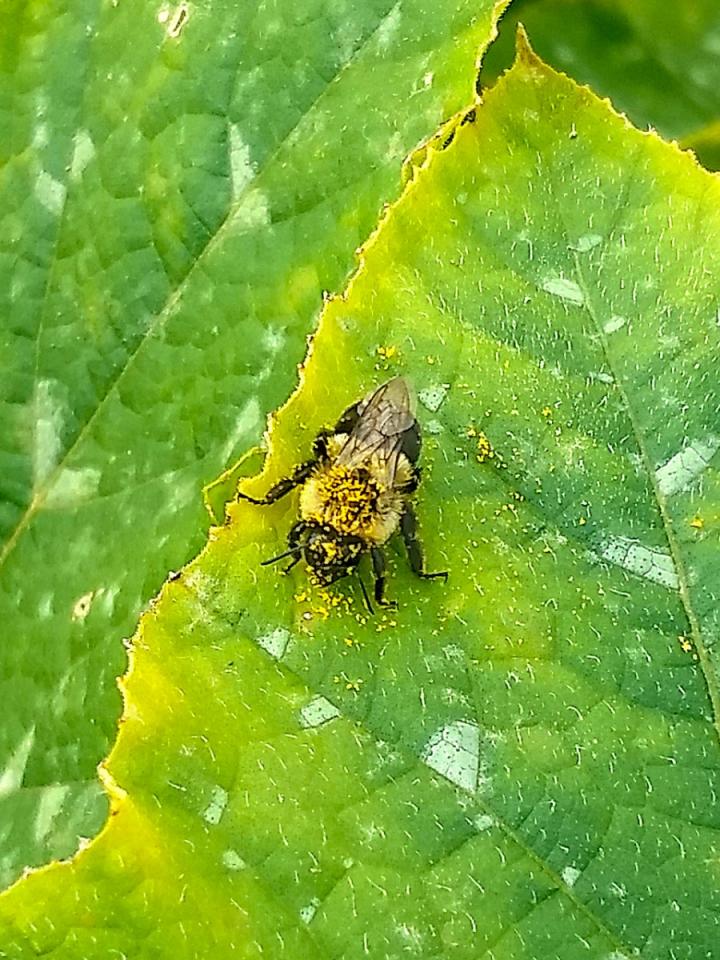
Credit: Kristen Brochu, Cornell University


ITHACA, N.Y. – Cornell University researchers have found that squash and pumpkin pollen have physical, nutritional and chemical defense qualities that are harmful to bumblebees. The results of their recent study suggest that deterring bumblebees from collecting and eating pollen may provide an evolutionary benefit to cucurbit plants.

“When bumblebees are fed cucurbit pollen, it causes all kinds of problems,” said Bryan Danforth, professor of entomology and the paper’s senior author. “Adults have damaged and distorted digestive tracts and colonies fed cucurbit pollen failed to rear any offspring.”

Bumblebees do visit pumpkin and squash flowers for the nectar, and though they don’t collect the pollen, some might inadvertently get on their legs. However, these bees that visit plants for nectar but don’t collect pollen may be good pollinators, as stray pollen on their bodies may end up pollinating the next flower.

“I actually saw them in the field using their legs to groom it off their bodies and then wipe it on a leaf,” said first author Kristen Brochu, a former Cornell doctoral student in Danforth’s lab and a postdoctoral researcher at Pennsylvania State University. “Not only are they not collecting it, they actually hate it.”

In the study, Brochu and colleagues created diets that represented different defenses to test which cucurbit pollen characteristics deterred bumblebees. Microcolonies of five bees were each fed a separate treatment. The bees fed wildflower pollen thrived, as expected. Under a natural cucurbit diet, the cumulative effect of the pollen’s physical defenses, poor nutritional content and chemicals led to bees ejecting their offspring from their brood cells and killing them. Bumblebees do this when stressed, possibly because they can’t take care of the larvae, Brochu said.

In a third treatment, the team extracted the chemicals from the cucurbit pollen and added them to the control diet of nutritionally rich wildflower pollen. With the crushed pollen diet, where the pollen’s physical defenses were removed, eggs and larvae failed to mature. “Over the course of the 50 days of the experiment, in both the crushed and natural cucurbit treatment, no offspring made it to adulthood,” Brochu said.

In the crushed treatment, the adults also died at a higher rate, possibly due to a release of additional toxic chemicals.

For the sake of bumblebees, she said, pumpkin and squash growers may think twice about bringing commercial bumblebees into their fields and may provide wildflower strips as alternative food sources.

###

The study, “Pollen Defenses Negatively Impact Foraging and Fitness in a Generalist Bee,” published in the journal Nature Scientific Reports.

Study co-authors include Brian Nault, professor of entomology at Cornell AgriTech, and Jessica Peterson, a former postdoctoral researcher in Nault’s lab who is an invertebrate ecologist at the Minnesota Department of Natural Resources.

Cornell University has dedicated television and audio studios available for media interviews supporting full HD, ISDN and web-based platforms.

Media Contact
Lindsey Hadlock
[email protected]
607-269-6911

Original Source

https://news.cornell.edu/stories/2020/03/bumblebees-hate-pumpkin-pollen-which-may-help-pumpkins

Related Journal Article

http://dx.doi.org/10.1038/s41598-020-58274-2

Tags: AgricultureBiologyEntomology
Share12Tweet8Share2ShareShareShare2

Related Posts

Transforming Jellyfish Bycatch into a Valuable Collagen Source for Cosmetics and Biotechnology — Biology

Transforming Jellyfish Bycatch into a Valuable Collagen Source for Cosmetics and Biotechnology

May 11, 2026
Ancient Plant Populations Reveal Fresh Insights into Climate Resilience — Biology

Ancient Plant Populations Reveal Fresh Insights into Climate Resilience

May 8, 2026

Rare Brain Disorders in Children Linked to Mutations in Lesser-Known Protein Complex

May 8, 2026

From Odd Insect to Underwater Predator: The Remarkable Evolution of a Bloodthirsty Fruit Fly

May 8, 2026
Please login to join discussion

POPULAR NEWS

  • Research Indicates Potential Connection Between Prenatal Medication Exposure and Elevated Autism Risk

    840 shares
    Share 336 Tweet 210
  • New Study Reveals Plants Can Detect the Sound of Rain

    728 shares
    Share 290 Tweet 182
  • Salmonella Haem Blocks Macrophages, Boosts Infection

    62 shares
    Share 25 Tweet 16
  • Breastmilk Balances E. coli and Beneficial Bacteria in Infant Gut Microbiomes

    57 shares
    Share 23 Tweet 14

About

We bring you the latest biotechnology news from best research centers and universities around the world. Check our website.

Follow us

Recent News

NELA, P-POSSUM, Muscle Index Predict Elderly Surgery Risk

PeroCycle Partners with Jindal Steel (Oman) to Pioneer Low-Carbon Steel Innovation

Widely Used Cholesterol Medication Could Disrupt Ovarian Cancer’s Stealth Defense

Subscribe to Blog via Email

Enter your email address to subscribe to this blog and receive notifications of new posts by email.

Join 82 other subscribers
  • Contact Us

Bioengineer.org © Copyright 2023 All Rights Reserved.

Welcome Back!

Login to your account below

Forgotten Password?

Retrieve your password

Please enter your username or email address to reset your password.

Log In
No Result
View All Result
  • Homepages
    • Home Page 1
    • Home Page 2
  • News
  • National
  • Business
  • Health
  • Lifestyle
  • Science

Bioengineer.org © Copyright 2023 All Rights Reserved.