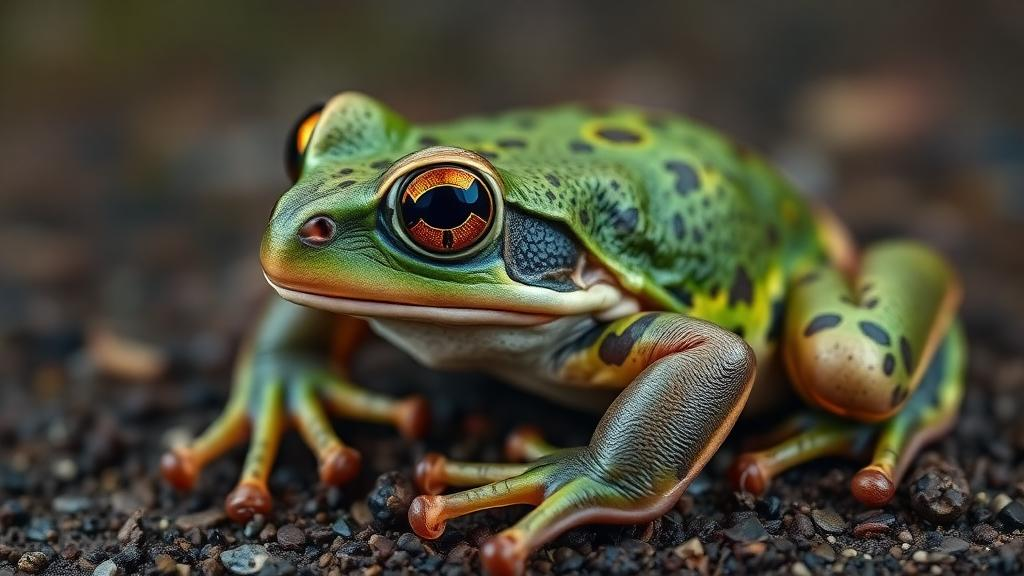
In a discovery that upends one of the most basic assumptions in neuroscience, researchers at the University of Missouri have shown that bullfrog brains can manufacture their own emergency fuel supply on site. For decades, the textbook picture has been straightforward: the brain runs on glucose, and when glucose runs out, neural activity falters, sometimes with devastating consequences. The new study, published in the Proceedings of the National Academy of Sciences, demonstrates that bullfrogs break that rule in a remarkable way. When their brains run short of glucose, they can produce ketone bodies, an alternative energy molecule, directly inside neural tissue rather than waiting for the liver to ship them in through the bloodstream. The finding, led by Joseph Santin, an associate professor of biological sciences, reframes how scientists think about brain energy metabolism and opens an unexpected window onto human diseases in which that metabolism goes wrong.
To appreciate why this is so surprising, it helps to understand how fuel delivery normally works in vertebrates. In most animals, ketone bodies are manufactured far from the brain, in the liver. When glucose levels fall during fasting, starvation, or prolonged exercise, the liver breaks down fatty acids into these compact energy molecules, which then travel through the circulation to hungry organs, including the brain. Neurons, which are among the most energy-demanding cells in the body, typically have little capacity to make this fuel themselves. The conventional view, as Santin put it, is that ketones are always delivered to the brain from elsewhere in the body. His team’s experiments revealed that bullfrogs bypass that supply chain entirely, generating ketones locally and creating an energy reserve exactly where it is needed most. He compared the discovery to finding a backup generator inside a building that everyone assumed had only one power source.
The technical heart of the study lies in showing that neural circuits can keep functioning when glucose metabolism is cut off, provided the brain can switch on its own ketone production. The researchers describe this in the study’s title as transforming neural activity to operate without glucose metabolism using brain-derived ketone bodies. In practical terms, that means the frog brain does not simply shut down when its primary fuel disappears. Instead, it appears to reconfigure its metabolic machinery so that critical neural functions continue on the alternative fuel. The team does not believe the metabolic shift is permanent; rather, it seems to act as a robust backup system that engages when the usual energy supply falls short. What remains unknown, and what the researchers flag as a key question for future work, is what molecular signal triggers the switch and how long the brain can sustain production before reserves are exhausted.
The evolutionary logic behind such a system becomes clear when you consider the bullfrog’s annual calendar. Each winter, the animals enter a hibernation-like state that slows their metabolism to a crawl and steadily drains their energy reserves. By the time spring arrives, oxygen and stored fuel are running dangerously low, yet the frogs must immediately reactivate the essential brain circuits that control breathing, heart rate, and other bodily functions. There is no grace period; a frog that cannot bring its neural command centers back online quickly will not survive the transition. The newly discovered metabolic backup system may be one reason bullfrogs can make that leap from near-dormancy to full alertness so reliably. Local ketone production would give the brain a way to keep its most vital circuits powered even as glucose availability collapses, buying the animal time until normal feeding resumes.
The work builds on years of prior research in Santin’s laboratory into how frogs endure conditions that would severely injure or kill most other animals. Earlier studies from the group showed that the hibernation-like state helps protect neural circuits during extreme oxygen deprivation, a capability that has long fascinated comparative physiologists. The new findings add a second layer to that survival strategy: the ability to maintain brain activity even when glucose metabolism is compromised. Together, the two capabilities suggest that the bullfrog brain is equipped with a layered defense against energy crisis, one that safeguards circuits against oxygen starvation and fuel starvation alike. That combination is rare among animals and makes the bullfrog an unusually valuable model for studying how neural tissue copes with metabolic stress.
What makes the result resonate beyond amphibian biology is the growing recognition that impaired brain energy metabolism sits at the center of several devastating human neurological conditions. Alzheimer’s disease, ALS, and schizophrenia have all been linked to defects in the way neurons generate or use energy. In Alzheimer’s, for example, brain glucose metabolism often declines measurably before significant memory loss appears, and researchers have debated for years whether that metabolic failure is a cause or a consequence of the disease. Because bullfrogs and humans share many of the same fundamental biological processes, according to Santin, understanding how a frog brain reprograms itself to run on self-made ketones could suggest new angles for studying what happens when human brains cannot get enough energy. The frog’s trick may not translate directly into a therapy, but it identifies a biological capability that was previously invisible and therefore never a target of investigation.
The discovery also carries a broader lesson about the assumptions embedded in neuroscience. The dependence of the mammalian brain on a continuous glucose supply is so well established that it functions as a foundational principle, taught in introductory courses and baked into experimental designs. Studies of stroke, hypoglycemia, and metabolic disease often take for granted that fuel must come from outside the brain. A vertebrate that violates that principle forces researchers to ask which other species might share the capability and what cellular machinery makes it possible. If bullfrog neurons can express the enzymes needed to synthesize ketone bodies on demand, the question becomes whether dormant or stressed brains in other animals, perhaps even under certain conditions in mammals, retain vestiges of a similar program. The Missouri team’s result does not answer those questions yet, but it makes them legitimate and urgent.
For now, the most immediate payoff is conceptual: a demonstration that the brain’s fuel economy is more flexible than assumed, and a natural experiment in how neural circuits can be retooled to survive an energy shortage. The study, titled Transforming neural activity to operate without glucose metabolism using brain-derived ketone bodies, appeared in the Proceedings of the National Academy of Sciences in early September 2026. Its authors suggest the finding could eventually inform research into neurological disorders tied to failing brain metabolism, from Alzheimer’s disease to ALS and schizophrenia, by revealing mechanisms that keep neurons alive when their preferred fuel is scarce. The open questions, including what triggers the switch to ketone production and how long bullfrogs can sustain it, now define the next phase of work in the Santin lab. In the meantime, the bullfrog has earned a new reputation: not just a hardy survivor of frozen winters, but the owner of a built-in backup generator that science is only beginning to understand.
Subject of Research: Local brain-derived ketone body production in bullfrogs as a backup fuel system during glucose shortage
Article Title: Researchers discover bullfrog brains can make their own backup fuel
Article References: Researchers discover bullfrog brains can make their own backup fuel. (n.d.). Original publication
Image Credits: AI Generated
DOI: Not provided
Keywords: bullfrogs, ketone bodies, glucose metabolism, brain energy, hibernation, neuroscience, Alzheimer's disease, ALS, schizophrenia, University of Missouri, neural circuits, PNAS
News Source: Cassandra Pierce. (October 12, 2026). Bullfrog brains found to brew their own backup fuel when glucose runs dry. Scienmag.