Dissolved organic carbon (DOC) is the majority of marine organic carbon. Understanding its source and sink processes is of great significance to global carbon cycle and will provide insights in achieving carbon neutrality. How do different physical and biogeochemical processes interact to contribute to the budgets of DOC and particulate organic carbon (POC)? Are there unique dynamics in different regions? The journal “Science China Earth Sciences” published online a carbon cycle study in the South China Sea led by Dr. Peng Xiu (South China Sea Institute of Oceanology, Chinese Academy of Sciences) and Dr. Wentao Ma (Second Institute of Oceanography, Ministry of Natural Resources). The purpose of this study is to quantitatively evaluate processes of carbon fixation, sequestration, and the interaction between biological carbon pump and microbial carbon pump.
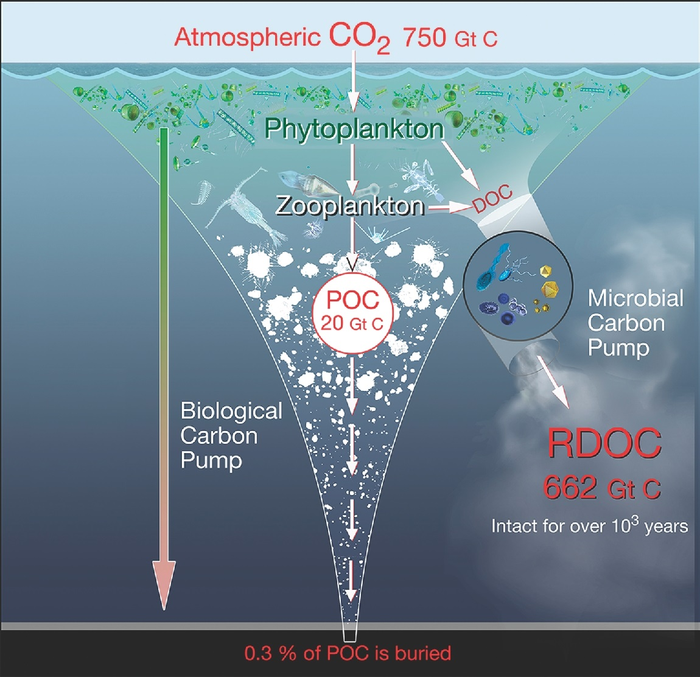
Credit: ©Science China Press
Dissolved organic carbon (DOC) is the majority of marine organic carbon. Understanding its source and sink processes is of great significance to global carbon cycle and will provide insights in achieving carbon neutrality. How do different physical and biogeochemical processes interact to contribute to the budgets of DOC and particulate organic carbon (POC)? Are there unique dynamics in different regions? The journal “Science China Earth Sciences” published online a carbon cycle study in the South China Sea led by Dr. Peng Xiu (South China Sea Institute of Oceanology, Chinese Academy of Sciences) and Dr. Wentao Ma (Second Institute of Oceanography, Ministry of Natural Resources). The purpose of this study is to quantitatively evaluate processes of carbon fixation, sequestration, and the interaction between biological carbon pump and microbial carbon pump.
“The South China Sea (SCS) is the largest semi-enclosed marginal sea in the western Pacific. We know that the alternation of northeast winter monsoon and southwest summer monsoon makes the distribution of phytoplankton chlorophyll concentration show clear seasonal pattern according to satellite products” Dr. Ma says. However, the budget of organic carbon in the SCS is less studied before.
The team used an eddy-resolving marine physical-biogeochemical model to analyze the seasonal changes in phytoplankton photosynthesis and the storage of these fixed carbon in the SCS.
“Our research focused on two main carbon sequestration paths, one is the storage in deep sea through gravitational sinking and remineralization of the POC, which is known as the biological carbon pump (BCP), and the other one is the microbial carbon pump (MCP), which transforms DOC from labile to refractory forms through microbial activities.” Dr. Xiu introduces.
The numerical simulations reported fluxes of carbon fixation by phytoplankton, export of POC by gravity, and DOC production and transformation by microbes. “The model results can be validated by observations from satellite to ship-based datasets.” Dr. Ma says. The production of refractory DOC (RDOC) reaches 26% of the carbon sequestration rate of the biological carbon pump, and its contribution to carbon storage cannot be ignored. In addition, this study also found that the SCS has three typical areas with distinct DOC production dynamics in the northern coast, off the Luzon Strait and off the southeastern coast of Vietnam.
###
See the article:
Ma W, Xiu P, Yu Y, Zheng Y, Chai F. 2021. Production of dissolved organic carbon in the South China Sea: A modeling study. Science China Earth Sciences, https://doi.org/10.1007/s11430-021-9817-2
https://www.sciengine.com/publisher/scp/journal/SCES/doi/10.1007/s11430-021-9817-2?slug=fulltext
Journal
Science China Earth Sciences
DOI
10.1007/s11430-021-9817-2