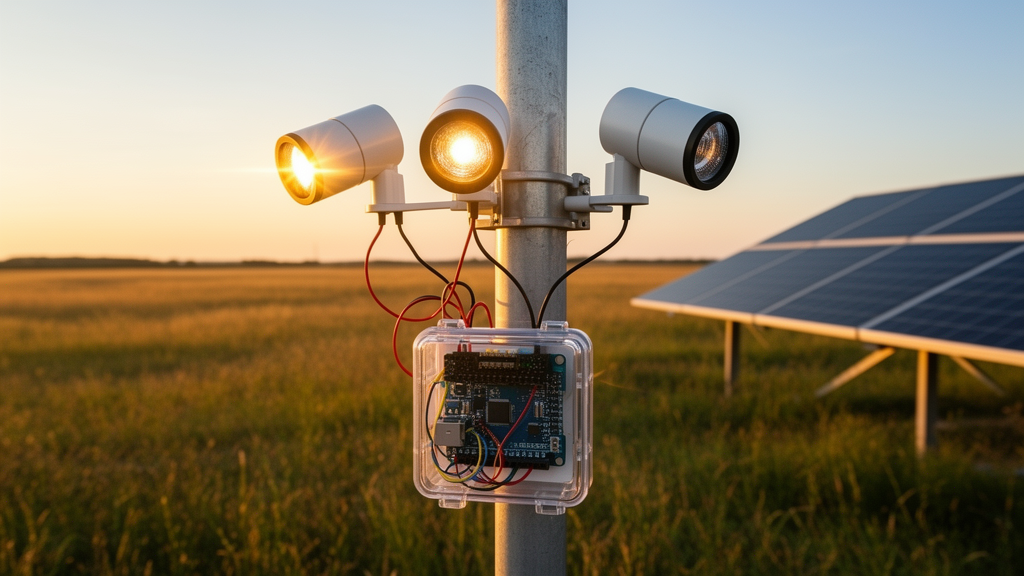
A pair of researchers has built a low-cost, wireless sensing platform that estimates global horizontal solar irradiance using three inexpensive sensor proxies instead of a commercial pyranometer, and a new feasibility study reports that the setup tracked real-world sunlight with respectable accuracy when calibrated against a reference solar power meter. The work, published in the journal Discover Electronics, was motivated by a familiar problem: high-precision commercial pyranometers and radiometers are often prohibitively expensive, while cheap solar power meters lack integrated wireless connectivity, which limits their use in decentralized monitoring networks.
The system, developed by Hritam Sarkar and Tamal Sarkar, centers on a NodeMCU ESP8266 microcontroller that continuously acquires data from three distinct, non-intrusive radiometric proxies. The first is a thermodynamic proxy built from two 3-inch circular aluminum plates, one painted matte black and the other gloss white, each embedded with a 1-wire DS18B20 digital thermometer probe. Because the black surface absorbs most incident solar energy while the white surface reflects most of it, the temperature difference between the two plates after they reach steady-state equilibrium is proportional to the incident solar flux, assuming the absolute temperature difference remains small.
The second proxy is optical. A BH1750 digital ambient light photodiode measures illuminance in lux with a resolution of 65,535 lx and a spectral response that mimics the human eye, covering the visible spectrum. Because direct exposure to intense sunlight risks saturating the sensor, the team fitted an optical diffuser over the module. The raw illumination readings are then converted into physical irradiance in watts per square meter using standard calibration factors aligned with professional reference metrics. The third proxy is electrical: a small 5-volt, 100-milliwatt polycrystalline silicon photovoltaic panel is monitored by an INA219 voltage and current sensor. When the panel is short-circuited, its terminal voltage drops to zero and the resulting short-circuit current is driven directly by the generation and collection rate of photo-generated charge carriers, giving an instantaneous measure of available light energy.
The photovoltaic conversion model is anchored to Standard Test Conditions, defined as 1000 watts per square meter of irradiance, a cell temperature of 25 degrees Celsius, and an AM1.5 spectral distribution, under which the panel current exhibits an excellent linear relationship. For the 100-milliampere panel used here, instantaneous irradiance is estimated from the ratio of measured short-circuit current to its standard-test value, scaled by the 1000 watts per square meter reference and a temperature correction factor built around a coefficient of roughly 0.0005 per degree Celsius. An SHT21 sensor tracks ambient relative humidity and temperature, and a 20-by-4 character I2C liquid crystal display provides local visual monitoring.
Wireless telemetry is a central design feature. Sensor streams are transmitted continuously over TCP/IP socket connections to a centralized workstation running a dedicated Python script for processing and real-time visualization, eliminating manual logging errors and keeping all channels synchronized. The engineers also had to solve a practical hardware conflict: the INA219 current sensor and the SHT21 climate sensor share the default I2C address of 0x40, so the team reconfigured the INA219 to address 0x44 by soldering a hardware bridge across its A1 terminal, ensuring collision-free data fetching on the shared bus.
Calibration proceeded in three phases. First, the sensor array was placed in a controlled laboratory environment beneath a 50-watt ultraviolet-B light source, commonly known as a turtle bulb, with measurements logged at vertical distances of 35, 40, and 45 centimeters after strict thermal equilibrium was reached. This established the linear performance of each proxy relative to the reference instrument. Second, the setup was deployed outdoors to log raw high-resolution data at 30-second intervals while a commercial HTC Instruments LX-107 solar power meter logged absolute global horizontal irradiance at 5-minute intervals. Third, timestamps from the high-resolution sensor streams and the reference meter were synchronized, and a training subset spanning various diurnal phases was used to fit empirical regression models.
The outdoor training dataset consisted of 46 synchronized data points collected across four days in late August and early September 2026. Indoor testing confirmed the expected inverse-proportional decay of radiant energy with distance for all three sensor modules, and the linear regressions against the reference meter showed exceptionally strong relationship coefficients. After time-series filtering and timestamp alignment removed noise from the 30-second telemetry streams, multi-regression fitting against the outdoor reference measurements indicated high R-squared values, particularly for the light-intensity sensor proxy.
To test generalizability, the derived calibration equations were evaluated on two independent out-of-sample validation days, September 9 and September 10, 2026. The optical illuminance proxy achieved the highest dynamic responsiveness, with R-squared values from 0.69 to 0.94 and root-mean-square errors of roughly 51.32 to 115.03 watts per square meter, reaching its best accuracy with a multi-regression model that accounted for ambient conditions. The differential temperature proxy followed closely, with R-squared values of 0.81 to 0.88 and root-mean-square errors of about 70.82 to 94.92 watts per square meter. The photovoltaic proxy performed poorly under simple linear regression, with R-squared values ranging from minus 0.05 to 0.23 and errors between 190.18 and 211.88 watts per square meter, but stabilized considerably under multi-regression, reaching R-squared values of 0.68 to 0.77 and errors of roughly 103.06 to 117.45 watts per square meter.
Each proxy showed a characteristic behavior under dynamic outdoor conditions. The thermal plates carry considerable thermal inertia: when irradiance fluctuates suddenly due to transient cloud cover or physical obstructions, the differential temperature signal enters a transient mode and takes more than 100 seconds to restabilize, although once settled it reliably tracks absolute changes in solar flux. The photovoltaic panel, by contrast, responds instantly but is highly sensitive to temperature, since prolonged outdoor exposure raises cell temperature and reduces the efficiency of short-circuit current generation. During sudden spikes in ambient thermal levels, the panel tended to consistently overestimate irradiance, showing positive mean bias errors ranging from 69.92 to 197.14 watts per square meter, which the authors say underscores the need for active thermal compensation using dedicated panel temperature probes.
The most striking result came from fusing all three proxies. By integrating differential temperature, light intensity, and photovoltaic drift current alongside ambient temperature and relative humidity, the combined outdoor multi-regression model achieved a training fit with an R-squared of 0.99 and a root-mean-square error of just 29.55 watts per square meter. On unseen data it tracked diurnal fluctuations on September 9 with an R-squared of 0.91 and an error of 66.44 watts per square meter, and on September 10 performance remained acceptable at an R-squared of 0.70 with the error rising to 113.73 watts per square meter. A consistent positive mean bias error of 55.37 and 89.71 watts per square meter on the two days indicates a systemic tendency to overestimate absolute irradiance in real-world deployments. The authors are careful to position the platform as a feasibility-oriented, budget-friendly monitoring tool rather than a metrologically equivalent substitute for industrial pyranometers, but they argue that automated wireless telemetry, multi-sensor fusion, and low component costs make it viable for solar energy management, agricultural microclimate monitoring, smart grid integration, and educational deployments at a fraction of the cost of commercial hardware. Future work will target long-term durability, solar-powered energy harvesting for the microcontroller, mobile applications for decentralized agricultural decision-making, and thermal compensation algorithms for the photovoltaic proxy.
Subject of Research: A low-cost IoT sensor platform for estimating global horizontal solar irradiance using three calibrated sensor proxies
Article Title: An IoT-based approach for solar irradiance estimation using three different sensor proxies
Article References: Sarkar, H., & Sarkar, T. (2026). An IoT-based approach for solar irradiance estimation using three different sensor proxies. Discover Electronics, 3(1), Article 149. https://doi.org/10.1007/s44291-026-00299-4
Image Credits: AI Generated
DOI: 10.1007/s44291-026-00299-4
Keywords: solar irradiance, IoT, pyranometer alternative, BH1750, photovoltaic proxy, NodeMCU ESP8266, multi-sensor fusion, wireless telemetry, renewable energy, agricultural monitoring, calibration regression, low-cost sensing
News Source: Faith Mcneil. (October 28, 2026). Budget IoT sensor array tracks solar irradiance with three low-cost proxies. Scienmag.