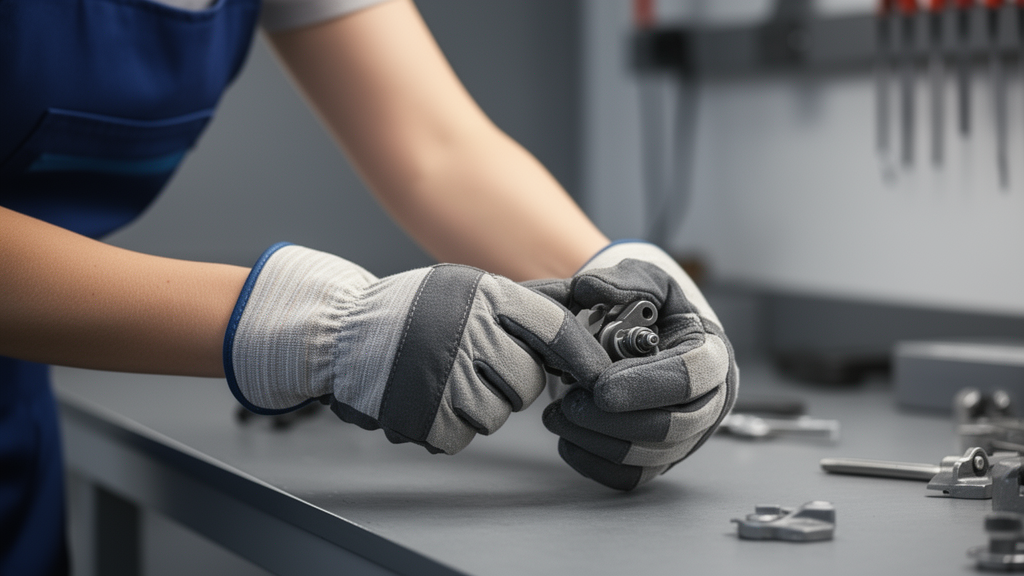
Anti-vibration gloves are meant to protect workers from the hand-arm vibration produced by impact drivers, chainsaws, grinders and other powered hand tools, but the thick padding that absorbs vibration often comes at a hidden cost: reduced finger dexterity and greater muscular effort. A new controlled study published in Fashion and Textiles suggests that the answer may lie not in the padding material itself but in how that padding is arranged across the palm. When three glove prototypes with identical material stacks but different palm padding layouts were tested on female participants, the glove with a continuous gradient palm padding preserved dexterity best and produced the smallest increase in forearm muscle activity, while a segment-based layout was more often linked to poorer dexterity and higher muscle demand.
The research team, led by Annie Yu and Shu-Ning Yan, built three anti-vibration glove prototypes that differed only in the cutting, shaping and local thickness of neoprene padding in specific hand movement zones. The first design, G1, used segment-based padding divided into independent units across the fingers and central palm to follow bending lines. The second, G2, employed a continuous palm pad with gradual thickness change intended to mimic the muscle force path while reducing restriction in mobile regions such as the thenar web space. The third, G3, introduced gaps around the proximal interphalangeal joints to free finger-joint movement, with the remaining padding connected from the metacarpophalangeal base toward the flexor zones to support grip-related loading.
All three prototypes shared the same base glove structure and assembly procedure, which allowed the researchers to isolate the effect of padding distribution. The palm reinforcement layer was made of 0.85 mm-thick genuine suede cowhide leather, and a 6.5 mm thick neoprene foam sheet served as the padding and main vibration absorption layer, positioned within the mid-palm, thenar and hypothenar regions according to each design. The dorsal side and gussets used a 4-way stretch knitted fabric of 78% nylon and 22% spandex, the palm lining was a 160 g/m2 modal knitted jersey, and a 3 cm-wide hook-and-loop fastening secured the wrist. The design followed the anti-vibration glove requirements of EN ISO 10819:2013, which specifies that the palm damping layer should be no thicker than 8 mm.
Twenty-one right-handed female participants aged 19 to 34 were recruited, and after data quality screening excluded three participants whose surface electromyography recordings contained severe non-physiological artifacts, the final analysis set involved eighteen participants. Each completed six tasks under four hand conditions: bare hand and the three gloved conditions, with the order of conditions randomized. The tasks were grip strength measurement with an electronic hand dynamometer, key pinch strength with a mechanical pinch gauge, a wooden bar transporting task, a metal bar lifting task, an impact drilling task with a cordless impact driver, and a pegboard task adapted from the Purdue Pegboard Test in which participants inserted M5 screws into a wooden board. Forearm muscle activity was recorded from three extrinsic muscles of the right hand: the extensor digitorum, flexor digitorum superficialis and flexor pollicis longus, with signals normalized to maximum voluntary electrical activity.
The results showed a consistent pattern for maximal force tasks. Relative to the bare hand, mean grip force was reduced by about 26 to 30% when any of the gloves was worn, and pegboard screwing time increased by 38% with the gradient design G2, 47% with the PIP-oriented design G3, and 51% with the segmented design G1. In contrast, key pinch strength was largely preserved, with the pinching force means closely clustered across all hand conditions. When the three outcomes were combined into a composite dexterity index, the overall condition effect was strong, and among the gloves the composite means were highest for G2, moderate for G3 and lowest for G1, although paired comparisons among the gloves did not reach statistical significance after multiplicity correction.
The electromyography findings added a physiological dimension to the performance data. During gripping and key pinching, differences between conditions were confined to the thumb flexor: the flexor pollicis longus activity was higher with G3 than with the bare hand during gripping, and higher with G1 during pinching, both with large effect sizes. During load-transfer tasks such as woodblock transporting and metal bar lifting, muscle activity generally increased with any glove compared with the bare hand, but among the glove designs G1 produced the highest muscle activity and G2 the lowest. In the impact drilling task, wearing any glove clearly increased muscle activity relative to the bare hand, yet differences among the three layouts were minimal, suggesting that for this intense precision task the main contrast was between gloved and bare hands. In the lighter pegboard task, however, the segmented layouts G1 and G3 more frequently required extra muscle effort, while the continuous palm layout of G2 produced little additional forearm activation.
The subjective ratings, collected on 9-point scales covering comfort, task ease, mobility, fatigue and perceived vibration, broadly matched these patterns without reaching statistical significance. The gradient design G2 consistently scored above the neutral midpoint, whereas G1 and G3 tended to hover around the midpoint, and paired analyses showed a moderate advantage for G2 over G3 in wear comfort. Ratings for perceived vibration were generally favorable and showed few differences among the three gloves, indicating that when padding area and thickness are approximately the same, layout differences may have limited influence on the perceived anti-vibration function.
The authors argue that these findings elevate padding layout to an independent design variable rather than a secondary feature of padding material. Because the material stack was held constant, differences in hand performance were mainly related to padding placement, local thickness and the gaps left for joint movement. Notably, the grip strength loss of roughly 25% observed here is far smaller than the 52.5% loss previously reported for a bulky, non-segmented padded glove, suggesting that distributing material into lighter, partitioned areas is preferable to a uniform padded block. The results also indicate that continuous palm support better preserves dexterity and limits additional forearm activity during fine manipulation and sustained grasping, while PIP-targeted segments may be beneficial mainly in heavy-load or externally supported tasks where redistributing local loading matters more than maximizing dexterity.
The study was designed as an initial controlled investigation using a female-only sample, motivated by evidence that women report smaller hand dimensions, lower grip strength and more frequent glove fit and bulkiness problems than men, and the authors state that the findings are directly applicable only to female participants. The study was not intended to examine sex differences, and it did not directly evaluate anti-vibration performance through standardized vibration transmissibility testing, since one of the six tasks provided a vibration-related condition but the experimental design was not a standardized transmissibility assessment. The material stack was held constant to isolate layout effects, which limits generalization to other material moduli, friction levels and thermal behaviors, and only single-hand operations were evaluated.
Within those limits, the work offers a concrete message for glove designers and occupational safety practitioners: the configuration of palm padding can influence dexterity and physiological demand independently of material composition. Continuous palm pads appear more favorable for tasks demanding rapid manipulation, segments aligned only with anatomical crease lines may introduce unwanted resistance during manipulation, and thinner, more conforming coverage at the fingertip region seems more compatible with tasks requiring fine control. Future work, the authors note, should incorporate different materials, glove geometries, task conditions, long-term wear outcomes and potential sex-related differences to refine design guidelines for occupational gloves.
Subject of Research: How different palm padding layouts in anti-vibration gloves affect dexterity, grip strength and forearm muscle activity in female participants
Article Title: Design approach for padding patterns of anti-vibration gloves and their influence on dexterity, strength, and muscle activity
Article References: Yu, A., & Yan, S.-N. (2026). Design approach for padding patterns of anti-vibration gloves and their influence on dexterity, strength, and muscle activity. Fashion and Textiles, 13(1), Article 40. https://doi.org/10.1186/s40691-026-00491-w
Image Credits: AI Generated
DOI: 10.1186/s40691-026-00491-w
Keywords: anti-vibration gloves, hand-arm vibration, padding layout, dexterity, grip strength, forearm muscle activity, electromyography, neoprene padding, occupational safety, glove design, female participants, wear comfort
News Source: Denise Maddox. (October 28, 2026). Glove Padding Layout Shapes Dexterity and Muscle Effort in Female Workers. Scienmag.