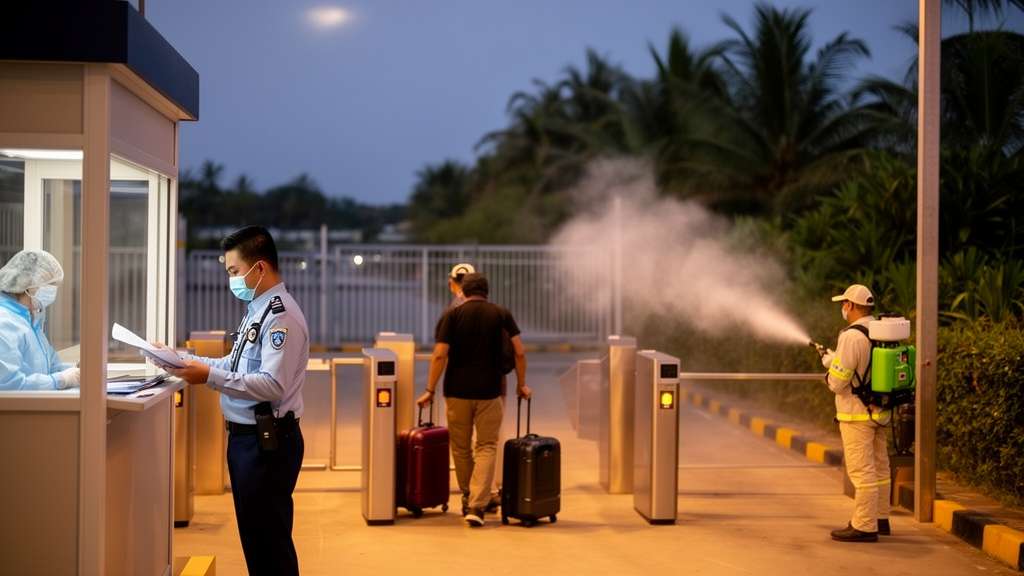
Border restrictions imposed during the COVID-19 pandemic may have sharply reduced dengue cases in China and Australia, according to a retrospective modeling study published in Globalization and Health, while the same measures appeared to have little dampening effect in endemic settings such as Thailand and Singapore, where local transmission continued largely unabated.
The researchers treated the pandemic-era imposition of travel restrictions as a natural experiment. They first used Generalized Additive Models to characterize dengue case trends from 2009 to 2019, capturing the seasonal periodicity and incidence patterns of transmission in each country. They then applied SARIMA models to generate counterfactual estimates of what dengue incidence would likely have been in 2020 in the absence of COVID-19-related non-pharmaceutical interventions, and compared those predictions with the cases actually observed. Correlation analyses were also run to examine possible links between international air passenger arrivals and reported dengue cases across the four countries in 2020, using passenger volume data.
The results pointed to a marked divergence between non-endemic and endemic countries. Compared with the 2009 to 2019 epidemic seasons, dengue activity in China and Australia remained below historical levels in 2020. Thailand’s activity was slightly lower than its historical peak, with cases fluctuating within the moderate-to-high range, while Singapore’s dengue activity stayed consistently above historical maximum levels throughout the period.
In contrast, observed cases in Thailand and Singapore were 79.62 percent and 164.31 percent higher, respectively, than the historical trend-based predictions.
Correlation analyses added a further layer to the picture. In non-endemic countries, the study found a positive linear association between international air passenger arrivals and dengue cases, with Pearson correlation coefficients exceeding 0.75. However, no such association was apparent in Thailand and Singapore, the two endemic settings in the analysis, where local transmission appeared to predominate over imported cases.
The authors caution that these are modeled associations rather than demonstrated causal effects, and the study is a retrospective analysis of surveillance and passenger volume data rather than a controlled experiment. The article was published as an accepted manuscript shared early for faster access, and is subject to further edits before the final version of record appears.
Before 2020, the four countries exhibited distinct seasonal dengue patterns, the study notes, which provided the baseline against which pandemic-era deviations could be measured. The findings suggest that pandemic-related border controls may have influenced dengue trends in selected non-endemic countries, but appeared to have a limited association in endemic settings.
Based on these results, the authors argue that mitigating dengue importation requires an integrated framework that synchronizes risk-stratified screening for arrivals, vector surveillance, and strengthened multilateral collaboration. They present these insights as a strategic roadmap for global efforts against what they describe as the increasing threat of dengue.
Subject of Research: Associations between COVID-19 border restrictions and dengue case trends in four Asia-Pacific countries
Article Title: Impact of COVID-19 outbreaks and border control measures on dengue cases in four Asia-Pacific countries
Article References: Fan, X., Huang, X., Zhou, S., Zhang, T., Cui, J., Li, Z., Zhang, G., Chen, Q., Li, Z., & Yang, W. (2026). Impact of COVID-19 outbreaks and border control measures on dengue cases in four Asia-Pacific countries. Globalization and Health. https://doi.org/10.1186/s12992-026-01247-3
Image Credits: AI Generated
DOI: 10.1186/s12992-026-01247-3
Keywords: dengue, COVID-19, border controls, travel restrictions, Asia-Pacific, non-endemic countries, endemic transmission, GAM models, SARIMA, air passenger arrivals, China, Australia
News Source: Courtney Benton. (October 28, 2026). COVID-19 border controls linked to sharp dengue declines in non-endemic Asia-Pacific countries. Scienmag.