• HOME
  • NEWS
  • EXPLORE
    • CAREER
      • Companies
      • Jobs
    • EVENTS
    • iGEM
      • News
      • Team
    • PHOTOS
    • VIDEO
    • WIKI
  • BLOG
  • COMMUNITY
    • FACEBOOK
    • INSTAGRAM
    • TWITTER
Sunday, May 10, 2026
BIOENGINEER.ORG
No Result
View All Result
  • Login
  • HOME
  • NEWS
  • EXPLORE
    • CAREER
      • Companies
      • Jobs
        • Lecturer
        • PhD Studentship
        • Postdoc
        • Research Assistant
    • EVENTS
    • iGEM
      • News
      • Team
    • PHOTOS
    • VIDEO
    • WIKI
  • BLOG
  • COMMUNITY
    • FACEBOOK
    • INSTAGRAM
    • TWITTER
  • HOME
  • NEWS
  • EXPLORE
    • CAREER
      • Companies
      • Jobs
        • Lecturer
        • PhD Studentship
        • Postdoc
        • Research Assistant
    • EVENTS
    • iGEM
      • News
      • Team
    • PHOTOS
    • VIDEO
    • WIKI
  • BLOG
  • COMMUNITY
    • FACEBOOK
    • INSTAGRAM
    • TWITTER
No Result
View All Result
Bioengineer.org
No Result
View All Result
Home NEWS Science News Chemistry

Breathing new life into dye-sensitized solar cells

Bioengineer by Bioengineer
June 13, 2019
in Chemistry
Reading Time: 3 mins read
0
IMAGE
Share on FacebookShare on TwitterShare on LinkedinShare on RedditShare on Telegram

Japanese researchers are poised to reboot the field of aromatic-fused porphyrin sensitizers for dye-sensitized solar cells, the most efficient solar efficient solar technology available at present
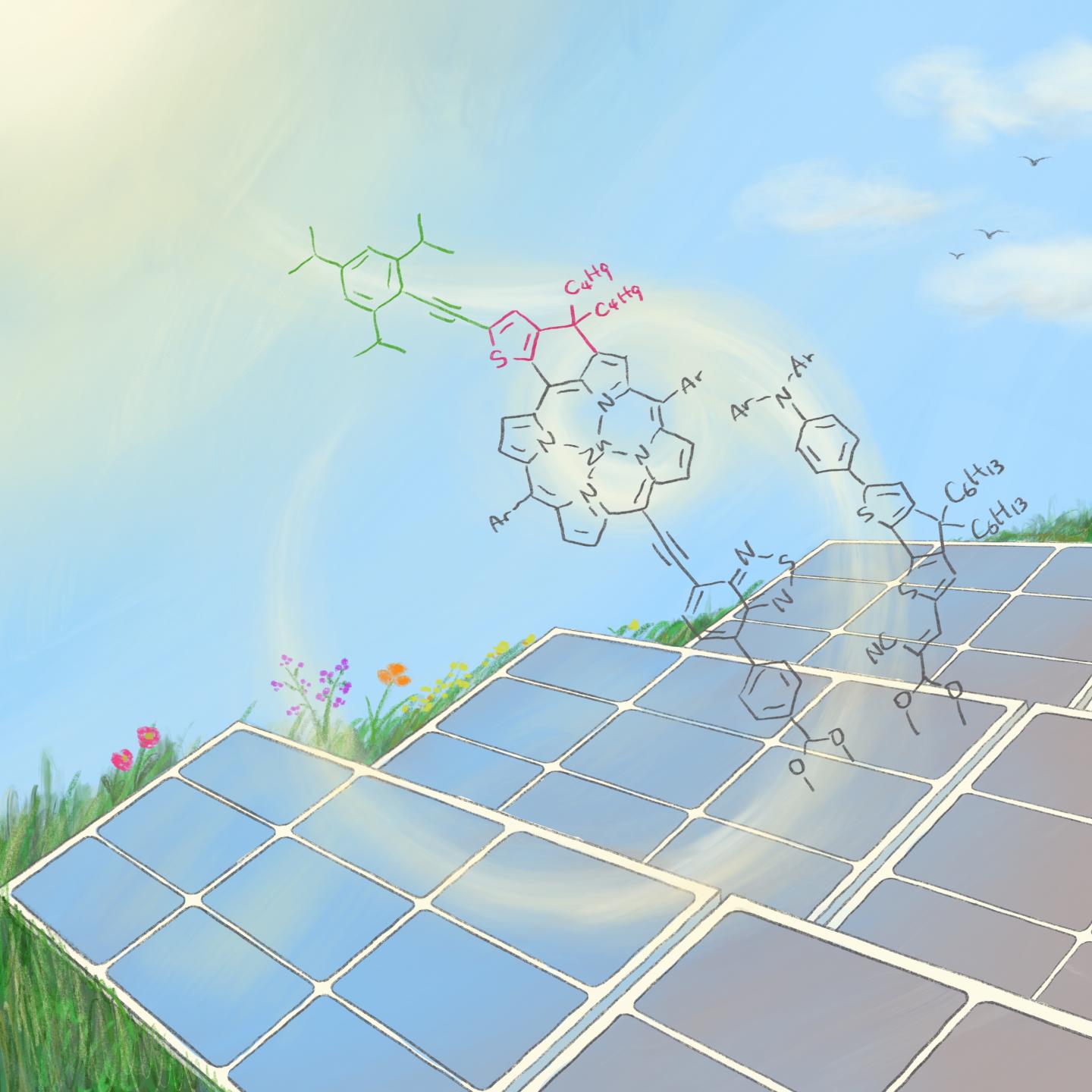
IMAGE

Credit: Illustration by Izumi Mindy Takamiya

Researchers at the Institute for Integrated Cell-Material Sciences at Kyoto University have made a popular type of dye-sensitized solar cell more efficient by adjusting and updating their structure. Published in the Journal of the American Chemical Society (JACS), the team report a series of adaptations with a power conversion efficiency of 10.7%, the highest yet for this kind of dye-sensitized solar cell, the most efficient solar technology available at present.

Current dye-sensitized solar cells are made up of a porous layer of titanium dioxide covered with a molecular dye. As sunlight is taken in, electrons are excited as they pass through, and are collected for power, before being ‘recycled’, reintroduced into the electrolyte and back to the dye molecule. As they are lightweight and low density, they have a high industry appeal as a replacement material for current rooftop solar panels.

There are different approaches to structuring these solar cells; with aromatic ring fusion to a porphyrin core being the most attractive, as they absorb red light well. Yet they have their downsides: the electrons are only excited for a short lifetime, have a tendency to aggregate, making conversion to power difficult.

In order to improve efficiency, Hiroshi Imahori, Tomohiro Higashino and colleagues investigated the use of a methylene bridged material, fused to the porphyrin core. They believed this would overcome the downsides, particularly by suppressing the aggregation and enhancing energy conversion.

With the new molecular dye, DfZnP-iPr, they achieved a higher efficiency than previously reported. They believe their research will reinvigorate the exploration of aromatic-fused porphyrin sensitizers for these high performance solar cells.

“Growing concern over the use of fossil fuels and environmental issues means we need to work hard on improving sustainable energy systems. Our work improves the efficiency of a lightweight and attractive solar technology and we hope will stimulate the research community to further explore the potential of aromatic-fused porphyrin sensitizers for high performance dye-sensitized solar cells.” says Hiroshi Imahori of Kyoto University’s Institute for Integrated Cell-Material Sciences (iCeMS)

###

For more information about this research, contact

Hiroshi Imahori

[email protected]

DOI: 10.1021/jacs.9b03302

About Kyoto University’s Institute for Integrated Cell-Material Sciences (iCeMS)

At iCeMS, our mission is to explore the secrets of life by creating compounds to control cells, and further down the road to create life-inspired materials that confront the myriad problems that afflict modern society. In only a decade, collaborative research at iCeMS has resulted in significant cutting-edge scientific discoveries, and the creation of over 1500 unique materials. We will keep running for the greater future of science.
https://www.icems.kyoto-u.ac.jp/en/

For more information about iCeMS, contact

I. Mindy Takamiya

[email protected]

Media Contact
Izumi Mindy Takamiya
[email protected]

Related Journal Article

http://dx.doi.org/10.1021/jacs.9b03302

Tags: Biomedical/Environmental/Chemical EngineeringChemical/Biological WeaponsChemistry/Physics/Materials SciencesElectrical Engineering/ElectronicsEnergy SourcesEnergy/Fuel (non-petroleum)Industrial Engineering/ChemistryMaterialsSuperconductors/Semiconductors
Share12Tweet8Share2ShareShareShare2

Related Posts

Miniature Sensor Uses Light to Detect Touch — Chemistry

Miniature Sensor Uses Light to Detect Touch

May 8, 2026
Iron Minerals Determine Whether Dissolved Organic Matter Fuels Microbes or Becomes Long-Term Carbon Storage — Chemistry

Iron Minerals Determine Whether Dissolved Organic Matter Fuels Microbes or Becomes Long-Term Carbon Storage

May 8, 2026

Kate Evans Appointed Associate Lab Director for Biological and Environmental Systems Science at ORNL

May 8, 2026

Advancing Multiscale Modeling and Overcoming Operational Challenges in Autothermal COâ‚‚-to-Methanol Reactors

May 8, 2026
Please login to join discussion

POPULAR NEWS

  • Research Indicates Potential Connection Between Prenatal Medication Exposure and Elevated Autism Risk

    840 shares
    Share 336 Tweet 210
  • New Study Reveals Plants Can Detect the Sound of Rain

    727 shares
    Share 290 Tweet 181
  • Scientists Investigate Possible Connection Between COVID-19 and Increased Lung Cancer Risk

    68 shares
    Share 27 Tweet 17
  • Salmonella Haem Blocks Macrophages, Boosts Infection

    61 shares
    Share 24 Tweet 15

About

We bring you the latest biotechnology news from best research centers and universities around the world. Check our website.

Follow us

Recent News

Evaluating Digoxin Use in Patients with Symptomatic Rheumatic Heart Disease

Evaluating the Effectiveness and Safety of Digitalis Glycosides in Treating Heart Failure

Urdu Fall Risk Questionnaire Adapted for Elderly

Subscribe to Blog via Email

Success! An email was just sent to confirm your subscription. Please find the email now and click 'Confirm' to start subscribing.

Join 82 other subscribers
  • Contact Us

Bioengineer.org © Copyright 2023 All Rights Reserved.

Welcome Back!

Login to your account below

Forgotten Password?

Retrieve your password

Please enter your username or email address to reset your password.

Log In
No Result
View All Result
  • Homepages
    • Home Page 1
    • Home Page 2
  • News
  • National
  • Business
  • Health
  • Lifestyle
  • Science

Bioengineer.org © Copyright 2023 All Rights Reserved.