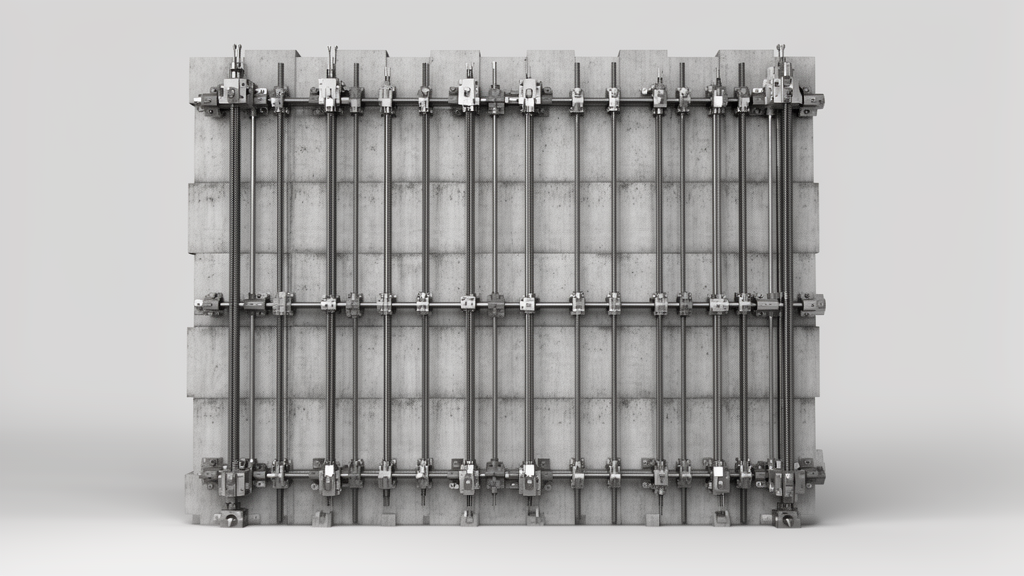
A full-scale field monitoring investigation of a prestressed reaction wall and pedestal system has demonstrated that concrete compressive strains and reinforcement stresses remained well below structural design thresholds throughout construction and service conditions. All monitored locations across the mass concrete assembly remained under compression across all evaluated stages, confirming stable overall mechanical performance during tendon tensioning and quasi-static service loading within the structural testing facility.
Conducted by researchers at Henan University of Technology and Zhongzhou University of Technology in Zhengzhou, China, the investigation evaluated a prestressed reaction wall and pedestal designed for a large-scale structural testing laboratory. The comprehensive monitoring program captured the sequential evolution of internal concrete microstrain and steel reinforcement stress across distinct developmental phases, specifically encompassing concrete hydration, prestressing tendon tensioning, and subsequent quasi-static service loading conditions.
To capture these internal mechanical shifts, the research team deployed an integrated instrumentation network combining vibrating-wire strain sensors with fiber-optic strain sensors embedded throughout the mass concrete components. This integrated monitoring configuration allowed the investigators to track the continuous evolution of concrete microstrain and reinforcement stress as cement hydration proceeded and as internal prestressing loads were applied to the system.
During the initial construction stage, tendon tensioning operations induced a clear redistribution of internal strain and stress throughout the prestressed reaction system. Measurements showed that the maximum concrete compressive strain was −168.37 microstrain prior to tendon tensioning. After tensioning was completed, the maximum concrete compressive strain reached −290.90 microstrain, an increase that occurred alongside a concurrent rise in reinforcement compressive stress.
During subsequent quasi-static service loading, internal deformations increased but remained well within established structural design limits. Under these service loading conditions, the maximum recorded concrete compressive strain reached −321.36 microstrain, representing approximately 54 percent of the design strain limit for the structure. Concurrently, the maximum stress recorded in the reinforcing steel remained below 25 percent of the material’s design strength, indicating substantial operational safety margins.
Continuous instrumentation data collected throughout all experimental stages confirmed that every monitoring location remained under net compression without experiencing tension. The persistence of compressive states across all monitored positions demonstrated the overall mechanical stability of the prestressed system, verifying that the assembly accommodated construction-induced redistributions and quasi-static service forces while maintaining stable overall structural integrity throughout testing.
The monitoring program also provided a comparative evaluation of the two strain-sensing methodologies implemented within the mass concrete structure. The researchers reported that fiber-optic sensors were highly effective in capturing localized strain anomalies associated with concrete cracking. In contrast, vibrating-wire strain sensors provided stable and dependable measurements suitable for tracking the long-term response of the prestressed reaction assembly.
Together, these field findings deliver full-scale experimental evidence for understanding the direct relationship between construction-induced stress states and the subsequent service performance of mass concrete prestressed structures. By documenting the evolution of concrete microstrain and reinforcement stress across hydration, tendon prestressing, and quasi-static loading, the study establishes important empirical observations for large-scale prestressed reaction wall and pedestal systems.
Subject of Research: Full-scale field monitoring of a prestressed reaction wall and pedestal system
Article Title: Field monitoring study of reaction walls and pedestals during construction and service phases
Article References: Wang, H., Xu, Q., Ding, Y., Hu, P., Ma, S., & Liu, Q. (2026). Field monitoring study of reaction walls and pedestals during construction and service phases. Frontiers in Materials, 13, Article 1944093. https://doi.org/10.3389/fmats.2026.1944093
Image Credits: AI Generated
DOI: 10.3389/fmats.2026.1944093
Keywords: prestressed reaction wall, prestressed pedestal, full-scale field monitoring, vibrating-wire sensors, fiber-optic strain sensors, concrete microstrain, reinforcement stress, tendon tensioning, quasi-static loading, cement hydration, internal strain redistribution, mass concrete structures, localized strain anomalies, structural cracking detection, design strain limit, structural materials, large scale testing laboratory
News Source: Denise Maddox. (November 17, 2026). Prestressed Reaction Wall System Retains Stable Compression Across Construction and Loading. Scienmag.