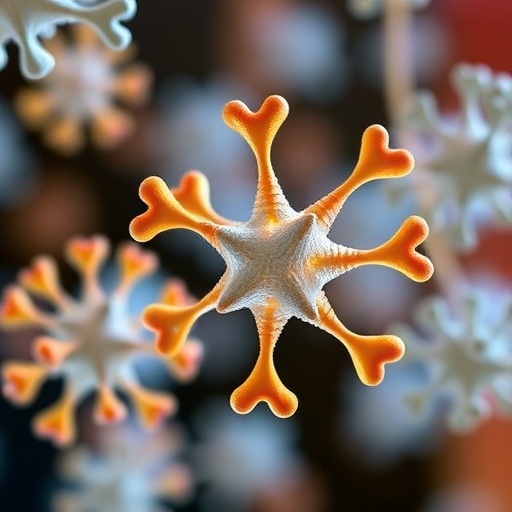
In a groundbreaking study emerging from Linköping University, researchers have unveiled a novel mechanism to halt the pernicious collaboration between two pivotal proteins implicated in cancer progression. This discovery marks a significant stride towards the development of targeted therapies for devastating childhood cancers such as neuroblastoma, a malignancy notorious for its aggressive nature and limited treatment options. Published in the prestigious journal Nature Communications, this research sheds light on previously elusive molecular interactions critical to tumor growth and prognosis.
Neuroblastoma presents a unique challenge in pediatric oncology, primarily affecting children under two years old. Despite advancements in childhood cancer therapies, about half of the high-risk neuroblastoma cases remain refractory to current treatments, underscoring an urgent need for innovative strategies. Central to the aggressiveness of these tumors is the protein N-MYC, a member of the MYC family well-known for its oncogenic prowess and direct association with poorer patient outcomes.
Efforts to develop drugs targeting MYC proteins have been stymied historically by their ambiguous structural nature. Unlike conventional proteins that assume stable three-dimensional conformations, MYC proteins exhibit intrinsic disorder—they are protean in shape, constantly shifting between multiple conformations. This structural fluidity poses a formidable barrier to classical drug design approaches that rely on inhibiting fixed, well-defined binding pockets on target proteins.
Professor Maria Sunnerhagen’s team at Linköping University tackled this challenge head-on by focusing on the specific interaction between N-MYC and the kinase Aurora A, a relationship that contributes to tumor cell proliferation and survival. Aurora A itself is a well-characterized oncogenic kinase implicated in mitotic control and cancer cell cycle dysregulation. Disrupting the binding interface between these two proteins promised a novel avenue to selectively hinder oncogenic processes without collateral damage to healthy cellular functions mediated by MYC.
To elucidate the elusive interaction surface between N-MYC and Aurora A, the researchers deployed an interdisciplinary arsenal that combined nuclear magnetic resonance (NMR) spectroscopy, advanced artificial intelligence modeling, and biochemical assays. NMR proved instrumental in capturing transient and dynamic interactions at atomic resolution, overcoming the inherent challenges posed by N-MYC’s structural plasticity. AI algorithms complemented empirical data by predicting conformational ensembles and interaction hotspots within the protein complex.
Their investigation pinpointed the MB0-MBI region of N-MYC as the critical segment involved in binding with the N-lobe domain of Aurora kinase A. This fine mapping revealed that although N-MYC lacks a stable folded structure, it nonetheless acts through a defined region to mediate this pathogenic protein-protein interaction, providing a tangible target for future therapeutic intervention. The researchers further identified a small molecule capable of effectively uncoupling N-MYC from Aurora A, demonstrating proof of concept that these “undruggable” oncogenic interfaces may indeed be pharmacologically targetable.
This achievement was the culmination of close collaboration with an international team including Professor Linda Penn’s group at the University of Toronto, which brought complementary expertise in cellular pharmacology and cancer biology. The synergy between structural biologists, chemists, and computational scientists was vital in overcoming the complexity of MYC biology and advancing the project from mechanistic study toward translational potential.
Beyond its immediate impact on neuroblastoma research, the study carries broader implications for cancer therapeutics. MYC proteins drive a spectrum of malignancies, yet attempts to inhibit them have remained an elusive holy grail for oncology drug discovery. By demonstrating that specific dynamic interactions involving MYC proteins can be dissected and pharmacologically disrupted, this work paves the way for a new class of precision medicines aimed at transcription factors historically deemed intractable.
Importantly, the researchers emphasize the necessity of selectivity in targeting MYC functions. Since MYC proteins regulate vital processes in normal cell proliferation, indiscriminate inhibition could result in unacceptable toxicity. The small molecule identified exhibits specificity, intervening only in the pathological interface without broadly abrogating MYC activity. This level of precision minimizes potential side effects and enhances the therapeutic index of future drug candidates.
The study also epitomizes the growing role of multidisciplinary approaches in tackling challenging biomedical problems. Integrating biophysical techniques like NMR with AI-driven molecular modeling accelerates discovery by uncovering cryptic binding interactions invisible to traditional methods. As computational power expands and experimental methods refine, this hybrid approach signals a paradigm shift in drug discovery, especially for targets once considered inaccessible.
Dr. Johanna Hultman, the doctoral candidate spearheading the experimental work, described the elusive nature of N-MYC as a “worthy opponent,” highlighting the perseverance and innovation required. The team’s success reflects an evolving understanding of intrinsically disordered proteins—not as insurmountable obstacles, but as dynamic participants in cellular signaling susceptible to well-designed molecular interventions.
Looking ahead, the researchers plan to entrust their findings to researchers in clinical cell biology and pharmacology to validate the efficacy and safety of the identified small molecule in cellular and animal models. This translational step is critical to moving from bench to bedside, with the hope that these insights will culminate in effective neuroblastoma treatments and improved survival for children affected by this devastating disease.
The funding for this research was generously provided by national and international agencies including the Swedish Research Council, the Swedish Cancer Society, the Canadian Institutes of Health Research, and the European Research Council. This support underscores the global commitment to overcoming childhood cancers through innovative science.
In summary, this landmark study not only charts new territory in understanding protein dynamics in cancer biology but also delivers a strategic blueprint for drugging the undruggable. By revealing how the N-Myc MB0-MBI region dynamically interacts with the N-lobe of Aurora kinase A and demonstrating disruption with small molecules, the scientists illuminate a promising path forward in the fight against neuroblastoma and potentially other MYC-driven malignancies.
Subject of Research: The dynamic interaction between the N-Myc MB0-MBI region and the N-lobe of Aurora kinase A as a therapeutic target for neuroblastoma.
Article Title: The N-Myc MB0-MBI region interacts specifically and dynamically with the N-lobe of Aurora kinase A
News Publication Date: 24-Feb-2026
Web References:
http://dx.doi.org/10.1038/s41467-026-69725-1
References:
Hultman, J., Morad, V., Tanner, E., Kenney, T. M. G., Pietras, Z., Khare, L. P., Derbyshire, D., Resetca, D., Arrowsmith, C. H., Aili, D., Ekström, S., Penn, L. Z., Wallner, B., Ahlner, A., & Sunnerhagen, M. (2026). The N-Myc MB0-MBI region interacts specifically and dynamically with the N-lobe of Aurora kinase A. Nature Communications. https://doi.org/10.1038/s41467-026-69725-1
Image Credits:
Olov Planthaber/Linköping University
Keywords:
N-MYC, Aurora kinase A, neuroblastoma, protein-protein interaction, intrinsically disordered proteins, cancer therapeutics, nuclear magnetic resonance, AI modeling, oncogenic proteins, drug discovery, childhood cancer, molecular targeting
Tags: childhood cancer researchdrug design challenges for disordered proteinshigh-risk neuroblastoma treatment resistanceinnovative cancer treatment strategiesintrinsic disorder in cancer proteinsLinköping University cancer studymolecular interactions in tumor growthMYC family oncogenesN-MYC protein role in cancerneuroblastoma targeted therapiespediatric oncology breakthroughsprotein-protein interactions in oncology